Showing posts with label Stoicism. Show all posts

Monday, March 16, 2026

Marcus Aurelius: A Life by Frank McLynn


More historical context than biography
British historian and author Frank McLynn has written over two dozen books of history and biography including books on Napoleon, Genghis Khan, and Carl Jung. His biography Marcus Aurelius: Warrior, Philosopher, Emperor was published in 2010 and has since been rereleased as Marcus Aurelius: A Life. Marcus is often cited as the best of all the Roman emperors (or at least the least cruel and crazy) and is highly regarded as a paragon of leadership and wisdom. In this in-depth life history, McLynn sets out to investigate whether Marcus actually deserves such praise.


Besides being a Roman emperor, Marcus was also a philosopher. Many regard him as perhaps the closest anyone has come to the ideal of the philosopher-king that Plato put forth in his Republic. Marcus’s brand of philosophy was Stoicism, and he is considered one of the big three of that school (along with Epictetus and Seneca) because of his book Meditations, a classic Stoic text. If you’re considering reading McLynn’s biography because you are a modern disciple of Stoicism, prepare to be disappointed. McLynn despises Stoicism, calling it “nonsense” and “gibberish.” He thinks Marcus’s philosophical pursuits were a waste of time. Marcus should have concentrated on military and economical matters, as McLynn mostly does in this book. To McLynn’s credit, however, he does give some thoughtful and intelligent discussion to Marcus’s views on philosophy and religion, at least three solid chapters worth, plus a relentlessly negative appendix on Stoicism. Although tens of thousands of books have been published disputing contradictory views on Christian theology, McLynn thinks any time two Stoics disagree with each other, such inconsistency renders the whole school of thought null and void. I don’t agree with everything (or much) that McLynn has to say about Stoicism, but he’s certainly done his research, and I learned a lot about Marcus from this analysis of his philosophical thought.


The biggest complaint I have about McLynn’s biography of Marcus Aurelius is that only about a third of the book is actually about Marcus Aurelius. As the book opens, we get biographies of other figures who were connected to Marcus: a chapter on Hadrian, a chapter on Antoninus Pius, one on Lucius Verus, and maybe two on Fronto, Marcus’s tutor. McLynn provides historical context about what was going on in Rome at the time of Marcus’s reign, but he goes way overboard with it. For example, when he informs us that a war against the Parthians was underway during Marcus’s reign, we then get a complete detailed history of Rome’s relations with the Parthians going back two or three centuries, then a discussion of the Parthians themselves—their governmental structure, internal conflicts, the various nations and peoples surrounding them—then a primer on the organization of the Roman military, before we ever even get to talking about Marcus. After all that, what Marcus actually did about the Parthians, I couldn’t tell you. The Germanic tribes get a similar background treatment, but then you actually do get a pretty detailed blow-by-blow account of Marcus’s relations with them. McLynn sometimes wanders pretty far afield in his digressions, particularly towards the end of the book. In a book about Marcus Aurelius, did we really need the whole life story of Jean-Jacques Rousseau?


McLynn’s books have achieved a wide popular audience, but if this book is any indication, he writes with the scholarly rigor of a historian. This is not Marcus Aurelius for Dummies. Part of the historian’s job is to bust myths, and McLynn does some of that here. Given all the adulation that has been heaped upon Marcus over the centuries, the truth can’t help but be less flattering than the legend. McLynn points out that life was not so fine under the Marcus administration, and of all the Roman emperors, he was one of the most severe in persecuting Christians. McLynn certainly does admire Marcus as a leader, and he shows his respect for his subject by conducting a fair and thorough character analysis, neither a panegyric nor a hatchet job. He should have narrowed his focus more tightly on the man himself, however, instead of cramming in so much extraneous detail.

Wednesday, January 12, 2022

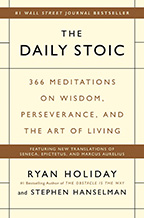
The Daily Stoic: 366 Meditations on Wisdom, Perseverance, and the Art of Living by Ryan Holiday and Stephen Hanselman


Insightful reflections on the ancient philosophy of life
The philosophical school of Stoicism may have been born in the 3rd century BC, but it has enjoyed a resurgence in recent years. In modern times, Stoicism served as the basis for cognitive behavioral therapy, a psychotherapeutic technique used to treat depression, substance abuse, eating disorders, and other mental maladies. Many contemporary would-be Stoics, however, prefer to bypass CBT entirely and go straight to the source for their life-coaching by using the writings of the Stoic philosophers of ancient Greece and Rome as the basis for a guide to living. With all the Stoic self-help books published in recent years, it was only a matter of time before one utilized the “daily affirmations” format. Such is the strategy of The Daily Stoic, published in 2016. The book was written by Ryan Holiday, a former PR man and marketing director, and Stephen Hanselman, a publisher and literary agent with a master’s degree in philosophy.

As the title of the book indicates, The Daily Stoic delivers 366 mini-lessons in Stoicism, dated January 1st through December 31st. These daily entries are divided into months, each revolving around a different theme, such as “Passions and Emotions,” “Duty,” “Fortitude and Resilience,” and “Virtue and Kindness.” Each daily lesson begins with a quotation from an ancient Stoic—most commonly Epictetus, Seneca, or Marcus Aurelius, but the authors also include selections from less familiar Stoics like Musonius Rufus, Cleanthes, and Zeno (the latter quoted from Diogenes Laertius’s Lives and Opinions of Eminent Philosophers). Holiday and Hanselman then provide a page or two of elaboration on the quote and how it applies to the problems of modern life.

Overall these daily Stoic meditations are really quite well-written. The authors are adept at taking ancient Stoic concepts and translating them into plain English without dumbing-down the philosophical content. Holiday and Hanselman certainly know their stuff and write about Stoicism knowledgably and intelligently. They often use examples from history or current events to illustrate the points made in the ancient quotes, which keeps the text interesting and relevant to 21st century readers. If you have already looked into Stoicism, chances are you’ve probably already read the Meditations of Marcus Aurelius or the Discourses of Epictetus, but this book will help you see those texts in a new way. Occasionally, the lectures sometimes veer into what one might call “self-help shaming,” implying that if you’re not living your life to the fullest, then your life is a waste. Such instances read more like a 21st-century conceit than what the Stoics had in mind when they promised a life of tranquility. Overall, however, I found the book quite insightful and useful.

Though I believe in Stoicism and its benefits for mental and emotional health, I did not diligently stick to the lesson-a-day schedule the book prescribes. Sometimes I got bored with The Daily Stoic and let several days go by without picking it up; sometimes I would enthusiastically devour half a month’s worth of entries in one sitting. This is not the best book I’ve read on Stoicism (William B. Irvine’s A Guide to the Good Life is hard to beat), but it is better than most. If you are serious about Stoicism, these daily contemplations on Stoic thought can be a useful tool to augment your studies. Having just finished the book with the end of the calendar year, I’ll probably just go back to the beginning and read it all over again.
If you liked this review, please follow the link below to Amazon.com and give me a “helpful” vote. Thank you.
https://www.amazon.com/review/R2I505MTLBP5V0/ref=cm_cr_srp_d_rdp_perm

Tuesday, September 22, 2020

The Speeches and Sayings of Marcus Aurelius


Bits and pieces beyond the Meditations
Marcus Aurelius
Emperor Marcus Aurelius ruled the Roman Empire from 161 to 180 AD and is remembered as one of Rome’s wisest and most benevolent rulers. He also left behind a wonderful book of philosophical thought, the Meditations, which is considered one of the fundamental texts of ancient Stoicism. The Meditations, however, is not Marcus’s only extant written work. A number of brief and fragmentary writings and quotations have survived from antiquity. These are generally grouped under the categories of Speeches and Sayings. Both are included in The Complete Works of Marcus Aurelius, an ebook published by the Delphi Classics, which is the edition that I am reviewing.


The Speeches of Marcus Aurelius consist of three brief orations. Two of them concern a rebellion led by Avidius Cassius in 175 AD. The third speech purports to be “The Last Words of Marcus,” spoken on his deathbed. One of the Cassius speeches was written down by Marcus and sent as a letter to the Senate, which speaks in favor of its veracity. The other two speeches are related second-hand, perhaps by first-hand observers or perhaps by writers long after the fact. The deathbed speech certainly reads as if it were embellished with the perfect eloquence possessed by dying characters in tragedian dramas. None of the speeches contain any overtly Stoic content, but they do illustrate Marcus’s good qualities as a leader, such as the two addresses regarding the revolt of Cassius, in which Marcus strongly emphasizes forgiveness and leniency over vindictiveness and harsh punishment.


The Sayings of Marcus Aurelius consist of 22 numbered paragraphs. These are written in an anecdotal third-person style similar to the Analects of Confucius. Each paragraph relates that on such-and-such an occasion, when addressing so-and-so, Marcus said . . . and then follows a quotation or aphorism from the master. It is unclear whether these sayings were gathered by an ancient author, or whether they are second-hand quotations selected from a number of ancient texts. The anecdotes collected represent a series of historical scenes in the life of Marcus, and the words he delivers often relate directly to that context. A few of the sayings can be taken to have broader philosophical meaning, touching upon Stoicism, as Marcus reveals his humble nature, his desire to be a good leader, and his brave attitude toward facing death. Also lumped in with the Sayings is a letter Marcus wrote to the Common Assembly of Asia, in which he censures the violent persecution of Christians and urges leniency instead.


There is nothing in the Speeches or Sayings that in any way competes with the insight or profundity of the Meditations. These writings are interesting in their own way, however, more for historical and biographical content than for philosophy. The Speeches and Sayings are unnecessary to an understanding of Marcus as a Stoic, so if Stoicism is you’re primary interest in the man then you’d be better off rereading the Meditations. On the other hand, for those completists who wish to cover the complete works of Marcus Aurelius, reading these brief works will likely take up less than an hour of your time.


Thursday, November 7, 2019

Stoicism and the Art of Happiness by Donald Robertson


A fine introductory text to applied Stoic philosophy
In the past few decades, the ancient philosophy of Stoicism has seen a resurgence in appreciation as it has been rescued from the arcanity of academic philosophy textbooks and repackaged as a self-help program, which really was its original intention all along. British-Canadian psychotherapist Donald Robertson has distinguished himself as one of the current leading writers on Stoicism. His book Stoicism and the Art of Happiness, published in 2013, is a volume in the Teach Yourself series published by Hodder & Stoughton. True to the self-educational mission of that series, this book is an instructional manual for readers with little or no knowledge of Stoic philosophy. In this well-organized text, Robertson defines and expands upon Stoic principles and guides the reader in their practical application to modern life.

Perhaps the most popular book in the recent Stoic renaissance (at least in the U.S.) has been William B. Irvine’s Guide to the Good Life: The Ancient Art of Stoic Joy. While Irvine is a professor of philosophy, Robertson writes from the perspective of a psychotherapist. He repeatedly points out that ancient Stoic philosophy was the basis for modern cognitive behavioral therapy (CBT), and in this book you will often find excerpts from Epictetus, Seneca, and Marcus Aurelius alongside quotes from the twentieth-century founders of CBT. Robertson points out, rightfully so, that Irvine’s conception of modern Stoicism is not entirely faithful to the ancient writings of the Stoic philosophers. Robertson is more of a purist who prefers to stick to the wisdom of the ancients as closely as possible. Of the two writers, however, Irvine’s text is the more accessible and more likely to make inspired converts of philosophically challenged general readers. Robertson is more methodical and systematic in his approach, perhaps because of the textbook format required by the Teach Yourself series, which sometimes renders the subject a bit dry and lifeless. Overall, however, both books are great introductions to Stoicism, and a novice couldn’t really go wrong with either one.

Because of its textbook format, the contents are quite repetitive. After Robertson discusses concepts in the main chapter text, those same concepts are then repeated in sidebars, instructions for exercises, and a list of points to remember at the end of each chapter. This repetition supports the book’s function as an introductory text, but it can prove tedious for those who have already put some study into Stoicism. Even for those readers already familiar with Stoicism, however, the book can serve as a useful reference and refresher course. One annoying thing about the edition I purchased is that Robertson states on a few occasions that those reading the ebook will get an extra bonus chapter dealing with the subject of death. First of all, I’m reading the ebook, and that chapter is not included. Secondly, if I were reading the print edition, I would feel ripped off.

Despite that editorial fault, this really is one of the best non-academic books on Stoicism that I’ve encountered and one well worth reading for curious beginners or well-read enthusiasts. (By “non-academic” I mean not intended solely for grad students in philosophy.) The lessons are clear, and the psychological exercises are genuinely useful. Those wishing to apply Stoic principles to their daily life will find this book a worthy practical guide.
If you liked this review, please follow the link below to Amazon.com and give me a “helpful” vote. Thank you.
https://www.amazon.com/review/R2KLQKX0NY417R/ref=cm_cr_srp_d_rdp_perm

Monday, December 17, 2018

Ancient and Modern Celebrated Freethinkers by Charles Bradlaugh, A. Collins, and J. Watts


Poorly written sketches of interesting people
Ancient and Modern Celebrated Freethinkers is the American reprint of a work previously published in England in 1857 under the title Half-Hours with the Freethinkers. It is a collection of what appear to have been columns in a periodical, though the title of the journal is never named. The book provides profiles of 23 important freethinkers throughout history, a group that broadly includes atheists, pantheists, deists, and other heretics who publicly disagreed with Christian dogma. The essays are written by Charles Bradlaugh (writing under the pseudonym of Iconoclast), A. Collins, and J. Watts.

Bradlaugh was a prominent spokesman for freethought in his own right, but his writing here, and that of his colleagues, leaves much to be desired. The essays are a mixture of biographical sketches, philosophical summary, adulatory tribute, and textual excerpts. Unfortunately the authors rely far too heavily on the latter. Many of the chapters contain very little biographical content and instead rather lazily reproduce extensive and not judiciously edited excerpts of the subjects’ writings. Baruch Spinoza, for example, led an interesting life, but his chapter is mostly one big chunk taken from his Ethics, which I’d already read. One of the reasons I pick up a book like this is because I don’t want to read Percy Bysshe Shelley’s poetry; I just want to get an idea of his philosophical thought. Bradlaugh, however, chooses to reprint page after page of Shelley’s poetry when two summary paragraphs on the poet’s freethought views would have been more useful and effective. As far as biographical content goes, the best you can hope for is maybe two or three interesting facts about each person’s life, and for some of the lesser known personages you get almost no idea of who they were. Rather than really trying to educate readers, the authors write in a “but of course you already know this” tone that is strange and off-putting.


Because of the heavy reliance on excerpts, two of the more interesting entries are about ancient authors whose written works no longer exist: Epicurus and Zeno of Citium (the founder of Stoicism). With the exception of these two ancient thinkers and Spinoza, almost all the remaining figures are 17th or 18th century deists, meaning those who believed in an impartial creator god as opposed to the anthropomorphic Judeo-Christian deity who judges man and answers his prayers. The authors themselves are atheists, but they view the heretical thinking of these deists with admiration as necessary precursors toward modern atheism. A few of the subjects were bona fide members of the clergy who departed from church doctrine, and their excerpts tend to be long and tedious catalogs of biblical inaccuracies. Robert Taylor’s chapter consists almost entirely of Bible quotes while Joseph Barker focuses on the error-prone process of translating holy scripture. To 21st century freethinkers, this stuff is old hat and makes for a boring read, unless you are a fundamentalist Christian thinking of leaving the Church, in which case you could probably find a better book to guide you than this 19th century anthology.


I was hoping for a collection of biographical sketches, but what I got was far less interesting. The book did very briefly introduce me to some thinkers of which I was unfamiliar, and for that I am thankful. There are a few choice chapters, like the ones on David Hume or Frances Wright D’Arusmont, the only woman represented here. In general, however, the text was mostly dull and annoying. For those interested in the history of freethought, I would recommend the 1889 work compiled by Joseph Mazzini Wheeler, A Biographical Dictionary of Freethinkers of All Ages and Nations, a far more interesting work than this collection by Bradlaugh and company.

If you liked this review, please follow the link below to Amazon.com and give me a “helpful” vote. Thank you.
https://www.amazon.com/review/RXBCU800L2MM5/ref=cm_cr_srp_d_rdp_perm

Friday, February 23, 2018

How to Be a Stoic: Using Ancient Philosophy to Live a Modern Life by Massimo Pigliucci


Irvine’s been there, done that
Stoicism is an ancient school of philosophy that originated in Greece in the 3rd century BC. Its most famous spokesmen from ancient times—Epictetus, Seneca, and Marcus Aurelius—taught their followers the path to a life of tranquility and virtue through the mindful exercise of reason in mastering desires, emotions, and judgments. Stoicism has enjoyed a resurgence of sorts in recent years because its ancient tenets and techniques have proven to be a timelessly effective code of living. Stoicism is the basis for modern cognitive behavior therapy, and has also given rise to a number of self-help publications, the latest of which is Massimo Pigliucci’s 2017 book How to Be a Stoic: Using Ancient Philosophy to Live a Modern Life. As the title suggests, Pigliucci makes the case for Stoicism as a way of life and offers practical suggestions to today’s readers on how to apply Stoic concepts to their daily lives. While this is a great idea, it has been done before, most notably by William B. Irvine in his 2009 book A Guide to the Good Life: The Ancient Art of Stoic Joy. In my opinion, the more books about Stoicism the better, and Pigliucci’s entry is a welcome addition to the Stoic corpus, but it doesn’t really cover much new ground.

For those who have never read a philosophy book, Pigliucci’s How to Be a Stoic may be the easier entry point to the subject, but Irvine’s book is still remarkably accessible and more substantial in its content. The one unique twist to Pigliucci’s approach is that he carries on an imaginary conversation with the ancient teacher Epictetus, whose Discourses is arguably the most important fundamental text of Stoicism. To illustrate Stoic concepts, Pigliucci uses a brief saying or story from Epictetus as the basis for each chapter and elaborates upon it with examples from his own life. The drawback to this approach is that Epictetus’s contributions to the dialogue tend to be oversimplified and overshadowed by Pigliucci’s personal reflections. While I agree with many of Pigliucci’s views on politics and society, I don’t agree that he should have devoted so much ink to them in this book. While examples are important to connect the ancient philosophy to modern life, in this case it feels like examples make up the bulk of the book. Furthermore, while one of the advantages of Stoicism is its adaptability, Pigliucci seems too ready to depart from the ancient teachings in favor of his own personal interpretation or modern compromise. In contrast, Irvine also used helpful personal examples to support his text, but he places the philosophy at the forefront and does a better job of letting the Stoics speak for themselves.

The best part of Pigliucci’s How to Be a Stoic is its final chapter, entitled “Practical Spiritual Exercises,” which offers a dozen specific cognitive and behavioral practices that budding Stoics can utilize to hone their thoughts and actions in order to live, as the Stoics say, in accordance with nature. Recommendations such as “Examine your impressions,” “Remind yourself of the impermanence of things,” and “Speak little and well,” may seem like simple rules to follow, but in practice they require repetition, discipline, and fortitude to be effective. Again, many of these exercises have been previously suggested by Irvine and other writers of the new Stoic movement, but Pigliucci does an exceptionally fine job of laying them out in an organized and accessible manner that encourages the reader not only to try them but also to persist and succeed.

Though How to Be a Stoic feels a lot like an Irvine redux, there is still room for one more philosopher under the stoa. Irvine himself gave his blessing to Pigliucci’s book, and it will no doubt succeed in recruiting more than a few new students to this worthy school of thought.
If you liked this review, please follow the link below to Amazon.com and give me a “helpful” vote. Thank you.
https://www.amazon.com/review/RPOCR0APIGBH/ref=cm_cr_srp_d_rdp_perm

Monday, February 20, 2017

Wisdom and Destiny by Maurice Maeterlinck


Post-Christian Stoicism
Maurice Maeterlinck, winner of the 1911 Nobel Prize in Literature, was a Belgian playwright, poet, and essayist. His essays often blur the line between literature and philosophy, and perhaps in none of his works is this more true than his 1898 book Wisdom and Destiny. In this volume, Maeterlinck takes on the role of life coach. In 112 numbered passages, he provides his readers with thoughtful guidance on how to achieve a life of virtue, happiness, tranquility, and love.

Much of Maeterlinck’s personal philosophy is built upon a foundation of Greek and Roman Stoicism. In essence, the book is like a 19th-century version of William B. Irvine’s A Guide to the Good Life: The Ancient Art of Stoic Joy. Maeterlinck does deviate somewhat from the precepts of Epictetus and Marcus Aurelius, however, and he expresses his teachings in a literary style all his own. One can also find inklings of Arthur Schopenhauer’s fatalism, but Maeterlinck expresses it in a kinder, gentler, more optimistic manner. Maeterlinck was raised in the Catholic tradition, but became disillusioned with organized religion as he grew older. Writing in the 19th century to a European audience, it was necessary that he must at least address Christianity. The philosophical advice he dispenses in this volume can be utilized by theists and atheists alike, but usually when he references God it sounds like the pantheistic god of the Stoics. Maeterlinck cites Jesus Christ as an example of a “sage” from whom we can learn valuable life lessons, alongside other positive and negative examples, including historical figures like Louis XVI, Marcus Aurelius, and Emily Bronte, or fictional characters such as Hamlet or Balzac’s Pierrette.

As a frequent reader of philosophy and an admirer of Stoic thought, I should have appreciated this book more than I did. Outside of philosophers themselves, no one really likes the jargon and dry, ultralogical prose that’s used to express most philosophical arguments, yet there is a good reason for it. The complex reasoning often requires a precision and clarity that conversational language cannot provide. Here, Maeterlinck errs in the opposite direction, eschewing clarity in favor of ambiguity. His poetic prose and flowery language come across as pretentious, flighty, and ill-suited to getting his point across. If one compares Maeterlinck’s writing to that of another literary/philosophical life coach, Ralph Waldo Emerson, the Belgian author uses simpler vocabulary, but his syntax is far more obscurely circuitous than even the transcendentalist’s dense prose. To be fair, the English translation by Alfred Sutro might be partly to blame. Words like wisdom, destiny, love, virtue, happiness, consciousness, truth, and reason are bandied about in vague constructions. These terms are never adequately defined, or rather they are overdefined to the point where their definitions encompass everything and they simply become interchangeable.

Occasional pearls of insightful wisdom emerge from this verbal maze, enough to demonstrate that Maeterlinck was indeed a profound thinker, but such gems are few and far between. The medium does not do justice to the message. I much prefer Maeterlinck’s 1911 book Death, which is written in more straightforward language. If I were to read Wisdom and Destiny three or four times, I might eventually decipher Maeterlinck’s philosophical platform, but I would rather just reread the Discourses of Epictetus or the Meditations of Marcus Aurelius.
If you liked this review, please follow the link below to Amazon.com and give me a “helpful” vote. Thank you.
https://www.amazon.com/review/R2836CV1LRYHA2/ref=cm_cr_rdp_perm

Monday, December 28, 2015

Life Without Principle by Henry David Thoreau


American Stoic
Henry David Thoreau
Life Without Principle, an essay by Henry David Thoreau, was originally published in the Atlantic Monthly in 1863. It briefly encapsulates much the same argument in favor of individuality and nonconformism that Thoreau championed in his classic memoir Walden, without all the attention paid to natural phenomena. Here Thoreau focuses strictly on human nature and how one should conduct him- or herself in society. In tackling the question of how to live an ethical and happy life, Thoreau, as always, proves himself a wise and insightful teacher.

He begins by talking about business. He points out that too many people are busy working to make a living when they should be working to make a life. One who is engaged in work he doesn’t enjoy is trading away his life for a paycheck, or “sell[ing his] birthright for a mess of pottage.” A better strategy would be to find work that one enjoys doing and do it for the satisfaction of doing it, the money being merely icing on the cake. The natural and eternal joys of life rarely have a high monetary value; instead, far too much effort is expended on material trivialities in the pursuit of keeping up with the Joneses. The more one lives his life according to his own nature, disregarding the popular conception of fortune, the happier and richer he will be.

Thoreau’s doctrine in this essay sounds a lot like the teachings of the ancient Stoic philosophers Epictetus and Marcus Aurelius, who urged their students to take a rational, detached look at what was truly important in life. One should distinguish between those occurrences in life over which he has control and those over which he does not have control, focus on the significance of the former, and disregard the distraction of the latter. After thoroughly discussing business and financial matters, Thoreau applies his rational individualism to science and philosophy, religion, journalism, slavery, and politics. The latter category is where Thoreau perhaps diverges the furthest from ancient Stoicism. The Stoics encouraged active involvement in civic life, while Thoreau advocates a deliberate abstention from public affairs. Though on social issues Thoreau was a liberal, as far as politics go he was a libertarian. If everyone were to take care of himself and get his own house in order, he suggests, we would have no need for politics at all.

Thoreau’s vision of life in accordance with nature does not seem as attainable as it may have been a century and a half ago. I’m not sure I would want to live in a society where everyone behaved according to Thoreau’s precepts. Nevertheless, I’m glad there’s a Thoreau, and I think we can all learn a lot from him. We could all stand to take a step back and think about what’s important in life, reconsider the importance of our lives outside of work, waste less time on the pointless trivialities of news and social media (“Read not the Times. Read the Eternities.”), and cultivate our own person rather than slavishly live our lives in response to others’ opinions or conventions. Overall, Life Without Principle is one of Thoreau’s most accessible pieces of writing. Despite references to gold prospectors and slavery, most of the issues he discusses reflect universal aspects of human nature that are still very much applicable to life in the 21st century. This essay will take up less than an hour of your time, and the food for thought Thoreau serves up makes it an hour well spent.
If you liked this review, please follow the link below to Amazon.com and give me a “helpful” vote. Thank you.
https://www.amazon.com/review/R23M8V7G869KED/ref=cm_cr_rdp_perm

Monday, July 20, 2015

Stoicism Today: Selected Writings, Volume One. Edited by Patrick Ussher


Applying ancient philosophy to modern life
Stoicism is an ancient school of philosophy founded in Athens in the 3rd century BC. It is a practical philosophy, intended as a guide for how to live one’s life. The Stoics stressed that we have no control over what happens in our lives, only control over our perceptions. They advocated living one’s life in accordance with nature (not “nature” as in grass and trees, but “nature” as in the order of the universe). By concentrating one’s thoughts and choices on what is good and virtuous, and disregarding the “indifferent” distractions of everyday life, one can avoid negative emotions like fear, anger, grief, and frustration, and live a life of happiness and tranquility.

In recent years, there has been a burgeoning resurgence in Stoicism, with modern writers producing manuals on how to apply Stoic principles to life in today’s world, such as William B. Irvine’s A Guide to the Good Life. Along similar lines, Stoicism Today is a blog published out of the University of Exeter in England, edited and largely written by a team of British philosophers. This 2014 book, edited by Patrick Ussher, is the first volume of writings reprinted from the blog. 36 articles are included in the collection, covering a mixed bag of Stoic-related topics.

The collection starts out strong with essays summarizing and explaining the core concepts of Epictetus, Marcus Aurelius, and Seneca. These ancient Roman writers are the most prominent Stoics whose teachings survive today. The 21st-century writers clarify the ancient Stoic precepts and discuss their applicability to modern life. Though the bloggers hold PhDs in philosophy and command a thorough understanding of their subject, they do a great job of expressing these complex concepts in language that is accessible to the general reader, without dumbing down the subject matter.

While the first half of the book provides a good, broad education on Stoicism, the second half covers a diverse assortment of topics and perspectives. A section called “Life Stories” consists of accounts by people of various walks of life on how they use Stoicism in their daily lives and work, including a lawyer, a doctor, and a woman who suffered a traumatic brain injury. The most fascinating and inspiring story is that of Sam Sullivan, a quadriplegic who became mayor of Vancouver. Next is a section on how Stoicism can be applied to parenthood and the education of children. This is followed by a section on Stoicism and psychotherapy which will mostly appeal to psychiatric professionals, as it will likely be over the head of most general readers. Three articles deal with the concept of Stoic “mindfulness” and its relation or lack of relation to Buddhism. Finally, the book falls apart somewhat with its final section on Stoicism in popular culture. It includes an excerpt from a Stoicism-infused novel about prison inmates which is OK, but also a sample chapter from a horrible science fiction novel. The book’s final selection is a pretty good examination of the portrayal of Stoicism in the Star Trek television series.

This collection by its very nature is a hodgepodge, and the selections vary greatly in quality as well as subject matter. The core team of philosophers are good writers for the most part, but the ensemble cast of guest bloggers is hit and miss. Nevertheless, if you’ve read all the Stoic classics and are looking for further advice on how to put Stoicism into practice, you’re bound to find something here that will interest you.
If you liked this review, please follow the link below to Amazon.com and give me a “helpful” vote. Thank you.
https://www.amazon.com/review/RNV8XWCLMM25X/ref=cm_cr_rdp_perm

Friday, November 22, 2013

A Guide to the Good Life: The Ancient Art of Stoic Joy by William B. Irvine


Ancient wisdom for modern times
Philosophy ain’t what it used to be. While today’s philosophers tend to be highly specialized in esoteric realms of thought that bear little relevance on our everyday activities, there was a time when the purpose of philosophy was simply to make people’s lives better. Philosophical schools provided their students with much needed guidance in making decisions, setting priorities, and achieving goals. One such school was the Stoics of ancient Greece and Rome, whose teachings survive today in the writings of Epictetus, Marcus Aurelius, Seneca, and Musonius Rufus. In his 2009 book A Guide to the Good Life: The Ancient Art of Stoic Joy, author William B. Irvine argues that citizens of the modern world need a philosophy of life now more than ever. Most of us wander through our lives aimlessly with screwed-up priorities, longing for a happiness that never comes. To continue wandering aimlessly is futile, and for those seeking direction, Irvine urges readers to let the Stoics be their guide.

Stoicism asserts that the key to living a good life is achieving tranquility, a state in which negative emotions like anger, grief, and worry are replaced by positive emotions of joy and contentment. This tranquility comes not from without but within. We can achieve it by modifying our perceptions, desires, and goals, and living in accordance with nature. Through diligent rational thought and self-examination we can teach ourselves not to worry about things that are out of our control and to appreciate what we have rather than pursuing one insatiable desire after another. Irvine provides practical and useful exercises for accomplishing this. I’m oversimplifying Stoicism for the purpose of this review, but rest assured that Irvine does not. He gives a thorough overview of Stoic thought, its history and its main precepts. He ingeniously explains how the wisdom of these ancient philosophers is still meaningful to us today. For example, the Stoics wrote much about the ancient punishment of exile. While few us are likely to face that sentence in the 21st century, Irvine insightfully relates it to the exile most of us will eventually face when banished to a nursing home. He also explains why Stoic teachings are still valid in a world where modern scientific discoveries like the theory of evolution have replaced the Stoic conception of God or Zeus.

Philosophical purists may quibble with Irvine’s take on Stoicism, emphasizing the ways in which his interpretation differs from the teachings of the classical masters. There is some truth to that—even Irvine admits it—but the fact is, if there is a resurgence of interest in Stoic thought among the general reading public, it will largely be due to this excellent book. Irvine’s writing is impeccably articulate throughout. He explains Stoicism in a way that’s easily accessible for novices, yet allows those familiar with the classical philosophers to see their work in a whole new light. In recent years, there seems to be a plethora of philosophy books aimed at the nonphilosopher. Most of them relate philosophy to popular culture, but a few, like Irvine’s, focus on the application of philosophy to life in the modern world. What sets Irvine apart from these other authors is that he states his case without a trace of “Aren’t I clever?” His prose is utterly devoid of egotism and condescension, as a true Stoic’s should be. When he’s required to talk about his own experiences with Stoicism, he’s almost apologetic about it. Irvine seems genuinely sincere in his desire to help people better their lives, and with this book he is quite successful toward that end. It provides an excellent road map for anyone interested in engaging in the practice of Stoicism. A Guide to the Good Life is easily one of my top five favorite nonfiction books of the last decade. I highly recommend it to anyone—theist or atheist alike—who’s seeking answers for a happier life.

If you liked this review, please follow the link below to Amazon.com and give me a “helpful” vote. Thank you.
http://www.amazon.com/review/RMLU0WVN4P86A/ref=cm_cr_rdp_perm

Monday, April 29, 2013

Enchiridion by Epictetus


Stoic philosophy in a nutshell
Epictetus, despite being born a slave in Greece, went on to become an influential philosopher of ancient Rome. Today he is considered one of the foremost thinkers of the Stoic school of thought. His teachings were oral; he wrote no books himself. In AD 108, however, a student of his, Arrian, transcribed and collected his lectures into a multi-volume work known as the Discourses. About two decades later, shortly before the death of Epictetus, Arrian compiled another, briefer work know as the Enchiridion (a.k.a. Manual or Handbook), the purpose of which was an attempt to popularize Epictetus’s teachings and gain a wider audience for Stoic thought.

The Enchiridion is divided into 52 chapters or sections, most of which are less than a page long. Some are little more than aphorisms. Each section is filled with helpful pearls of wisdom applicable to facing the trials of everyday life. Stoicism advocates living one’s life in accordance with nature. The only things we really have control of in life are our judgments, opinions, and desires. All else is beyond our control, and handed to us by the universe. The key to tranquility and happiness is to resign ourselves to fate and form our opinions such that we cease desiring or fearing those things which are beyond our control. It is in man’s nature to be a rational animal, and it is only by using our faculty of reason that we can live up to our potential as human beings and live a life free of anger, fear, grief, frustration, and shame. The Enchiridion essentially offers a code of conduct which, when practiced, can allow us to live such a life. Modern readers can still find much use for the ethical code of living that Epictetus prescribed almost two millennia ago.

As good as the Enchiridion is, it is by no means a substitute for reading the Discourses, which are the truly authoritative compendium of Epictetus’s thought. The Enchiridion can be useful to two main types of readers. The first type is the reader who is curious about Stoicism, but not ready to invest the time and energy into tackling the Discourses. For this reader, the Enchiridion offers an accessible introduction to Stoic concepts. The brevity of the Enchiridion, however, requires a much more dogmatic tone—“You must do this. You must not do that.”—that may be off-putting to the newcomer. It lacks the nuance and detail that the Discourses provide in explaining these lofty goals and instructing the student in how to achieve them.

The second type of reader for whom the Enchiridion will prove useful is one who has already read the Discourses. For this reader, the Enchiridion serves as a cheat sheet or crib notes to the Discourses’ complicated contents. Each brief passage provides a reminder of the lessons that were more fully covered in the more extensive work. The Enchiridion can be utilized as an inspirational text for the disciple of reason, a simplified encapsulation of Stoic thought that can easily and frequently be consulted for ethical guidance.

Regardless of your reasons for approaching the Enchiridion, you really can’t go wrong in reading this brief but powerful work. For a minimal investment of your time, it just might change your life.

If you liked this review, please follow the link below to Amazon.com and give me a “helpful” vote. Thank you.
http://www.amazon.com/review/R1UE7TS6SI3CIT/ref=cm_cr_rdp_perm

Monday, March 11, 2013

Discourses by Epictetus


An inspirational text for the rationally inclined
Epictetus, the Stoic philosopher of ancient Rome, did not leave behind any writings of his own, but fortunately his lectures were transcribed by a student, Arrian, and compiled around AD 108 into the collection known as the Discourses. The Discourses consist of 95 chapters of varying length divided into four books. The chapters don’t necessarily follow each other in a sequential train of thought. Nevertheless, Arrian did a pretty good job of editing and ordering the pieces so that they do proceed in a somewhat logical progression. Of the works by ancient Stoic philosophers that have been passed down to us, the Discourses is rightly seen by many to be the most important and complete expression of the thought of this ancient philosophical school.

The Stoic philosophy, as taught by Epictetus, can be expressed in a nutshell, as follows. Some things in life are within our control, while others are not. Those which are in our control are our own will, our opinions and desires, and the actions which we assent to. Everything else is beyond our control and should be accepted rather than hated or feared. The key to happiness and tranquility is to live one’s life in accordance with the natural order of things. This is done by rejecting irrational desires, resigning oneself to providence, and forming one’s opinions to accept what the universe dispenses. Everything beyond the control of one’s will is neither good nor bad, but indifferent. By utilizing one’s faculty of reason, to want only those things which are in our control, we can live a life free of anger, fear, grief, frustration, and shame. Of course, the Discourses go into much more detail as to how this is accomplished, but these are the fundamental ideas.

Epictetus believed that philosophy was useless unless it changed people’s lives for the better. He had little tolerance for philosophy as a pointless intellectual exercise. His teachings are filled with practical concepts that his students, ancient or modern, can use to live happier and more meaningful lives. It is almost useless to highlight passages from the Discourses, because there’s hardly a sentence contained therein that’s not worthy of being singled out as a pearl of wisdom. The book’s only fault is that it is quite repetitive. The same messages are reiterated over and over, so that they become second nature to the student. For that reason, it’s most effective to read the Discourses in small chunks, and allow yourself time in between servings to digest its lessons.

Such repetition, of course, is a useful tool of all inspirational texts, and the Discourses can be seen as a sort of secular Bible, a book to turn to for advice when in need of solace or personal clarification. Epictetus uses the word “God” many times throughout the Discourses, but it is used synonymously with comparable terms like “nature,” “the gods,” “Zeus,” “fate,” or “providence,” making it clear that his idea of God is different from the Judeo-Christian sense of the word. The ancient Greek and Roman philosophers’ conception of a monotheistic deity was a sort of precursor to the Christian version, and was much more Pantheistic in nature, resembling a kind of universal force that governs and guides the actions of the universe and the lives of men. This force could either be interpreted as divine direction or materialistic determinism, thus the basic teachings of Stoicism can be appreciated and utilized by readers of all beliefs, theist or atheist alike. The Discourses is really too complex to be of interest to the casual reader simply looking for self-help advice, but for anyone who takes philosophy seriously, this book will change your life.

After sampling a few of the inexpensive Kindle versions of Epictetus’s writings, I purchased a combined edition called Discourses and Enchiridion, offered by Amazon. I can’t be more specific than that, because the publisher is not named on Amazon nor in the file itself. I chose it because of its easy-to-read typography and interactive table of contents, but the file is riddled with typographic errors. It was edited by spell-check, so the typos take the form of word replacements like “be” for “he” or “the” for “they,” making it even more difficult to figure out. It claims itself to be “annotated,” but there are no notes in the Discourses, only in the Enchiridion. The translation of the Enchiridion by Elizabeth Carter is fine, but the translation of the Discourses by George Long is a clumsy read, with oddly constructed sentences and confusing terminology. I have read some passages from the translation by P.E. Matheson and found them to be a much smoother read and easier to comprehend. The generic Long edition is only worthy of two or three stars. I would recommend buying the Matheson version, even if it’s a couple bucks more.

If you liked this review, please follow the link below to Amazon.com and give me a “helpful” vote. Thank you.
http://www.amazon.com/review/R1X6YVJFREP3IM/ref=cm_cr_rdp_perm

Wednesday, September 19, 2012

Epictetus: A Stoic and Socratic Guide to Life by A. A. Long


A helpful companion to the Discourses
This comprehensive look at Epictetus, the man and his thought, provides a wealth of valuable information for anyone hoping to read and understand the Stoic philosopher’s Discourses. The subtitle “A Stoic and Socratic Guide to Life” is accurate only in reference to Epictetus himself as a guide; this book is not a practical “guide to life” per se, and might have been more aptly called “A Companion to the Discourses.” This book will not change your life, but it will help you understand the writings of Epictetus, which will change your life. The strength of this book is that it concentrates on Epictetus as an individual and not just as a member of the Stoic school. It emphasizes the ways in which his teachings differ from those of the earlier Stoics, and the strong influence that Socrates had on his philosophy and methodology.

Reading this book was frustrating at first because it felt like a lot of set-up with little payoff. The first five chapters provide a mother lode of background material on the life of Epictetus, his place in history, the record of philosophy up to that time, other schools of thought that were prevalent in his time, who Arrian was and how he transcribed Epictetus’s words, who Epictetus’s students were, plus an excessively detailed discussion of Epictetus’s rhetorical style and the methods he used to construct his arguments. It isn’t until chapter 6 that Long really starts analyzing the actual message of the Discourses, which is what I, and probably most readers, really want to get at. In the latter half of the book, Long’s insightful commentary on the Discourses is accompanied by a generous helping of judiciously selected excerpts, and Long’s translations of these are a pleasure to read. I would have preferred more of this concentration on Epictetus’s words themselves and less of the contextual foundation that preceded it. On the other hand, I thought the epilogue about the effect of Epictetus’s thought over the last 2,000 years was one of the more interesting parts of the book.

In his introduction, Long states he has “tried to make this book as accessible as possible,” but to that end he only achieves mixed results. At times the intended audience seems unclear. There is a lot of introductory material that would seem elementary to a philosophical scholar, yet there are more complex passages that seem directed towards Long’s peers and would probably be over the head of a novice. The result is a book that philosophy professors would probably love to assign to their students, but not one the average student himself would necessarily enjoy nor perhaps even understand. Those serious about the subject, however, will find it a rewarding read and well worth the effort.

If you liked this review, please follow the link below to Amazon.com and give me a “helpful” vote. Thank you.
http://www.amazon.com/review/R1Q4T9P8QTZ3Z7/ref=cm_cr_rdp_perm

Friday, May 18, 2012

The Stoic Life: Emotions, Duties, and Fate by Tad Brennan


A nuts-and-bolts guide to Stoicism
This book provides a fascinating, in-depth examination of Stoicism, though I think the title is a little misleading. “The Stoic Life” gives the impression that this is a book about practical applications of Stoic thought to one’s life, which is not the case. This book never enters into “self-help” territory, like William Irvine’s Guide to the Good Life: The Ancient Art of Stoic Joy, for example, nor does it offer the sort of issue-specific Stoic advice (on grief, on anger, etc.) one might find in the writings of Seneca or Marcus Aurelius. Brennan doesn’t advocate Stoicism, and I’m not sure he’s even a fan of it. His primary objective is to define Stoicism, what it is and how it works. To do this he painstakingly dissects ancient texts word by word, phrase by phrase in order to clearly determine what exactly the ancient Stoics believed. While the contents of the book weren’t what I expected, I certainly wasn’t disappointed.

The Stoics believed that the key to happiness was to live in accordance with nature. But how does one put that into practice? Some of the things that we encounter in life are good (virtues), some bad (vices), but most are indifferents (neither good nor bad). How do we recognize which is which, and how should that affect our choices and actions in life? The bulk of the book consists of Brennan’s analytical breakdown of this decision-making process. Once the ethical framework of Stoic behavior is established, Brennan goes on to address the conundrum of why any of it makes any difference at all, given that the Stoics believed that all events were predetermined by fate, even our own thoughts.

Brennan has a real talent for taking complex philosophical ideas and explaining them in clear and precise terminology that is easily accessible to the general reader. He also chooses ingenious analogies that are truly helpful in illustrating Stoic ideas. While the quality of the writing makes this book an enjoyable read, it is in no way a simplistic look at the subject. Brennan essentially starts with the assumption that his audience knows nothing about Stoicism, gives a historical overview, then builds the structure of Stoic thought from its most basic terminology to its most complicated concepts. What results is almost a flow chart of the Stoic thought process that seamlessly marries their metaphysics, ethics, and epistemology into a cohesive whole. The Stoic Life will prove a valuable companion to anyone who plans to read (and hopes to understand) the works of Epictetus, Seneca, or Marcus Aurelius.

If you liked this review, please follow the link below to Amazon.com and give me a “helpful” vote. Thank you.
http://www.amazon.com/review/RAUSXDSWQKJQ1/ref=cm_cr_rdp_perm

Friday, February 24, 2012

Letters from a Stoic by Seneca


Every sentence an aphorism
Although not the most original philosopher to ever bear the designation of Stoic, Seneca is most likely the best writer that school ever produced. His works are far more accessible to the general reader than the more analytical writings of Epictetus or even the more personal reflections of Marcus Aurelius. Seneca had a true gift with words, which when brought out by a skilled translator results in beautiful, inspirational prose. The translation by Robin Campbell in the Penguin Classics edition is excellent; the book reads like butter. Some of Seneca’s contemporary critics complained that every line he wrote was a motto, and they were not far from the truth. Almost every sentence in this book could be singled out and quoted as “words to live by.”

The basic message of Stoicism that Seneca presents here is profound and vital. The key to a happy life is to live in accordance with nature. This is accomplished by training yourself not to desire more than you have and to learn to be content with what comes to you. Govern your emotions with reason, resign yourself to fate, and free yourself from the attachments of your desires. This includes not only the extravagance with which society distracts us from nature, or the obviously harmful excesses of food and drink, but even the attachment to your own life. Only by conquering your fear of death can you experience true freedom and live a life of quality.

While Seneca states the basic concepts of Stoicism in clear and engaging language, he doesn’t offer much original thought here. For those deeply interested in Stoic philosophy, these works may act as a supplement to those of Epictetus, but they are certainly no substitute. Even comparing them to Seneca’s own works, these letters do not measure up to his deeper dialogues and essays. An obvious problem, common to many Stoic works, is the lack of organization and haphazard hopping from one subject to the next, which precludes an in-depth investigation into any particular topic. Another problem is the frequent digression from philosophical instruction. Oftentimes Seneca avoids specific philosophical ideas and merely sounds off generally on the value of philosophy (by which he means Stoicism) in improving people’s lives. Many of the letters are light on philosophy altogether, but do have historical value. For example, Seneca gives us an insider’s glimpse into aspects of Roman life such as the gladiatorial games and slavery, and relates interesting anecdotes about Socrates, Cato, and various Emperors. Although all the digressions are filtered through Seneca’s uniquely Stoic lens, I found some of the wanderings too far afield for my liking. Though I enjoyed the 42 letters that Campbell has collected here, I can’t say I’m eager to get my hands on a complete edition of the 124 letters any time soon.

Despite my reservations, any Stoic text is an important text, Seneca’s more than most. The ancient wisdom is invaluable, and Penguin has done it justice in this volume.

If you liked this review, please follow the link below to Amazon.com and give me a “helpful” vote. Thank you.
http://www.amazon.com/review/R1BZK7W5QYZNPJ/ref=cm_cr_rdp_perm

Friday, January 27, 2012

Meditations by Marcus Aurelius


Ancient musings, timeless wisdom
Marcus Aurelius, emperor of Rome, may be the closest mankind has ever come to producing the philosopher king that Plato envisioned in The Republic. A reluctant ruler and a reluctant warrior, much of his reign was spent in battle, defending the frontiers of the empire from the “barbarian” hordes. Fortunately for us, he carried a notebook along on his military campaigns, and thus we have the Meditations. Marcus’s writings reveal him to be the last and greatest of the classical Stoics. Stoicism is a school of thought that asserts we have no control over our lives, only control over our perceptions. It advocates that the best life is the life that is lived in accordance with nature (not “nature” as in grass and trees, but “nature” as in the order of the universe). By concentrating one’s thoughts and choices on what is good and virtuous, and disregarding the unimportant distractions of everyday life (even life and death are said to be neither good nor bad, but “indifferent”), we can avoid negative emotions like fear, anger, grief, and frustration, and live a life of happiness and tranquility. That’s an oversimplification, of course. If you really want to know what Stoicism is and how it works read Epictetus or Seneca. What Marcus provides us with are the reflections of a man who studied and lived the Stoic life, and was its ultimate exemplar. Even if you don’t buy into Stoicism, or have no interest in Philosophy with a capital P, you can still find inspiration and solace in the Meditations, as Marcus instructs us in dealing justly with others, overcoming emotional hardship, living life to the fullest by overcoming the fear of death, and resigning oneself to the insignificance of man in the universe.

The Meditations are divided into twelve books. Each book contains anywhere from 16 to 75 numbered paragraphs, ranging in length from a sentence to a page. The paragraphs are arranged without regard to sequence or subject matter. This haphazard method of compilation is really the book’s only flaw. What the Meditations has always needed is a good index, but I’ve never found a volume that has one.

The Wordsworth Classics series is an excellent collection of inexpensive paperbacks. They are beautifully typeset for easy reading, and usually well-edited. Their edition of the Meditations contains extensive endnotes, plus a valuable introduction by Christopher Gill, an afterword by Matthew Arnold, and an essay on “Marcus Aurelius and Stoicism” featuring excerpts from Epictetus and contemporary scholars of Stoicism.