Thursday, April 7, 2022

Marco Millions by Eugene O’Neill


Historical drama satirizing materialism
American playwright Eugene O’Neill, winner of the 1936 Nobel Prize in Literature, is best remembered as the author of tragic family dramas set in New England, such as Desire Under the Elms, Mourning Becomes Electra, or Long Day’s Journey Into Night. Alcoholism and the sea are frequent themes that reappear in his writings. One delving into the obscurities of his literary output, however, will find some surprising oddities in his body of work. Among these anomalies are two historical dramas about explorers of centuries past. The Fountain, a play about Spanish Conquistador Ponce de León’s quest for the fountain of youth in America, was completed in 1922. In a similar vein, Marco Millions is a historical play about the Venetian merchant Marco Polo’s journey to China to meet Kublai Kaan (the way O’Neill spells it). Marco Millions was published in 1927, and was first produced for the stage in the following year.

As the play opens, Marco Polo has reached an age where he is ready to play a decisive role in the family business, though he still has a lot to learn about the world. He accompanies his father Nicolo and his uncle Maffeo on an epic business trip to the East to trade with the great Kublai Kaan. In departing, Marco leaves behind his betrothed, Donata, vowing to remain faithful to her and marry her upon his return. Over the course of the trip, his youthful innocence gradually wears away as he acquires financial, political, and carnal knowledge. He is still naive in some ways, however, as demonstrated by the fact that he fails to notice that Kukachin, the lovely daughter of the Kaan, has fallen in love with him.


Marco may be the hero of this play, but O’Neill also makes him out to be rather a boob. Like a grandiose parody of an American middle-class shopkeeper, salesman, or bean counter, Marco’s eyes don’t see much beyond his business. His every action is directed toward profit. Rather than even noticing the exotic love and romance that is right under his nose, he is determined to make his fortune, win the respect of the folks back home, and marry his high school sweetheart. At times O’Neill makes the character so clueless that it becomes difficult to see what Kukachin finds attractive in him. In the end, the social commentary is pretty tepid, the cynicism hinders any emotional involvement, and the satire can hardly be called laugh-out-loud funny. The play ends with a brief epilog that delivers an odd meta-twist that breaks the fourth wall in a way (though nonverbally). While it may have been unusual and innovative for its time, this gimmicky device doesn’t really pay off by adding anything to the play.


Judging by the stage directions, Marco Millions would be a difficult and expensive production to stage. Although only about an hour in length, the includes scenes that take place in Italy, Persia, India, Mongolia, and China. The set specifications include palaces and ships, and some scenes require dozens of lavishly costumed extras. Bringing O’Neill’s elaborate vision of the play to life would require a tremendous amount of work for such a brief and relatively lighthearted affair. Some literary critics have described Marco Millions as “Shavian,” meaning similar in style to the plays of George Bernard Shaw, whose work was praised for its wittiness and its wealth of quotable bon mots. What may have worked for Shaw, however, doesn’t necessarily work for O’Neill. Marco Millions feels a bit like an overly built-up joke with a disappointing punch line or a somewhat pointless fable that’s misplaced its moral.

If you liked this review, please follow the link below to Amazon.com and give me a “helpful” vote. Thank you.
https://www.amazon.com/review/R289PV9XKC5ALT/ref=cm_cr_srp_d_rdp_perm

Tuesday, April 5, 2022

Landscape Sketching in Pen and Ink: With Notes on Architectural Subjects by Donald Maxwell


Great illustrations, but not enough preliminary sketches
Donald Maxwell (1877-1936) was an English illustrator who specialized in landscape drawings. Over the course of his career, he created hundreds if not thousands of scenic illustrations for newspapers and books, including many travel books that he wrote himself. Maxwell was enough of a recognized expert in the field to write his own how-to guide to illustration. Landscape Sketching in Pen and Ink was first published in 1932. I read the 2019 paperback edition from Dover Publications.

I admire Maxwell’s art, but this book was a disappointment. There just isn’t enough step-by-step insight into Maxwell’s process of illustration. The book is loaded with Maxwell’s beautiful, finished illustrations reproduced from previously published books. There are hardly any examples, however, of the preliminary sketches that led to these completed pictures. The “Look Inside” sample pages displayed on Amazon lead the reader to believe that the book is going to be composed of instructional, in-progress drawings. Examples of such preliminary drawings, however, do not appear beyond page 16. In the first chapter, Maxwell basically teaches you how to draw a brick wall and how to shade a cylinder. After that, he just discusses his finished illustrations, pointing out compositional considerations and variations in tone. There is some merit in these discussions—the book is not totally useless—but it doesn’t give aspiring landscape artists much of an education into how they are supposed to rapidly capture scenery on-site en plein air.


At the start of Chapter 2, Maxwell already assumes the reader is a professional illustrator. Of course, 90 years ago when this book was published, there were a lot of artists working in black and white line illustration, so he would have had quite an audience to address. There is an entire chapter, for example, on how to execute a drawing that will reproduce on a commercial printing press without detrimental loss of detail. Today, the professional audience for such trade secrets has unfortunately shrunk since book illustration has mostly been relegated to juvenile literature, mostly by cartoonists, while changing tastes and advances in printing technology have rendered pen and ink illustration nearly obsolete. To the artist interested in this style of drawing, Maxwell’s book now serves as a nostalgic time capsule of a golden age of book illustration. What a joy to have been an artist in Maxwell’s day, when representational landscape art and fine bookmaking were more widely appreciated by the general public then they are today.


While Maxwell’s writing is a disappointment, the book is beautifully illustrated. Chapters 1 through 4 showcase Maxwell’s own art, while Chapter 5 is a textless gallery of pen and ink drawings by Maxwell’s contemporaries, including Frank Brangwyn, Ernest Peixotto, and Otto Fischer. All the images are black and white, as one would expect of a book on this subject. My medium of choice is linocut prints, so I like to have examples of black and white art on hand in order to sample and compare other artists’ techniques for rendering trees, water, sky, etc. To that end, I think Landscape Sketching in Pen and Ink will prove a valuable sourcebook of instructive artworks, even though I didn’t learn much about pen and ink drawing from Maxwell’s text. Dover’s books are always inexpensively priced, and in this case the pictures alone are worth the money spent.

If you liked this review, please follow the link below to Amazon.com and give me a “helpful” vote. Thank you.

Wednesday, March 30, 2022

Transcendentalism in New England by Octavius Brooks Frothingham


A contemporaneous account of the movement
Transcendentalism in New England
is a history of the 19th-century philosophical and literary movement that had a profound influence on American literature and thought. The author of this history, Octavius Brooks Frothingham, was a Unitarian preacher like many of the leading Transcendentalists. This book was published in 1876, while pioneering American Transcendentalists Ralph Waldo Emerson and Amos Bronson Alcott were still alive. Although it is unclear from the text if Frothingham ever met them personally, his writing indicates that he was definitely sympathetic to the movement. The relative contemporanaeity of this account is what makes it interesting, as Frothingham wrote this assessment of Transcendentalism shortly after the movement’s heyday, while its influence was still vibrant.

Frothingham begins by tracing the movement to its origins in Germany, particularly to the philosophy of Immanuel Kant. He then tracks the development of Transcendentalist thought through France and Britain to its appropriation by American clergy and scholars. Frothingham chronicles the establishment and progression of the movement in America, including a thorough look at Brook Farm, the experimental Utopian community founded by Transcendentalists in the 1840s. A series of chapters on individual Transcendentalists follows: Ralph Waldo Emerson, Amos Bronson Alcott, Margaret Fuller, Theodore Parker and George Ripley; plus a chapter on “Minor Prophets” briefly covering several other members of the school. Frothingham closes with a chapter on Transcendentalist literature, but it really doesn’t include much literary criticism. Rather, half its length is occupied by Emerson’s reprinted sermon on why he left the Unitarian ministry.


This is not so much a literary history as a philosophical history. Frothingham doesn’t talk much about the books and articles these figures published, but rather tries to ascertain each individual’s belief system, assessing how closely they adhered to or where they differed from the Transcendentalist party line. In making his case, Frothingham uses way too many extensive quotes, many of them several pages in length. If he truly wanted to educate his readers on Transcendentalism, he would have done better to explain matters in his own words rather than reproducing pages of text verbatim.


The idea of what constitutes a Transcendentalist has changed somewhat from Frothingham’s day. He held a very exclusive view of who truly belongs to the club. Frothingham praises Emerson highly and devotes at least two chapters to him, but considers him an Idealist rather than a Transcendentalist. “A Transcendentalist, in the technical sense of the term, it cannot be clearly affirmed that he was.” As to Fuller, “Strictly speaking, she was not a Transcendentalist.” Frothingham doesn’t even consider Henry David Thoreau worthy of discussion. Thoreau’s name is only mentioned twice in passing.


For those interested in learning just what Transcendentalism is and its effect on American literature and society, the best book I’ve read on the subject is the Modern Library’s volume The American Transcendentalists: Essential Writings. Although an anthology volume, editor Lawrence Buell provides a concise, enlightening introduction on the history, philosophical beliefs, and social agenda of the Transcendentalists that’s accessible to the general reader. Frothingham’s Transcendentalism in New England, on the other hand, will likely only appeal to historians of the era or theologians interested in splitting doctrinal hairs.

If you liked this review, please follow the link below to Amazon.com and give me a “helpful” vote. Thank you.
https://www.amazon.com/review/RB5TNFLPAWWWS/ref=cm_cr_srp_d_rdp_perm

Monday, March 28, 2022

The Rolling Stones All the Songs: The Story Behind Every Track by Philippe Margotin and Jean-Michel Guesdon


Informative record-by-record career retrospective
In The Rolling Stones All the Songs, first published in 2016, authors Philippe Margotin and Jean-Michel Guesdon systematically go through the Stones’ recording catalog giving due consideration to each individual track. The two Frenchmen have compiled similar books on the Beatles, Bob Dylan, Pink Floyd, and Led Zeppelin. I previously read the Bob Dylan volume, but I liked their Rolling Stones book better. The authors exhibit a more comprehensive knowledge of the Stones history than that of Dylan. The Rolling Stones All the Songs delivers an entertaining and informative tour through the career of the World’s Greatest Rock and Roll Band.


Each album-devoted chapter opens with a detailed introduction about the making of that album and what was going on in the lives of the band members at that time. This is followed by brief encyclopedic entries on each song, including full production credits. The authors then discuss the meaning behind the lyrics of the song in question and how it was written. In the Stones’ case, at least 90 percent of their songs are about love and sex, so there is no need to go into a great deal of depth in this department. This is followed by a discussion of the production of each song in great detail, often down to the specific brand and model of instruments played. The performance of each band member is commented upon, and much information is given about the guest artists—pianists, saxophonists, percussionists, etc.—who contributed to the songs. One surprising revelation that comes to light is just how much Mick Jagger has played guitar on the Stones’ recordings, at least since the late 1970s. Even avid Stones aficionados are sure to find some obscure trivia here.

I have the 2016 ebook edition, which covers up to the 2012 compilation album GRRR! Margotin and Guesdon have organized the contents of this book according to the United Kingdom releases of the Stones’ recordings, which differs from the United States releases, so there’s no 12 x 5 or Rolling Stones, Now! albums, for example. All the songs are present, but they are shuffled in different packages, which is not a big issue in this age of digital playlists. Unlike the Bob Dylan volume, Rolling Stones All the Songs does not cover all the outtakes and B-sides. One of my favorite Stones songs, “Everything is Turning to Gold,” is mentioned as the B-side of “Shattered” but not deemed worthy of discussion in detail. Meanwhile, however, the Mick Jagger solo single “Memo from Turner” from the movie Performance is granted a detailed profile, as is its B-side, “Natural Magic,” an instrumental by Jack Nitzsche and Ry Cooder on which Jagger merely played maracas. Even harder to understand is why the authors don’t cover the bonus songs released on the Exile on Main Street and Some Girls deluxe reissues.

I own the coffee-table print version of the Bob Dylan volume, which is loaded with pictures and a pleasure to browse through. For the Rolling Stones volume, however, I snatched up a bargain deal on the ebook, which doesn’t contain any photos. I can’t say I really missed the images all that much, however, since the information is what I came for. I really did learn a lot from Margotin and Guesdon’s track-by-track retrospective. It was fun to listen along while reading, and the book did increase my appreciation for the Stones’ music, even their worst albums (a “bad” Stones album is still better than the best records of most other bands).
If you liked this review, please follow the link below to Amazon.com and give me a “helpful” vote. Thank you.
https://www.amazon.com/review/RRWISR108THQ2/ref=cm_cr_srp_d_rdp_perm

Friday, March 25, 2022

Adventures with a Sketch Book by Donald Maxwell


A British landscape artist wanders around Europe
Donald Maxwell (1877-1936) was an English illustrator of books and periodicals. He specialized in landscapes and literally wrote the book on the subject, Landscape Sketching in Pen and Ink, published in 1932. Maxwell also penned around thirty travel memoirs that he illustrated himself. He would travel around Britain, continental Europe, or the Middle East making sketches of the scenery, which would then be used to illustrate anecdotes of his journeys. One of these self-illustrated travel accounts is Adventures with a Sketch Book, published in 1914.


The generic title, not specifying any particular location, is an indication of the hodgepodge nature of the book’s contents. This is not one continuous travel narrative, but rather a series of brief chapters covering a variety of locations. The book opens in Italy with Maxwell visiting the Renaissance master painter Titian’s hometown. He then travels through France on a series of canal barges, spends some time in Switzerland and Bohemia, treks across Kent to Canterbury, marvels at the architecture in Ragusa, Sicily, and enjoys the beauty of the humble mountains of the Netherlands. Finally, he is invited as a journalist on a festive promotional railroad tour through Austria, where he also explores some rugged terrain on foot.


The text is a mix of scenic summaries and humorous travel anecdotes. Sometimes Maxwell is accompanied by a traveling companion known only as Brown, who may be fictitious. Their adventures are never quite as funny as Maxwell seems to think they are. The most interesting thing that happens to the artist is when he is arrested in France as a spy for sketching a military fort. When I first became aware of this book, I was hoping for something along the lines of Rockwell Kent’s self-illustrated travel adventures, but Maxwell’s writing is nothing to get excited about. His descriptions of the natural landscape are more successful than his jokes, but one wishes he would have included a little more about the history and culture of the places he visited.


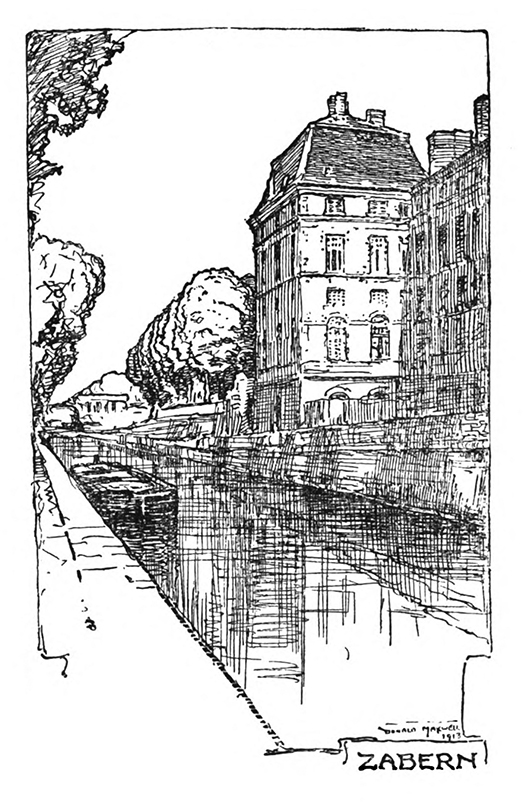
This is, however, an art book after all, so its real purpose is to serve as a showcase for Maxwell’s art. Almost every page of this 215-page volume features an illustration. Some occupy a full page, but most are smaller spot illustrations. Maxwell’s pen and ink drawings come in a spectrum of styles ranging from frameable finished works to intentionally rough and rapid scribblings. There are also some hand-drawn maps that are very hard to read. I read a digital copy of this book, so the art probably suffered some as a result of the scanning. In general the art in the book is reproduced rather small, which doesn’t do justice to Maxwell’s attention to detail. Several of the illustrations are in color. They do not appear to be full color, but rather watercolor washes printed in spot colors, usually green and yellow, over the black and white drawings. For the most part Maxwell’s illustrations of mountain scenery and historic architecture are really quite beautiful, the larger and most polished pieces being more successful than the more dashed-off gestural drawings.


Though Maxwell wrote a lot of these books, they are hard to find, even on the internet, despite many being in the public domain. While the writing of Adventures with a Sketch Book may not qualify as an essential travel narrative, anyone interested in landscape drawing, printmaking, or book illustration will enjoy viewing and learning from Maxwell’s accomplished artworks.

If you liked this review, please follow the link below to Amazon.com and give me a “helpful” vote. Thank you.

Wednesday, March 23, 2022

With Languages in Mind: Musings of a Polyglot by Kató Lomb


Meandering, repetitive grab bag on languages and language learning
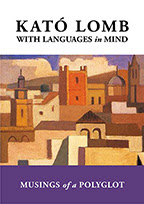
Kató Lomb was one of the twentieth century’s most accomplished polyglots (a speaker of many languages). Learning languages was her great love, and she did it well enough to work as a professional interpreter in sixteen tongues. Lomb also wrote books on language learning and interpreting, three of which are available for free download as pdfs on the website of The Electronic Journal for English as a Second Language (TESL-EJ). One of those books, With Languages in Mind: Musings of a Polyglot, was originally published in Lomb’s native language of Hungarian in 1983. The contents are aptly described by the subtitle as “Musings.” The book is comprised of 35 chapters, each from one to a dozen pages in length, in which Lomb shares thoughts, anecdotes, and her expert wisdom on languages, their interesting peculiarities, and how to learn and teach them.

This book will appeal to both language educators and language enthusiasts. For members of the latter category (like myself), Lomb does not provide a “fluent in 30 days” wonder scheme for how to learn languages quickly, but she does describe her preferred methods and acquired habits for studying and practicing new languages. She also advises teachers on how her methods could be incorporated into language education to improve student enthusiasm and success. Interspersed throughout the book are humorous anecdotes and horror stories of Lomb’s work as a simultaneous interpreter at various academic and political conferences. There isn’t really much rhyme or reason to the organization of the book; it is just a haphazard pouring forth of linguistic minutiae as the expert pontificates on her love of languages in a lively and for the most part accessible manner. Some topics Lomb discusses include the importance of context in learning vocabulary, the growing tendency in many languages towards the use of more and smaller words, general differences in speech patterns between males and females, and the purported value of learning Latin. To illustrate the points made in each chapter, she often cites examples from the linguistic characteristics of English, German, Hungarian, French, Spanish, Russian, and Japanese.


Lomb wrote her books in Hungarian primarily for a Hungarian audience. Thus the text includes many references, puns, inside jokes, and historical anecdotes that can only be truly understood by a native Hungarian. The English translator Ádám Szegi and/or the editor Scott Alkire explain these Hungarian-specific comments with footnotes, but much of the humor and import of such comments is lost to the English reader. This is an issue common to all of Lomb’s writings, but With Languages in Mind is by far the most Hungarian-centric of the three Lomb books I’ve read (the other two being Polyglot: How I Learn Languages and Harmony of Babel: Profiles of Famous Polyglots of Europe). In regard to her native tongue, some topics Lomb covers include the qualities of Hungarian that make it a beautiful literary language, the effect of the World War II fascist regime on the language, and generational changes in Hungarian over time.


The editor points out that some of the content in With Languages in Mind has either been pulled verbatim or slightly altered from the earlier published Polyglot: How I Learn Languages. Having read Polyglot previously, much of the content of With Languages in Mind did feel like a rehash, though I still enjoyed Lomb’s enlightening linguistic musings the second time around. Of the three Lomb books mentioned above that are freely available in English, With Languages in Mind is the least essential read. The other two books, Polyglot and Harmony of Babel, are more interesting, better organized, and cover more compelling ground.

If you liked this review, please follow the link below to Amazon.com and give me a “helpful” vote. Thank you.

Monday, March 21, 2022

An Ordinary Life by Karel Capek


Coming to terms with the prosaic and the perverse
An Ordinary Life
is the third book in what Czech author Karel Capek called his “Noetic Trilogy.” This novel was originally published in 1934, following Hordubal and Meteor, the first two books in the series. Though the stories and characters of the three novels are unrelated, they do share a common style and purpose. I won’t attempt to define “Noetic,” but I can say that the common theme or scheme that runs throughout the trilogy is that in each book the life of its protagonist is viewed and/or analyzed through multiple perspectives. The disagreements in the various viewpoints alternately obscure and enlarge the reader’s understanding of different aspects of the character and events of the story, thus calling into question how we myopically view our own lives and what narrative will be left behind after our own passing.


When an unnamed narrator is diagnosed with a terminal illness, he decides to write his autobiography. He doesn’t consider his life anything exceptional, but why shouldn’t an ordinary man leave behind an account of his ordinary life? So that’s what he sets out to do. He paints a prosaic and mundane picture of his life as a contented railroad employee. He diligently works his way from one incremental promotion to the next. Along the way he meets a young woman. They marry, but have not children. The first half of the novel leads the reader to expect exactly what the title promises, a life so unremarkable that the book begins to descend into boredom.

About the halfway point, however, the autobiography unexpectedly changes direction and turns into something different entirely. The narrator becomes more critical of his life and begins to reveal details that belie the serenity of the account he just related. What differentiates An Ordinary Life from its two predecessors is that in this case the multiple perspectives through which the man’s life are reflected are all within his own mind. This is not a case of literal schizophrenia or multiple personality disorder, but rather an example of one person’s ability to assess his own life through different aspects of his personality. The portrait of hard work and contentment is only one side of the story, much like the favorable life narratives we craft for public view on social media. As various sides of the subject’s psyche begin to argue with one another over what should be included or omitted from his autobiography, other aspects of his character are revealed, including an aggressive ambition, a hypochondria enabled by his coddling mother, and perverted desires spawned by forbidden sexual encounters in his past. Capek’s writing on these darker topics is surprisingly frank and disturbing. This was a challenging read for its time, not a pandering potboiler. Capek also delivers some insightful dissenting views on the institution of marriage, albeit the marriage dynamic of the 1930s, when women were forced into a more subservient role than today.

All three novels in the Noetic Trilogy are well worth reading. It is a toss-up between Hordubal and An Ordinary Life as to which is the best of the three books. Meteor is not quite as outstanding as the other two, but it is still a remarkable work. English-language readers primarily know Capek as a science fiction writer, from his futuristic play R.U.R. and his utopian novel War of the Newts. The books in the Noetic Trilogy, however, are not sci-fi at all but rather more along the lines of the existential fiction of Franz Kafka or Albert Camus. An Ordinary Life and the two books that preceded it reveal Capek to be an underrated author with a keen insight into human psychology and an exceptional talent for crafting innovative and thought-provoking literature.
If you liked this review, please follow the link below to Amazon.com and give me a “helpful” vote. Thank you.
https://www.amazon.com/review/R329KSCTD8V3DE/ref=cm_cr_srp_d_rdp_perm