Wednesday, May 7, 2025

The Black Hunter by James Oliver Curwood


Chivalric romance in the French and Indian Wars
James Oliver Curwood (1878–1927) was a Michigan-born writer who built a successful career writing popular wilderness adventure novels along the lines of Jack London. Many of Curwood’s books are set in Alaska or the Yukon, and some feature canine protagonists, much like London’s The Call of the Wild, White Fang, or Jerry of the Islands, among others. Curwood’s 1926 novel The Black Hunter, however, is a dog of a different color. This is a historical novel set in Quebec during the French and Indian Wars of the 18th century.


The story takes place in 1754 and 1755. David Rock is a young man who lives in the Valley of the Richelieu, a rural area in Southwestern Quebec. Though of English extraction, David lives in New France and is loyal to the French crown. He comes from a poor family and spends much of his time hunting in the nearby forests. His girlfriend, however, is loaded. Anne St. Denis, the daughter of a seigneur, lives in the local chateau. She and David have known each other since childhood and intend to marry. When some bigwigs from Quebec City come to visit Anne’s father, they insult the rustic David, and he responds by throwing two of them into a fountain. Since one of his victims is a high government official—François Bigot, the Intendant of New France—David is sentenced to a flogging. Bigot, however, at the advice of his cronies, pardons David of the sentence. What Bigot really wants is to hook up with the lovely Anne, and he figures he has a better chance of working his way into her heart (or rather her dress) if he is nice to her boyfriend rather than torturing him. The wily Bigot then takes the suspicious David under his wing, offering him a promising career in Quebec, much to the joy of Anne.


When I saw that this novel is set in “Old Quebec,” I expected a lot of backwoods Canada adventure typical of Curwood. Instead, Curwood’s depiction of Canada (New France) feels more like medieval Europe. This is mostly a courtly drama of romance and honor, somewhat along the lines of a Sir Walter Scott novel such as Ivanhoe, except that the good-versus-evil, damsel-in-distress triangle in this storyline is about as formulaic as the cartoon adventures of Dudley Do-Right, Nell Fenwick, and Snidely Whiplash. The book defies believability in the lengths that the villains go to pretend they are David’s friends and benefactors. In reality, if a powerful man of the 18th century wanted a helpless woman, he would probably use more barbaric methods rather than go to such sly lengths, but this is fiction not history, and that wouldn’t make much of a novel.


Most of the characters in the book, including Bigot, are real figures from Canadian history. Even the Black Hunter is a figure of local legend. He is a White man with black hair and black clothes, a nomadic backwoodsman with mythical skills as a hunter and warrior, like a cross between the Outlaw Josey Wales and James Fenimore Cooper’s Natty “Hawkeye” Bumppo. While David is the star of the book, the Black Hunter is a supporting character who barely appears in the book.


Only in the last quarter of the book does Curwood really dive into the French and Indian Wars, but that is the best part of the book. He has clearly done his research, and the brutality and gore of the final chapters belies the genteel chivalric tone of what came before. The treatment of Native Americans in the book is complicated. They are depicted largely as savage killing machines, but it is acknowledged that they have been made so by the English and French, with bounties and booze, who use the Indians for their own selfish ends. If Curwood had concentrated more on the wars and the Whites relations with the First Nations, it would have been a better book. Instead, you have to wade through an awful lot of wholesome romance and courtly intrigue to get to the good stuff. Nevertheless, the novel is fine overall and one of Curwood’s better efforts.

Monday, May 5, 2025

The Four Horsemen of the Apocalypse by Vicente Blasco Ibáñez


Gripping international family saga of World War I
One of the joys of reading old books by dead guys is occasionally discovering a previously unfamiliar author whose work really speaks to me. With the novel The Four Horsemen of the Apocalypse, published in 1916, I feel like I have discovered such an author in Vicente Blasco Ibáñez (1867–1928), one of the more prominent men of letters in Spanish literature of the late 19th and early 20th centuries. Blasco Ibáñez carries on the realist tradition epitomized by Honoré de Balzac and Émile Zola. Having survived Zola by a quarter of a century, he ushers Zola’s naturalism into the modern era without succumbing to artsy modernist aesthetics. The Four Horsemen of the Apocalypse is a novel about World War I, published during the height of the conflict, and it is easily one of the best novels about that war that I have read.

Julio Desnoyers, a young man of French and Argentinian heritage, is returning to the former country after a sojourn in the latter. Julio can’t wait to get to Paris to reunite with his mistress, a married woman whose husband seems to have resigned himself to a divorce. The ship carrying Julio from the New World to the Old is a German vessel. The ubiquitous topic of conversation on board is whether war will break out in Europe. The German passengers on the ship reveal an aggressive and prideful anticipation of the war, in contrast to Julio’s more pacifistic attitude.

From there, the novel looks back in time to the history of the Desnoyers family. Julio’s father, Marcelo Desnoyers, emigrated from France to Argentina during the Napoleonic era. Marcelo became the right-hand man of a rich Spanish-born rancher, and by marrying that rancher’s daughter, he became a very wealthy man himself. The family history in Argentina is an epic saga often told with a wry sense of humor, in which one can see the precursor of the Latin American family saga of Gabriel García Márquez’s novel One Hundred Years of Solitude—the so-called magic realist style, but without the “magic.” Much of the sense of humor disappears, however, when the focus of the novel turns to the war. The remainder of the novel is a gripping and often brutal exposé of the horrific realities of World War I. A relative of the Desnoyers marries into a German family, which sets up a clash of opposing viewpoints about the political situation in Europe. As one might expect of the time period, there is an anti-German slant to the book, but Blasco Ibáñez delivers a reasoned and realistic criticism of Germany rather than mere nationalistic caricature.

If you are looking for a novel about the military experience of the Great War, I would highly recommend Under Fire: The Story of a Squad by French author Henri Barbusse. Blasco Ibáñez’s Four Horsemen, on the other hand, is a novel about the civilian experience of the war. Both authors are pre-modern realists who tell their stories in the classic, now out-of-fashion style of straightforward, unostentatious prose that one finds in the works of Tolstoy or Zola, rather than the obliquely narrow and personalized narratives of the war you get from intentionally modernist writers like Ernest Hemingway’s A Farewell to Arms or John Dos Passos’s Three Soldiers. Blasco Ibáñez isn’t interested in idiosyncratic perspectives of the war. Like Tolstoy or Zola might have done, he wants to encapsulate the entire political and social scope of the conflict, and he does a superb job of it, with neither the overblown romance of Boris Pasternak’s Doctor Zhivago nor the didactic history lesson of Upton Sinclair’s World’s End. The Four Horsemen of the Apocalypse strikes the perfect balance of providing the reader with a historical education, a broad international perspective on the war, and affecting moments of personal tragedy and triumph.

I can’t say enough good things about this impressive novel. After reading The Four Horsemen of the Apocalypse, I can’t wait to dive deeper into the complete works of Blasco Ibáñez.

Wednesday, April 30, 2025

Hungry Hearts by Anzia Yezierska


Tales of Jewish immigrant life told and retold
A young Jewish woman from Russian-occupied Poland emigrates to America, where she hopes to find love, education, and personal freedom. Although only in her early twenties, she is considered an old maid in her home country. Her family’s poverty means she has no dowry to attract suitors. Once arrived in America, she lives in a squalid tenement building in a Jewish ghetto and slaves away sewing “shirt-waists” in a factory sweatshop. Then she meets a man, also Jewish, but educated and of a higher financial class than herself. She falls in love at first sight, but the feeling is not mutual. Because of her lack of means and sophistication, he shuns her, breaking her heart. She then vows to raise herself out of the poverty and ignorance of her station in life so that she may make herself worthy of him.

While I don’t know much about the author Anzia Yezierska (1880–1970), I’m guessing that’s her life story, because at least half of the short stories in her collection Hungry Hearts, published in 1920, bear this exact same narrative. Perhaps these stories were originally published individually in various periodicals before being gathered together in this book. When assembled, however, they comprise an extremely repetitive whole. The best story in the collection, “How I Found America,” is also its longest. Told in the first person by an unnamed narrator, this selection might very well be Yezierska’s autobiography. It is the most believable glimpse into immigrant life that Hungry Hearts has to offer. As the book’s closing selection, however, by the time you get to it you’ve already read the same plot six or seven times.

I like realist writers who capture the history of their times in their works. In America, the heyday for literary realism and naturalism was the late 19th and early 20th centuries. I’m always looking to discover previously unfamiliar writers of that style and period. After stumbling upon Yezierska’s name, I was hoping I might find in her an unsung virtuoso of American realism, but I was mostly disappointed by the stories in Hungry Hearts, especially after I read essentially the same plot for the third or fourth time. The reader does get a bit of muckraking realism from these stories, but it’s mixed up with too much romantic fantasy (see next paragraph). The best work of literature to capture the Jewish immigrant experience from this period is Abraham Cahan’s novel The Rise of David Levinsky, published in 1917. Yezierska’s stories here really don’t hold a candle to it.

What really undermines the realism of Yezierska’s stories is her attitude towards love. Not only does she believe in love at first sight (and includes a subplot about it in almost every story), she also seems to believe that love means abject worship at first sight. When a young woman in these stories meet a man, within a half an hour she’s ready to either have his babies or kill herself. In matters of the heart, Yezierska’s otherwise spunky heroines exhibit a total lack of self-esteem. Rather than romantic tales of courtship and heartbreak, these love stories read like evidence in some case study of neurosis. 

Yezierska also wrote a handful of novels, which I suspect cover much of the same ground as the stories in Hungry Hearts. It is admirable that she rose from humble beginnings to realizing her dream of being an author, and it’s good that someone has chronicled the struggles of immigrant women. Within that milieu, however, I think there are more stories to tell than the one Yezierska keeps repeating.

Stories in this collection

Wings
Hunger
The Lost “Beautifulness”
The Free Vacation House
The Miracle
Where Lovers Dream
Soap and Water
“The Fat of the Land”
My Own People
How I Found America

Monday, April 28, 2025

The Fabric of the Cosmos: Space, Time, and the Texture of Reality by Brian Greene


Least confusing state-of-physics overview
If Neil deGrasse Tyson is the 21st century’s Carl Sagan, then Brian Greene is its Stephen Hawking. Sagan and Tyson are the great popularizers of astronomy, while Hawking brought theoretical physics into the general public’s living rooms with his bestselling classic A Brief History of Time. Greene now follows in Hawking’s footsteps as the general reader’s Virgilian guide through the confusing Hell of quantum physics and string theory. In Greene’s book The Fabric of the Cosmos, published in 2004, he discusses the very nature of time and space, the creation of the cosmos, and the workings of physics at the sub-sub-atomic level. In addition to naturally being more up-to-date than A Brief History of Time, The Fabric of the Cosmos is easier to understand. Hawking may be the more important scientist (at least he’s a household name), but I found Greene to be the better explainer.

Greene takes a mostly chronological approach to this subject, beginning with Newton’s laws, then on to James Clerk Maxwell’s theory of electromagnetic radiation, then Albert Einstein’s general and special relativity, and on to quantum mechanics and beyond as scientists strive toward a unified theory to explain the workings of the universe. The reader follows as each successive generation of physicists points out the faults in their predecessors’ theories and formulates new ideas to resolve those issues. Greene is a proponent of string theory, so he gives that school of thought plenty of coverage. At the same time, however, he does admit there’s plenty the string theorists haven’t figured out yet. Whether discussing classical physics, relativity, or later developments, Greene is always very good about clarifying which ideas are generally accepted as fact by physicists and which are in various states of doubt, contention, or uncertainty.

Much of this is difficult for the nonphysicist to understand because so many of the answers to our questions about time and space can only be found outside the realm of our five senses, either beyond the reach of our microscopes and telescopes or perhaps in another dimension beyond the three that we perceive. Still, this book will leave you feeling amazed at the knowledge of the universe that physicists have been able to amass thus far using mathematics, logic, and indirect observation through experimentation.

This book does have some aspects that are less than satisfying. The illustrations are small and dark (in the paperback edition), making it difficult to see exactly what they’re trying to convey. The analogies that Greene chooses to illustrate his points can get annoying, like his overly cute reliance on The Simpsons references. Some of his comparisons are more perplexing than illuminating. For example, there’s got to be a better metaphor to explain a Higgs field than a frog in a Bundt cake pan. Overall, however, I think Greene does a fine job of explicating extremely complex concepts in everyday terms a layman can understand.

This book was published in 2004, and there have no doubt been discoveries and advances in physics in the two decades since. Even so, when nonscientists read about those advances in publications like Scientific American or Science News, you’re still going to need to know everything that came before, from Newton through the string theorists, in order to comprehend those articles. This book provides you with that basis of understanding. After reading The Fabric of the Cosmos, you will still likely be confused on some matters of time, space, and quantum physics. That’s the nature of the subject matter. In order for Greene to thoroughly explain how all this works, the book would have to be thousands of pages long. As an overview of physics at the dawn of the 21st century, however, it is unlikely you’ll find a better guide than this, unless it’s one of Greene’s more recent books.  

Thursday, April 24, 2025

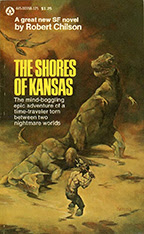
The Shores of Kansas by Robert Chilson


A time travel novel that’s more than just dinosaurs
I had never heard of the science fiction writer Robert Chilson before, but when I stumbled upon his 1976 novel The Shores of Kansas in a used book store, how could I resist?—being a Kansan myself and a fan of vintage sci-fi, time travel stories in particular. The title refers to the fact that back in the age of the dinosaurs, what is now Kansas was the center of a large inland sea. The novel doesn’t actually take place in Kansas but rather in Missouri, along the eastern edge of this prehistoric body of water.

As far as I can tell, the novel takes place in the present day (1970s). It has been discovered, however, that certain human beings possess a faculty for time travel, which, when properly developed and practiced, allows them to walk back through time. Of all these talented individuals, no one surpasses Grant Ryals, who is able to travel much farther back and remain far longer than any other time traveler. Ryals has achieved worldwide fame for his adventures in the Mesozoic Era, from which he has returned with photographs, films, and specimens of dinosaurs and other prehistoric life. Ryals is not interested in celebrity, however. He is a quiet man from rural Missouri who just wants to live a private life devoted to paleontological science. Ryals founded and funded the Chronological Institute, a paleontological research center, complete with a museum and zoo. While he is clearly the most powerful stakeholder in the Institute (imagine if Neil Armstrong founded NASA), the staff that he has hired to manage the daily affairs of the establishment are trying to wrestle control away from him. Ryals find himself reluctantly having to deal with such present-day woes when he would much rather avoid human interaction altogether and escape into the distant past.

As you’re reading The Shores of Kansas, the novel seems to be leading into one of two directions, either (a) a survival adventure in the prehistoric past or (b) Ryals makes an inadvertent change in the past that alters the present. As you cross the halfway point of the book, however, neither of these plot scenarios has yet materialized. The bulk of the novel, rather, is about Ryals’s life in the present day and his struggles managing the Institute and dealing with fame. It is surprising how little time travel actually takes place in this time travel novel. Instead, this science fiction is mostly just fiction about scientists—how they live their lives and conduct their research within the academic system through which discoveries are made and published. While this may sound less exciting than one would expect from a book with dinosaurs on the cover, I found this novel quite compelling and captivating because of its “realistic” approach to time travel and the depth, complexity, and authenticity that Chilson puts into the character of Ryals.

Had I not seen Chilson’s name on the cover, I would have sworn this novel were written by Clifford D. Simak. It has all the hallmarks of a Simak book: a Midwestern setting, an appreciation of country living and the outdoor life, time travel to prehistoric times (see Simak’s short story “Project Mastodon” and his novel Mastodonia), and an interest in higher education and academia (Ryals’s Chronographic Institute is not affiliated with a university, but it is run very much as an academic research institution). The one portion of the book that tells you this was not written by Simak is a chapter on Ryals’s sex life, which definitely evokes the swinging ‘70s and reads as if it were written by someone a generation younger than the more demure Simak. Since I’m a big fan of Simak’s work, I make this comparison as a compliment to Chilson. I don’t know much about Chilson’s career, but if I ever come across his name again on the shelves of a used book store, I will certainly consider any novel of his well worth the wager of a few bucks.  

Tuesday, April 22, 2025

Now I Ask You by Eugene O’Neill


Predictable free-love farce
Eugene O’Neill
After reading all of Eugene O’Neill’s best-known plays, I decided to dive deeper into his complete works. Doing so has brought my attention to a number of obscure dramas, some of which O’Neill himself wished to be forgotten. One such play is Now I Ask You, which O’Neill wrote in 1916. It was not performed on stage, however, until a 2010 production in St. Louis.

Tom Drayton is engaged to Lucy Ashleigh. Tom would like to marry Lucy, but she, being a modern woman, values her independence above all else. Luckily, Tom has his mother in law, Mrs. Ashleigh, on his side. She tells Tom that all of Lucy’s bohemian affectations and talk of feminism and free love is just an act. Mrs. Ashleigh assures Tom that if he calls Lucy’s bluff, Lucy will back down and eventually assume the role of the devoted wife that he desires. Tom reluctantly goes along with Mrs. Ashleigh’s plan, hoping it will pay off as she predicts. Lucy deigns to marry Tom if he signs a contract stating that theirs is an open marriage, with each party free to pursue their own interests, loves, and liaisons. Tom agrees. After the wedding, Tom keeps waiting for his wife to drop the modern-woman act, but contrary to his mother in law’s assurances, his calling Lucy’s bluff doesn’t seem to have paid off for him.


The fact that free love is even a topic in this play was probably very risqué for 1916. One can imagine O’Neill, like Lucy, envisioning himself as a bohemian artiste who dares to challenge his audience with such a controversial issue. The play in which he explores this theme, however, is about as conventional and predictable as it could be. It seems clear that O’Neill wrote this drama to appeal to a mainstream audience, hoping to make some money off of it. In that regard, however, Now I Ask You obviously didn’t pan out for him.


Over a century later, the free-love debate in this play is rather antiquated, but nowadays we still have to deal with characters like Lucy, counterculture posers who pretend to be more radical or woke than they really are. This is an aspect of the play with which modern readers can identify. Now I Ask You seems to be satirizing such posers, but in this play it’s often difficult to tell when O’Neill is trying to be funny and when he’s trying to be serious. Unless one has their grandparents’ sense of humor, the 21st-century reader really can’t be sure how much of the comedy here is intentional. One interesting piece of progressive-era slang that I picked up from this play is the expression, “I’ll blow you,” which apparently means “I’ll treat you (to dinner, drinks, or whatever the case may be).”


Any debate in this drama over free love, feminism, or modern marriage is overshadowed by the mystery of why Tom would ever want to marry Lucy in the first place, given that she is a truly unpleasant and simply mean person. In fact, Tom is the only sympathetic character in a cast full of arrogant and annoying players. Like the prime-time soap operas or reality TV of today, however, sometimes it is entertaining to observe a train wreck. Now I Ask You is tolerably mediocre and predictable for most of its length, but the epilogue is ridiculously bad, enough to make one lose respect for theatre audiences of 1916 that they would sit through such tripe. A century later, Now I Ask You is little more than a curious novelty that will only appeal to O’Neill completists.

Monday, April 21, 2025

Ms. Marvel Epic Collection, Volume 1: This Woman, This Warrior by Chris Claremont, et al.


Dismal attempt at a feminist superheroine
The superheroine Ms. Marvel made her debut in 1977 in issue #1 of her self-titled magazine. Marvel Comics’ trade paperback Ms. Marvel Epic Collection, Volume 1 collects issues 1 to 14 of Ms. Marvel, as well as Marvel Team-Up issues 61 and 62, and a crossover issue of The Defenders (#57). I grew up reading Marvel Comics, and I think of the 1960s, ‘70s, and to a lesser extent the ‘80s, as the glory days of superhero comics. Sometimes, however, Marvel’s Epic Collections remind me that there were plenty of mediocre and worse comics published during that era. This is one of those volumes.

Marvel had a few female superheroes before Ms. Marvel’s 1977 debut, among them the Invisible Girl (1961), the Wasp (1963), Marvel Girl (1963), Scarlet Witch (1964), Black Widow (1964), and Storm (1975). Those characters are all interesting in their own way, but Ms. Marvel just feels like she was created to satisfy some estrogen quota. By this point, Marvel really seems to have run out of good ideas for superheroes. Carol Danvers was a supporting character in the old Captain Marvel comic starring the male Kree warrior named Mar-Vell. She gets exposed to some alien radiation and is transformed into a sort of Kree/human hybrid, complete with a split personality. This identity crisis becomes cumbersome and is soon dispensed with. Ms. Marvel is super strong (boring) and her suit allows her to fly (also boring). Who knows how strong she is, but she says she’s not bulletproof. As if she weren’t powerful enough, she also has a Kree “seventh sense” that is somewhat similar to Spider-Man’s spider-sense, except that Ms. Marvel can actually see the future. 

Despite a ridiculous costume that flaunts her naked belly and back for all to see, Ms. Marvel isn’t just a slice of cheesecake. In fact, the artists can be commended for actually drawing her like a modern athletic woman who looks like she could be on the Olympic volleyball team. By issue #10, the powers that be had already demurely covered her midriff windows. All of the villains in these Ms. Marvel comics address her as “Woman,” as in “Woman, I will destroy you!” What’s funnier is that even in her own interior monologues, Ms. Marvel refers to herself as “Woman,” as in “Woman, that was a close call!” It couldn’t be any more obvious that this dialogue was written by men.

Chris Claremont, who went on to become one of Marvel’s golden boys with the X-Men, writes almost all the issues in this volume, and he delivers some really atrocious stories here. Gerry Conway created the character, however, and Claremont was just stuck with her. On the bright side, the art here is pretty good. Jim Mooney does his best John Buscema imitation, and John himself and his brother Sal are on hand for a few issues. John Byrne draws the two issues of Marvel Team-Up. It’s apparent that Marvel wanted to get this title off to a good start by putting some of their best 1970s talent at the drawing board, but it doesn’t make up for the abysmal storytelling.

The Brie Larsen version of Captain Marvel that you see in the Marvel Cinematic Universe is quite different from these comics but just as poorly thought-out. In the movies, she’s basically Marvel’s green lantern, and she’s as powerful as Superman. What makes Marvel’s heroes interesting is their weakenesses, the fact that they’re not perfect. The MCU’s Captain Marvel, however, isn’t allowed to have any weaknesses because then she wouldn’t be the epitome of female power. Heaven forbid an intentional feminist icon should have any flaws, so she ends up just being boring and ridiculous, much like Conway and Claremont’s version in these initial issues.