Showing posts with label Herbert Frank. Show all posts

Friday, February 20, 2026

Dune: The Butlerian Jihad by Brian Herbert and Kevin J. Anderson


Star Wars stole from Dune; now Dune steals from Star Wars
I’m a huge fan of Frank Herbert’s Dune saga, the original six novels that were published during his lifetime. I have read each of those books at least three times. For many years, however, I have purposely avoided reading any of the posthumous prequels or sequels put out by his son Brian Herbert. Brian’s takeover of the Dune franchise has always seemed to me a shameless nepo-baby move. Can Brian Herbert even write? I don’t know. I’ve never read anything written solely by him, except for his biography of his father, Dreamer of Dune, which I found disappointing. A smart move by Brian, however, was to team up with prolific sci-fi author Kevin J. Anderson. The recent Dune movies have renewed my enchantment with Frank’s fictional universe. Since I keep running into Brian’s Dune books in used book stores, I finally broke down and read one.


Dune: The Butlerian Jihad was published in 2002. It’s not the first Dune book that Brian Herbert and Anderson wrote, but it’s the first book chronologically in Dune history. The Butlerian Jihad is referenced in Frank Herbert’s books as a historic event having happened about 10,000 years in the past. It was then that mankind rose up against artificial intelligence and destroyed and outlawed computers and robots, which is why you never see any droids in the Dune books. Frank Herbert never sketched out the details of that landmark event, thus leaving his son the opportunity to write that history. I believe Frank Herbert named the jihad after Samuel Butler, author of Erewhon, an 1872 novel that presages a similar revolt against AI. In this Dune prequel, however, the jihad is named after a Butler family: Manion Butler is the political leader of the free humans, and his daughter Serena Butler is a prominent politician who inspires the humans to rebellion.


All of the familiar Dune planets are involved in this story, as well as a few new ones, including Earth. The groups and families that you would expect to be living on those planets, however, is much jumbled from the original Dune books. Cultures can move around a lot in 10,000 years, apparently. Because the Butlerian Jihad is in many ways the genesis of the Dune universe, Herbert and Anderson get to play with a lot of origin stories in this book. Here we get the origin of the spice trade, the Fremen, worm-riding, the Tleilaxu, possibly the Bene Gesserit (too soon to tell), and the Holtzman shields that characters wear to protect themselves in battle. We even get the origin of glowglobes, as if anyone was clamoring for that. Tio Holtzman, the creator of the Holtzman Effect, is a character in this novel, as are Aurelius Venport and Norma Cenva, who are mentioned in God Emperor of Dune as the creators of the foldspace technology that made the Spacing Guild possible (They haven’t invented that yet). Two of the major characters are an Atreides and a Harkonnen, but they are a far cry from the roles their families play in the original Dune. The treatment of the Atreides name is rather disappointing here compared to the illustrious history of the family that Frank Herbert hinted at in his books.


When George Lucas made Star Wars, he stole a lot of ideas from Dune. This book, however, reads as though Brian and Kevin stole some of those ideas back. This reads a lot like a Star Wars novelization. There’s a Luke Skywalker-type character and a Princess Leia-type character; not so much a Han Solo, though. The story is about a rebellion against an evil empire run by armored overlords. The Luke figure is the Darth Vader figure’s son. This is mostly typical interplanetary war fare without any of the philosophy or religious undertext one expects from Frank Herbert’s Dune. Anything that’s original in this book came out of Frank’s head, not Brian and Kevin’s.


Dune: The Butlerian Jihad certainly isn’t boring, but it’s neither as deep nor as awe-inspiring as Daddy Herbert’s books. I got more enjoyment and intellectual stimulation from The Dune Encyclopedia (1984), a non-canon expansion of the Dune mythos to which Frank Herbert gave his blessing. Which brings up another point: I’m not a fan of the way Brian Herbert has kept such a tight fist on the Dune legacy for so many years. If he had opened up the Dune universe to more licensing, as was done with the Star Wars and Star Trek franchises, the result would have been a lot more novels, comics, TV shows, etc. set in the Dune world. Many of those productions would have been non-canon and maybe downright bad, but, like those of Star Wars and Star Trek, the Dune characters would probably be household names by now. Even if Brian Herbert’s name on this book makes it “official,” I don’t think he and Anderson have done any better than many other sci-fi writers would have done. Despite my lukewarm reaction to this entry in the Dune saga, however, it’s probably got me hooked enough to at least read through this Butlerian trilogy.

Wednesday, February 14, 2024

Whipping Star by Frank Herbert


Weird-for-weird’s-sake space cop adventure
American science fiction author Frank Herbert is famous for his Dune series of novels, and some may be familiar with his trilogy The Pandora Sequence. His 1970 novel Whipping Star, however, is part of Herbert’s lesser-known ConSentiency series. This series takes place in a future where mankind has not only colonized other planets in the galaxy, but has also, unlike Dune, made contact with several sentient alien species. Somewhat like Star Trek, an interspecies government has been established to govern the galactic community. The ConSentiency series began with two short stories that are included in Herbert’s collection entitled Eye. Whipping Star is the first novel in this series. It is followed by 1977’s The Dosadi Experiment. These four works in the series were all previously published in science fiction magazines before appearing in book form.

What ties the ConSentiency series together is the character of Jorj X. McKie, agent of the Bureau of Sabotage (or BuSab for short). BuSab is a government agency created by the interplanetary government to sabotage the government itself and impede its own progress as a form of bureaucratic self-regulation. I found the idea of BuSab pretty ridiculous when I read the short stories in Eye; it is even more so here. Whipping Star comes across as so weird-for-weird’s-sake that you’re never quite sure when Herbert is trying to be silly.

A species called the Calebans have aided mankind through their gift of jumpdoors, teleportation portals between worlds. When a Caleban beachball (their form of spacecraft/dwelling) lands on the planet of Cordiality, McKie is sent to investigate. He finds that this particular Caleban is being literally and periodically whipped by an evil woman with an S&M fetish. (One can imagine Herbert delighting in his own naughtiness as he worked in that plot device.) This is more than just a consensual good time, however. This Caleban, in fact, is being slowly flogged to death. Even more shocking, McKie discovers that when this Caleban dies, almost all sentient life in the galaxy dies with her (why is too complicated to explain here). McKie must put a stop to the flagellations in order to save intelligent life as we know it. What makes his task difficult, however, is that these are long-distance floggings, employing jumpdoors (portal opens, arm swings whip, portal closes), so McKie has no idea where the dominatrix resides. He must track her down and stop her, or the end of humanity (and several other intelligent species) is imminent.

The most interesting aspect of this novel is McKie’s conversations with the Caleban, in which Herbert explores the language barrier between two species. Both parties speak the same language, but their syntax and vocabulary are different enough to impede understanding, which makes a critical situation even more difficult to overcome. These linguistic exercises seem to be the reason Herbert wrote the story, because beyond that, Whipping Star is just a jumble of goofy anything-goes space gibberish that is so divorced from any recognizable logic that it’s hard for the reader to care about any of it.
If you liked this review, please follow the link below to Amazon and leave me a “helpful” vote. Thank you.
https://www.amazon.com/review/R15QQUELZJUR0H/ref=cm_cr_srp_d_rdp_perm

Friday, February 24, 2023

The Ascension Factor by Frank Herbert


Not the strong finale one would hope for
The Ascension Factor
is the final novel in the Pandora Sequence by Frank Herbert and Bill Ransom. Herbert’s novel Destination: Void was a prelude of sorts to the series. He then collaborated with his friend, poet Bill Ransom, on a trilogy of novels set on a planet named Pandora, beginning with The Jesus Incident, which was followed by The Lazarus Effect. The Ascension Factor was published in 1988. Herbert died while the book was being written, and Ransom has stated that for that reason he had a bigger hand in writing this final book than he did for the previous two novels. Even if that’s the case, there is no noticeable change in style or narrative voice in this last installment, but the plot is the least interesting of the series.

While centuries passed between the previous novels in the Pandora series, The Ascension Factor takes place only 25 years after the end of The Lazarus Effect. A couple of characters have returned from that previous novel, but mostly this new book is populated by the children of The Lazarus Effect’s cast. One of the returnees is the recurring character Raja Flattery, the chaplain/psychiatrist of the original mission from Earth. Despite the fact that the astronauts who ventured to Pandora can stay alive for centuries in “hybernation,” this is not the same Raja Flattery who appeared in the previous novels, but rather another clone of the same person. This new Flattery is a tyrant who rules over Pandora with an iron fist, commanding a complex network of intelligence agents, assassins, and media outlets. Fed up with Pandora’s harsh environment and pestered by an underground resistance, Flattery has decided to build a new space ship to migrate humans to another planet where he will re-establish his authoritarian rule. Meanwhile, Pandora’s apex native species of sentient electrokelp, long controlled by humans for its climate-changing abilities, has started to outgrow the rule of its masters, and a legendary human/kelp hybrid messiah has appeared on the scene to challenge Flattery’s dictatorship.


The Pandora Sequence is also known as the WorShip series, after the conscious and omniscient spacecraft known as Ship, whom many humans on Pandora worship as a god. Herbert and Ransom never really followed up with that thread, however, as Ship abandoned Pandora after The Jesus Incident, never to return. The religious titles of the three Pandora novels lead one to believe that Herbert and Ransom might use this sci-fi series to examine religious and theological concepts. That’s true of The Jesus Incident, which contains a lot of Judeo-Christian imagery, but once again the authors pretty much abandoned that idea in the later novels. The only religion that’s really covered in the last two books is the sort of messiah worship that Herbert already explored more intelligently in his Dune series. The Ascension Factor, with its rather simplistic overthrow-the-tyrant storyline, feels too much like a rehash of Dune themes.


In the Dune books, the plots were driven by continuous confrontations between characters. The Ascension Factor, like The Lazarus Effect, suffers from too much going places and not enough getting there. The characters spend so much time in vehicles on their way to meeting each other that you have to wait until the very end of the book for much to happen, and then too much happens. Also plaguing this novel is a return to the technobabble that almost rendered Destination: Void unintelligible. Towards the end of The Ascension Factor, the authors (probably Ransom, mostly) get so bogged down in the technical details of the kelp, submarines, and hologram technology of Pandora that it’s hard to follow exactly what’s going on. Or rather, it’s hard to care when anything goes. Overall, the Pandora series is an entertaining and intriguing sci-fi saga, but it could have used a better finale.
If you liked this review, please follow the link below to Amazon.com and give me a “helpful” vote. Thank you.

Wednesday, December 7, 2022

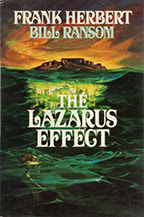
The Lazarus Effect by Frank Herbert and Bill Ransom


Off the deep end: Pandora becomes a waterworld
Beyond the Dune series, the other major multi-novel arc in science fiction author Frank Herbert’s body of work is his Pandora Sequence, a.k.a. the WorShip series. The Lazarus Effect is the third novel to feature the spacecraft-turned-god known as Ship and the second novel to take place on the planet of Pandora, following Destination: Void and The Jesus Incident. Like The Jesus Incident, The Lazarus Effect is a collaboration between Herbert and former poet Bill Ransom. In an introduction published after Herbert’s death, Ransom implies that he played a larger role in the writing of this book than the preceding novel because Herbert was busy writing The White Plague and dealing with his wife Beverly’s battle with cancer.

The Lazarus Effect takes place some unspecified centuries after The Jesus Incident, and much has changed in the interim. Pandora’s human inhabitants have extinguished the sentient kelp, which has caused sea levels to rise (the physics of that is unclear), turning the planet into a waterworld. That species’ DNA, however, still lives on in the genetic experiments of generations past. The human population has divided into two “races”: The Mermen are not fish-people like the mermen of mythology, but rather humans that live underwater through the aide of technology and some minor evolutionary adaptations. Genetically, they are more traditionally human than the Islanders who inhabit the surface and live on floating islands of organic material. The majority of the Islanders, descendants of the genetic anomalies created by the twisted experiments of Jesus Lewis in the last novel, are physically deformed in sometimes hideous but often useful ways. Though prejudices and suspicions exist between the Mermen and Islanders, they have managed to live in peace and cooperation for centuries. A faction of racist terrorists, however, threatens to destroy that peace and remake the world to their liking. Meanwhile, a spaceship full of Earth life, including thousands of human clones, continues to orbit Pandora in a state of hibernation, as it has done for centuries.

As weird as The Jesus Incident was, The Lazarus Effect is much weirder, and Herbert and Ransom drop you right in the middle of it with no orientation whatsoever. At first it is difficult for the reader to get his or her bearings, but once acclimated to this bizarre world it proves fascinating. God and religion play a smaller role in this novel than in the previous one. Ship has ostensibly left Pandora, abandoning the inhabitants to their own devices, though many still hold faithfully to the worShipful beliefs of their ancestors. Like Dune, there is also an ecological dimension to the plot that deals with planet transformation.

The culture and politics of Pandora are really interesting, but the waterworld itself doesn’t make for the most thrilling of settings. Much of the novel takes place on boats, which aren’t anywhere near as interesting as an extraterrestrial landscape. The characters are always trying to get somewhere but never seem to get there. With all the nautical encounters, embarkations, and mutinies, it is difficult to keep track of who’s on what boat, where they’re all going, and who’s holding whom prisoner.

Though this sequel is centuries removed from The Jesus Incident and thus features all new characters, the authors find clever ways to connect the story to the characters of the two preceding books. On its own, The Lazarus Effect is not an outstanding novel and would probably be so weird as to be off-putting, but as a part of the greater Pandora saga it advances the story arc in interesting ways, keeps the reader guessing, and makes one look forward to the final installment in the series, The Ascension Factor.
If you liked this review, please follow the link below to Amazon.com and give me a “helpful” vote. Thank you.
https://www.amazon.com/review/R2GDUSKKT5V8N/ref=cm_cr_srp_d_rdp_perm

Wednesday, October 19, 2022

The Jesus Incident by Frank Herbert and Bill Ransom


Herbert’s best world-building since Dune
The Jesus Incident
, published in 1979, is the sequel to Frank Herbert’s novel Destination: Void. In that earlier novel, a spaceship from Earth departs the solar system to colonize another star system. In The Jesus Incident, that ship has arrived at the planet of Pandora, making this novel the first in a Pandora trilogy, followed by The Lazarus Effect and The Ascension Factor. The three Pandora novels are a collaboration between Herbert and poet Bill Ransom.

In Destination: Void, the space travelers were tasked with creating not just an artificial intelligence but an artificial consciousness. In doing so, they inadvertently created a being with godlike powers. Unknown centuries have passed since the end of that last book. Their creation, Ship, seems to be omniscient. Unlike the Christian God, Ship isn’t shy about speaking directly to his subjects—straight into their minds, in fact. Ship’s powers also seem to inexplicably border on omnipotence. He captures humans from different worlds and brings them to Pandora, where he watches them act out experiments in civilization. He demands that his humans figure out how to “worShip” him, but so far no one has successfully solved that riddle. While many humans live in orbit within Ship, many others work to establish a colony on the surface of Pandora. The planet presents a harsh environment populated by savage and terrifying creatures. One species, however, the electrokelp of the planet’s oceans, shows promising signs of intelligence and may hold the key to worShip.

Though probably coincidental, there are some uncanny similarities between The Jesus Incident and the movie Avatar, which also takes place on a planet called Pandora. In Avatar, the two leads have sex by communing with the neural network of an intelligent tree. The electrokelp of Herbert’s Pandora serves the same purpose. Similarly, in both Pandoras all species in nature, from the beautiful to the savage, are connected by a universal mind that allows the apex species (tree or kelp) to influence the actions of all flora and fauna. This sort of Taoist or pantheistic conception of nature imparts an ecological message to both sci-fi narratives. Also, in both cases the hero demonstrates the unusual ability to ride a native creature by establishing a psychological rapport with it, which also calls to mind Paul Atreides riding the sandworms of Herbert’s Dune.

The Jesus Incident suffers from a pacing problem. The book is 69 chapters long, and for many of those chapters, not a whole lot happens. In chapter 69, however, everything happens, and it all happens so fast it’s difficult to figure out what exactly happened. The connection to Jesus in The Jesus Incident feels tenuous and forced. It almost seems as if Herbert came up with the title of the book first, and then had to find some way of incorporating Christ into the story. Of course, we know from Dune that Herbert is fascinated with messiahs and saviors, and he continues investigating such phenomena here. Omniscience is another favorite theme of Herbert’s, but for an ability that should be unique and amazing he sure does bestow it upon a lot of characters.

Despite all the religious subject matter, The Jesus Incident isn’t so much about Ship as it is about the humans battling each other for dominance over Pandora. In that sense, it is a lot like Dune in that it presents a psychological chess match between multiple parties with diverse self-interests. As a fictional universe, Pandora is not up to the complexity and ingenuity of Dune, but the multi-volume arc allows Herbert to delve into world-building to an extent unparalleled in his stand-alone novels. Dune fans will find much to enjoy in The Jesus Incident, but those unfamiliar with Herbert may be put off by the weird spiritual mysticism of Ship and Pandora.
If you liked this review, please follow the link below to Amazon.com and give me a “helpful” vote. Thank you.
https://www.amazon.com/review/R1WVRDP04CKFT6/ref=cm_cr_srp_d_rdp_perm

Wednesday, August 24, 2022

Destination: Void by Frank Herbert


Shiploads of techno-speak and psychobabble
Science fiction author Frank Herbert is best known for the six novels in his Dune series, but in between writing those novels he also composed another multi-volume series known as the Pandora Sequence or the WorShip series. The first book in that series, Destination: Void, was originally published in Galaxy Magazine in 1965 and released in book form the following year. Herbert revised the novel in 1978 before publishing its three sequels.

An experimental space ship is launched from Earth to colonize a planet in the Tau Ceti star system. This is the seventh attempt at this mission, the first six ending having ended in disaster. The population of the ship is comprised entirely of clones, who are the expendable lab rat slaves of this future Earth. Thousands of passengers are suspended in hibernation while a handful of crew operate the ship. The voyage is expected to take 400 years. As the novel opens, the ship is somewhere around Saturn. Three of the crew are dead; three remain alive and awake. The ship is too complex for the crew to operate alone, so the vessel’s systems have been hardwired directly into three disembodied human brains. As we join the story, however, these three brains have all gone insane and committed suicide, leaving the crew to their own devices. Their only hope of survival in the far reaches of space is to do something that’s never been successfully done before: create an artificial consciousness from electronic hardware and software. If they succeed, however, what will be the ramifications of spawning the first fully conscious artificial intelligence?


With Destination: Void, somehow Herbert manages to craft a very thrilling novel even though the average reader will have difficult understanding much of what’s going on. The problem of consciousness is an intriguing puzzle, and the crew have many interesting debates about what constitutes consciousness and what an artificial consciousness might require. For example, does a conscious being need to feel pain? Does it require a sense of guilt? Of love? A desire for self-preservation, and consequently, a killer instinct? The crew back up their arguments with psychological theory, some of which is probably authentic scholarship and some of which is a product of Herbert’s fictional future. After such speculations, the crew must then figure out how to implement these traits using computer hardware, and that’s where Herbert really indulges in the sci-fi gobbledygook. The “Ox,” as they call their mechanical Frankenstein’s monster, is made up of a cockamamie almagamation of circuits, wires, pipes, plastic blocks, neuron fibers, eng multipliers, tape loops, and more. You’d have to be a neuroscientist or an electrical engineer to figure it all out, but I suspect Herbert just made a lot of it up as he went along. At least three quarters of the novel is jammed with this nonsensical techno-speak. The amazing thing, however, is that the reader still cares about the characters and remains invested in the plot.


Herbert wrote Destination: Void by himself, but he collaborated with poet Bill Ransom on the remaining novels in the series. Those three sequels—The Jesus Incident, The Lazarus Effect, and The Ascension Factor—comprise a trilogy of sorts. Destination: Void is more of a prelude to that trilogy. Because it ends on a bit of a cliffhanger, it doesn’t really feel like a complete novel but rather the lead-in to a larger story. I wouldn’t classify Destination: Void as one of Herbert’s best works, but it does provide the foundation for the Pandora Sequence, which as a whole I think is a worthwhile read. As in the Dune series, the multi-volume arc allows Herbert to take a deep dive into world-building and thoroughly explore some philosophical issues of interest to him. At times he can get too esoteric, but the intellectually challenging nature of his work is also part of the attraction. Herbert fans will like Destination: Void, but don’t expect to understand it.

If you liked this review, please follow the link below to Amazon.com and give me a “helpful” vote. Thank you.

Monday, January 17, 2022

The Stars and Planets of Frank Herbert’s Dune: A Gazetteer by Joseph M. Daniels


Astronomical appendix for diehard fans only
Images from the movie Dune (1984)

Atypical of this blog, today’s review is not about a book but rather about an article. The Stars and Planets of Frank Herbert’s Dune was written by Joseph M. Daniels, about whom I know nothing, and published in 1999. I know not where this paper was originally published, perhaps in some fan-fiction zine, but the 44-page essay can be found online. In this article, Daniels tries to nail down the actual stars that might correspond to the fictional stars and planets mentioned in Frank Herbert’s novel Dune and its sequels. To accomplish this, Daniels relies on evidence quoted from Herbert’s six Dune novels, as well as from the non-canonical Dune Encyclopedia compiled by Dr. Willis McNelly and published in 1984.

The Star Trek television and movie universe mostly populated its United Federation of Planets with worlds revolving around real-life stars in our galaxy. Spock’s homeworld Vulcan, for example, orbits 40 Eridani A. On the other hand, the Star Wars universe, as far as I know, uses entirely made-up planets and stars. The Dune universe falls somewhere in between these two extremes, with a combination of both real and imaginary celestial bodies. Author Frank Herbert makes it clear in the first novel that Arrakis, the planet nicknamed Dune, revolves around the star Canopus, also known as Alpha Carinae. For other major recurring planets in the Dune saga, Herbert only hints at the stars they might orbit. Daniels’s mission is to turn these hints into conclusions, and he goes to great lengths to do so.


Unlike Star Trek, Herbert often changed the names of stars, assuming that tens of thousands of years in the future they might go by different appellations. In some cases it is pretty easy to decode the stellar references. For instance, it is a pretty safe bet that the repeatedly mentioned planet Bela Tegeuse likely has a relationship to the star we know as Betelgeuse. Most of Herbert’s star names, however, are more obscure than this. Thus, Daniel’s analysis of Herbert’s fictional planets is less about astronomy than one would expect, and more about linguistics. Daniels traces references to Latin, ancient Greek, Arabic, Persian, and Indian languages. In doing so, he reveals some complex relationships between the cultures of Dune and real Old Earth history. The inhabitants of the multiplanetary Dune universe, remember, are our descendants tens of thousands of years in the future. One of the most important events in Dune history is the Zensunni Wanderings, by which earthlings migrated for thousands of years from planet to planet, eventually becoming the Fremen of Arrakis. As Daniels traces this path of migration, he draws attention to the many references to Arabic and Muslim culture that Herbert snuck into the Dune books.


Some of Daniels’s planetary revelations are commendably well-founded on textual evidence, but many come across as mere educated speculation. Herbert himself was deceased by the time this was published, so he couldn’t comment on the subject. What Daniels does well, however, is compile a sort of concordance of astronomical shout-outs from the Dune texts. There is a whole list of planets briefly mentioned that are purely fictional, but Daniels reminds you of what happened there and why they were mentioned. If you are a big fan of the Dune books like I am, then it is good fun to relive Herbert’s fictional universe through this approach. One gains an even greater admiration for the thought and detail he put into his imagined worlds. Daniels’s rather obsessively detailed prose, however, will only appeal to the most diehard Dune fans. Those who haven’t read the Dune Encyclopedia will have trouble following his reasoning at times.

Monday, May 17, 2021

Frank Herbert by William F. Touponce


Lit crit of Dune
The 1988 book entitled Frank Herbert, a monograph of literary criticism on the science fiction author’s work, is part of the Twayne’s Authors Series from Twayne Publishers of Boston. It was written by William F. Touponce, a professor of English at Indiana University-Purdue University in Indianapolis. This is not the first book of literary criticism on Herbert’s work, but, having been published shortly after Herbert’s novel Chapterhouse: Dune, it is the first to cover all six novels in the Dune series.

Touponce opens his book with a brief biographical chapter on Herbert. This life summary has since been surpassed by Brian Herbert’s 2003 biography of his father, Dreamer of Dune, which naturally goes into far more detail. Those just looking for the basic facts of Herbert’s life, however, will find what they need to know here without having to put up with Brian’s numerous digressions. Next, Touponce discusses the first Dune novel. This is the book’s meatiest chapter, containing most of Touponce’s critical analysis. From there, he devotes chapters to each of the remaining Dune books, then ends with a brief overview of Herbert’s non-Dune career, in which about a dozen other Herbert novels are briefly summarized, spoilers included.


Touponce taught university courses on science fiction and has written other books of lit crit on the genre. This book on Herbert is not intended for the casual fan but for an audience of PhDs. In his analysis of the Dune novels, Touponce focuses mostly on Herbert’s use of language and narrative voice. He stresses that Herbert is not a dialectical writer but a dialogical writer. He doesn’t preach messages to his reader, but rather uses dialogue and multiple viewpoints to raise open-ended questions and discussions. Rarely does Herbert provide conclusive resolutions to these dialogues but rather leaves it to the reader to form his or her interpretation of the events and ideas presented in the Dune novels. Touponce also emphasizes the multiple levels of narrative voice through which Herbert tells these stories—the third person authorial narrative, first person interior monologues, the faux excerpts from the writings of fictional characters, historians, and archivists—and how all contribute to what Touponce calls a “polyphonic novel.” Naturally, given the plot of Dune, there is some discussion of Herbert’s views on religion, ecology, heroes, and messiahs, but most of Touponce’s textual analysis focuses on these issues of language and dialogue.


The main problem with Touponce’s book is that it’s at least 90 percent plot summaries. Granted, these are likely the most complete and in-depth plot summaries you are likely to find on the Dune novels, but if you’ve already read Herbert’s books then Touponce isn’t telling you anything you don’t already know. It makes for a nice stroll down memory lane, but there isn’t a whole lot of additional commentary and analysis above and beyond the extensive plot synopses. As a fan of Herbert’s work, I am glad that he was given the full-length scholarly monograph that his novels deserve, but I’m not sure if this is a particularly valuable work of scholarship in its field.


This is a short book, only about 125 pages, so not a major investment in time for the reader. Outside of literary academia, however, it will really only appeal to the most diehard Dune fans, like those who have already read through Willis McNelly’s Dune Encyclopedia.

If you liked this review, please follow the link below to Amazon.com and give me a “helpful” vote. Thank you.
https://www.amazon.com/review/R2ZLEO9UN3A59T/ref=cm_cr_srp_d_rdp_perm

Thursday, March 25, 2021

Chapterhouse: Dune by Frank Herbert


Wonderful world, boring story
Chapterhouse: Dune is the sixth and final volume in Frank Herbert’s series of
Dune novels. I first read the book shortly after it was published in 1985. Though I have reread some of the earlier Dune books a few times over the years, I just finished rereading Chapterhouse for the first time. In my opinion, the Dune universe that Herbert created in his six books is the most compelling and vividly imagined fictional universe in literature, putting The Lord of the Rings, Star Wars, and Harry Potter to shame. Despite my avid fandom, however, I have to admit that Herbert didn’t hit it out of the park every time. The phrase “last but not least” does not apply to the Dune series because Chapterhouse: Dune is clearly the worst book of the six.

The story takes place roughly 30,000 years in our future, immediately following the events of Heretics of Dune. At the end of that novel, the planet Arrakis was destroyed by the mysterious Honored Matres. The Bene Gesserit sisterhood, however, absconded with a sandworm and have proceeded to create a new Dune on the planet they call Chapterhouse, which serves as the administrative headquarters of their order. The Honored Matres are hunting the Bene Gesserit to extinction. They have destroyed multiple worlds that housed Bene Gesserit schools and strongholds, but the location of Chapterhouse remains a secret. In previous books, Herbert revealed how elements of Christianity, Islam, and Zen Buddhism have survived mankind’s epic migration throughout the galaxy. In this novel, he introduces a sect of Jews who have secretly preserved their faith for tens of thousands of years and have allied themselves with the Bene Gesserit.


The previous Dune novels were often told from multiple perspectives by jumping around among members of an ensemble cast, each player representing one of myriad competing factions in the complex galactic society. In Chapterhouse: Dune, however, probably 80 percent of the story follows the Bene Gesserit Mother Superior Darwi Odrade as she devises a plan to deal with the Honored Matre crisis and ensure the survival of her order. This results in the reader sitting through an endless series of meetings among the Bene Gesserit bureaucracy. The dialogue, both verbal and interior, is mostly written as a string of quotable philosophical aphorisms, each of which could serve as the motto for an intellectual embroidered sampler. No author in fiction writes these aphorisms better than Herbert, but the cumulative effect is one of tedious verbosity. Nothing much resembling action happens in the first three quarters of the book. The intense focus on the Bene Gesserit administration also severely limits the scope and fascination of the Dune universe. The Honored Matres must remain a mystery, so they barely appear. The Tleilaxu have been wiped out but for one survivor. Sheeana, the Fremen girl who can talk to worms, was one of the most interesting characters from Heretics, but she only plays a minor supporting role here. Duncan Idaho is on hand as usual, but his presence feels more obligatory than necessary.


Another mark against Chapterhouse is that it ends on a cliffhanger and therefore feels incomplete. The final chapter, deliberately vague and a little silly, adds insult to injury. Herbert intended to write a sequel but died before he could complete it. His son Brian Herbert has published many posthumous Dune novels since Frank’s death, among them two sequels to Chapterhouse entitled Hunters of Dune and Sandworms of Dune. (I haven’t read them.) If you enjoyed the first five books of Herbert’s Dune series, then by all means read Chapterhouse: Dune, but don’t expect it to be as great as the novels that preceded it.

If you liked this review, please follow the link below to Amazon.com and give me a “helpful” vote. Thank you.
https://www.amazon.com/review/RDSZHQTYGV1ZW/ref=cm_cr_srp_d_rdp_perm

Thursday, January 28, 2021

Soul Catcher by Frank Herbert


Spiritual thriller of Native American vengeance
Frank Herbert, author of
Dune, is one of the most highly regarded science fiction writers in the history of the genre. Soul Catcher, published in 1972, is the only non-science fiction novel that Herbert published during his lifetime. Growing up in the Pacific Northwest, Herbert made friends with members of the Native American community and became interested in Indigenous affairs. Soul Catcher is a reflection of those concerns and an expression of outrage over Native American oppression.

The story takes place in the state of Washington, near the Pacific Coast. Charles Hobuhet is a young Native American graduate student in anthropology. (His tribal nation is never specified.) His sister committed suicide after being raped by a gang of white men. This drives Hobuhet to plan an act of retaliation against white society. He withdraws from white America, embraces his Indigenous heritage, and adopts the Native name of Katsuk. Posing as a camp counselor, he kidnaps one of his campers, David Morgenstern, the 13-year-old son of the Undersecretary of State. Leaving notes behind as a political statement, Katsuk draws David deep into a remote wilderness area with the intention of killing the boy as a ritual human sacrifice.

While Herbert’s novels, such as the Dune series, often juggle multiple plot lines from different character perspectives, Soul Catcher consists of just one continuous story line that runs throughout the book. As he often does, Herbert opens each chapter with a fictional epigraph, here consisting of brief quotes from law enforcement officers, journalists, and family members. Beyond these epigraphs, however, the focus remains permanently fixed upon the relationship between Katsuk and David and their adventures in the wild. There is a trippier side to the story that deals with Native American mythology and Katsuk’s communications with the spirit world. Some mystical events in the story are open to supernatural interpretation, but never exclusively so. As he proved in the Dune books, Herbert is very skillful at rendering psychological imagery, visions, and the like. There is quite a bit of such interior drama in Soul Catcher, for which Herbert probably draws as much on Freud and Jung as he does on Native American folklore and religion.

Katsuk is essentially a terrorist, but the reader sympathizes with him because he is acting out of rage against the repression and genocide of his race. Even so, nowadays a novel with a Native American villain would likely have a hard time finding a publisher. I’d like to think, however, that literature and film give rise to enough villains that there is occasionally room in the rogues’ gallery for a person of color. Another mark against the book, by today’s standards, is that Herbert interprets Native American culture through his white perspective. If a Native American author had written Soul Catcher, it likely would have garnered more long-lasting attention and acclaim. Herbert’s close friend Howard Hanson, an elder of the Quileute tribe of Washington State, did not approve of this novel. In my opinion, however, Herbert should be commended for the problematic, challenging, and uncomfortable aspects of his narrative when he could have just taken the easy way out by delivering a feel-good story of racial understanding.

Unfortunately Herbert’s son, Brian Herbert, in his biography Dreamer of Dune, spoiled the ending of Soul Catcher for me. Even though I knew what was coming, however, I still found this narrative riveting. Combining elements of wilderness survival and crime fiction with an impassioned plea for Indigenous rights, Soul Catcher is a compelling and thought-provoking novel that is better than many of Herbert’s non-Dune science fiction books.

If you liked this review, please follow the link below to Amazon.com and give me a “helpful” vote. Thank you.

Thursday, December 10, 2020

The White Plague by Frank Herbert


Frightening premise, plodding execution
Published immediately after his immensely successful 1981 novel
God Emperor of Dune, The White Plague is a deliberate departure from Frank Herbert’s usual fare. Unlike the cerebral space fantasies that made him famous, The White Plague is a medical thriller, like a Michael Crichton story but a whole lot bleaker. In Herbert’s frightening vision, the plague in question is apocalyptic in scope and threatens the future existence of humanity.

Though published in 1982, The White Plague is set in 1996. John Roe O’Neill is an American molecular biologist who is in Ireland with his family while doing research for a study of Irish genetics. When the IRA sets off a bomb in Dublin, O’Neill’s wife and two children, bystanders at the scene, are horribly killed before his eyes. Driven insane by the event, O’Neill goes into hiding while devising an act of retribution for his loss. He creates a deadly pathogen and unleashes it on Ireland, Britain, and Libya—the nations he feels are responsible for the terrorist attack. The outbreak soon spreads to other nations, however, endangering humanity worldwide. Surprisingly, the plague only kills women. Men, merely the carriers of the disease, are thus left behind to feel the grief, guilt, and helplessness that O’Neill himself felt when his family was taken from him.


The oddest thing about The White Plague is how little the titular disease is discussed. Only a few paragraphs actually describe the symptoms of the disease, which include the appearance of white patches on the skin and an overall pallor at the time of death. There are no heart-wrenching or tear-jerking death scenes. Scientists and politicians hold many meetings in which cures are discussed, but very little delving into the actual mechanics of the contagion—DNA, RNA, microphages, and the like—takes place until the very end of the book. The bulk of the story is taken up by a cross-country trip through the semi-apocalyptic Irish countryside. The plot reads more like a spy thriller than a sci-fi or horror novel. The killer, the scientists looking for a cure, the IRA, world governments, militaries, and intelligence agencies are all vying to outsmart one another in order to emerge from this global catastrophe with the upper hand. Towards the very end Herbert offers some interesting speculation about what a world without women, or very few women, would look like, but the sci-fi fan is left wishing that idea had been developed further.


In this novel, Herbert is also very preoccupied with Irishness. Since the story is set primarily in Ireland, most of the characters are Irish, and Herbert uses those characters to illustrate and discuss various characteristics of an Irish nature and identity. Herbert’s maternal grandfather was an Irish immigrant, and according to Brian Herbert’s biography Dreamer of Dune, the family placed great pride in their Irish heritage. Herbert also spent a week in Ireland doing research for The White Plague. Though it’s obvious he’s done homework on the subject, Herbert’s views on Irishness and Catholicism feel like an outsider’s perspective of a foreign culture. It’s hard to believe so many modern Irishmen in positions of authority would speak so much about faeries and banshees, even metaphorically. The material about the IRA comes across about as realistic as is typical of American-made spy movies.


The White Plague starts with a great premise but lacks excitement in its execution. By Herbert standards, even compared to his non-Dune work, it’s a fine book but not great. The beginning and the ending of the novel are quite compelling, but in between there’s way too much trudging through heath and bog.

If you liked this review, please follow the link below to Amazon.com and give me a “helpful” vote. Thank you.
https://www.amazon.com/review/R3ARWUDWHU7AYI/ref=cm_cr_srp_d_rdp_perm

Tuesday, October 6, 2020

Heretics of Dune by Frank Herbert


Life after Leto II
Heretics of Dune,
the fifth book in Frank Herbert’s Dune series, was published in 1984, three years after the previous Dune novel. That fourth volume, God Emperor of Dune, was very much the culmination of the epic saga that began with 1965’s original Dune novel. God Emperor ended with a finality that brought closure to so many of the plot threads and grand schemes that Herbert conceived in the first four novels. As a result, Heretics of Dune often feels more like a spin-off than a sequel. When reading it, one gets the impression that Heretics is to the Dune universe what Rogue One is to the Star Wars universe: a stand-alone story with all new characters, surprisingly different in tone (somewhat of a spy thriller) and only tenuously related to the Duniverse timeline. By the time one finishes with the novel, however, it is clear that Heretics is only the beginning of a much grander narrative to come. It was, in fact, the beginning of a new trilogy envisioned by Herbert, but he died after having only completed two of the three novels.


Heretics of Dune takes place about 1500 years after God Emperor, or roughly 30,000 years in our future. The death of Leto II and the chaotic power vacuum that followed led to the Scattering, a tremendous diaspora of humanity to unknown stars and planets. What has taken place on those myriad far-flung worlds remains a mystery, but now descendants of those long-lost peoples, some with sinister intent, are beginning to return to the core planets of the former Imperium. While the first three novels of the Dune saga centered around a game of thrones between aristocratic houses, those dynasties disbanded during Leto II’s marathon reign. The Atreides and other noble families live on as DNA in the gene pool, but they no longer exist as political powers. The power struggle in Heretics of Dune takes place not between families but between bureaucracies: the religious/political sisterhood of the Bene Gesserit, the genetic manipulators of the Bene Tleilax, the technological wizards of Ix, and the priests of Rakis (the planet formerly known as Arrakis). From the Scattering, a new and terrifying faction enters the mix: the Honored Matres, an order of warrior women armed with supreme skills in both physical combat and sexual conquest.

The plot of Heretics of Dune is basically a strategic chess game among these various players, and like a chess game, it is sometimes thrilling, often intellectually stimulating, but occasionally just plain boring. While the story may not live up to Dune books past, Herbert still enchants Dune fans with the Byzantine ingenuity of his Dune universe. The action takes place on three planets: Rakis, Gammu (formerly Geidi Prime) and the Bene Gesserit’s Chapterhouse planet. While the earlier Dune books mostly focused on emperors, aristocrats, and their retinues (the Fremen excepted), Heretics gives the reader a broader glimpse into the lives of the common residents of Gammu and Rakis and the rank and file of the Bene Gesserit and Tleilaxu.

Heretics of Dune is not as strong as the four books that preceded it. Nevertheless, don’t believe those Dune fans who complain that everything sucked after God Emperor. It’s still Frank Herbert’s work, and he still manages to deliver gripping suspense, philosophical food for thought, and beautiful richness of detail. As a whole, Herbert’s six canon Dune books stand as a literary masterpiece. His fictional universe is more intricately complex and intelligently conceptualized than those of Star Wars, Harry Potter, The Lord of the Rings, Game of Thrones, or any other multi-volume sci-fi/fantasy narrative. While the foundation of the Duniverse was laid by earlier novels, Heretics of Dune does add a few more fascinating levels to Herbert’s monumental vision.
If you liked this review, please follow the link below to Amazon.com and give me a “helpful” vote. Thank you.
https://www.amazon.com/review/R1UN7QIX8OH144/ref=cm_cr_srp_d_rdp_perm

Wednesday, July 8, 2020

Direct Descent by Frank Herbert


Library planet under bureaucratic siege
Direct Descent is a work of science fiction by Frank Herbert, the author of Dune. Though considered a novel, the book is really a collection of two short stories, labeled Part I and Part II. Part I is based on a short story by Herbert entitled “Pack Rat Planet,” which was published in the December 1954 issue of Astounding Science Fiction magazine. Part II was presumably created specifically for the 1980 publication of Direct Descent. Altogether the book adds up to maybe 100 pages of text. Paperback editions of Direct Descent were padded with illustrations, but the ebook edition I read was not illustrated.

The two stories, Part I and Part II, are only loosely related and do not constitute a continuous narrative. In other words, Part II is not a sequel to Part I. The stories have different characters, but both take place on the same world and build upon similar plot premises. The world in question is Earth, but an Earth much changed from that which we know. Part I takes place in the 81st century, while Part II is set at least two thousand years beyond that. Much like in the Duniverse, mankind has spread outwards from Earth to colonize the galaxy. In Direct Descent, however, the Earth is now home to the Galactic Archives, a sort of gargantuan Library of Congress for the entire galaxy. The holdings of this library are so extensive that much of the planet has been hollowed out to make room for them, right down to the Earth’s very core.

The library director informs us that “The first rule of the Galactic Library Code is to obey all direct orders of the government in power.” How can the library management be expected to follow that directive, however, when the government is antagonistic towards the library and aims to shut it down? Such is the premise of both stories. Following a regime change, the new governing power sends auditors to the Library looking to disband it due to financial or ideological reasons. Besides hoarding archival materials from all of mankind’s planets, another mission of the Galactic Library is to disseminate information, which it does by sending out thousands of broadcasts of randomly selected content from its holdings. If one were to compare Direct Descent to present-day politics, the story is less analogous to the U.S. government’s treatment of the Library of Congress than it is to the government’s treatment of the Public Broadcasting Service. When conservative administrations take power, they look to cut the funding of PBS, which they see as a liberal enterprise. Direct Descent presents two gross exaggerations of this sort of ideological squabble.

I’m very interested in libraries and their history, so I enjoyed the library planet that Herbert envisioned for this novel. I can’t help thinking, however, that a more whimsical science fiction writer—Clifford D. Simak, perhaps—could have handled the idea better. The wonders of knowledge contained in this planet-sized institution are hardly explored at all. Herbert is more interested in government bureaucracy than he is in the library itself. Both stories in Direct Descent rely on legal technicalities for their resolutions. These technicalities are so technical, in fact, that they confuse the reader and may even defy logic. Nevertheless, I enjoyed my visit to the Galactic Archives for the most part. As a work of literature, this isn’t in the same league with the Dune saga or Herbert’s other major works. It’s just a light, fun read that doesn’t require much heavy mental lifting or a major investment of time.
If you liked this review, please follow the link below to Amazon.com and give me a “helpful” vote. Thank you.
https://www.amazon.com/review/R1QVC38ADMEOIU/ref=cm_cr_srp_d_rdp_perm

Monday, May 11, 2020

Dreamer of Dune: The Biography of Frank Herbert by Brian Herbert


But first, more about me . . .
The subtitle of Dreamer of Dune is deliberately misleading. This 2003 nonfiction book is not so much a biography of Frank Herbert as it is an autobiography of Brian Herbert. The first half of the book is really quite engaging, and you do learn a lot about Frank Herbert. At times, however, it comes across a bit too much like a memoir that genealogists write about their parents and grandparents for other family members to read, in which every story Dad ever told is taken as the God’s-honest truth, and Daddy could do no wrong in the eyes of his son. The only negative comments Brian has about his super-dad is that Frank was dismissive of his young children and sometimes practiced corporal punishment, as many fathers in the 1950s did. The way Brian speaks about his parents’ marriage is even more sweetly idealized. Mr. and Mrs. Herbert apparently shared the greatest love since Romeo and Juliet, never had a fight, and treated each other like saints. It’s hard to take such one-sided romanticized portraits seriously. To his credit, however, Brian does seem to have done some diligent research into his father’s early writing career.

The second half of the book takes a major turn for the worse. Frank Herbert is absent from much of it as Brian concentrates on his mother’s illness, his own writing career, and his own wife and kids. At one point Brian became an obsessive journaler, and it shows, as he feels the need to tell us every bottle of wine the family drank at dinner, what they were wearing, or the fact that on two occasions Brian was eating a banana while talking to his father. The reader sympathizes with Beverly Herbert and her battle with cancer, but Brian thinks you need to know the tedious details of every doctor’s appointment she ever had. On the other hand, he doesn’t even bother to interview his stepmother, who was with Frank for the last year of his life and was present at his death.


One thing that surprised me while reading Dreamer of Dune is the remarkable number of similarities between the life of Frank Herbert and that of Jack London (who also wrote science fiction). Both were born to humble beginnings and developed a love for the outdoors and boating. At the age of 9, Herbert was making solo sailing trips around Puget Sound, just as young London was doing in San Francisco Bay a half century earlier. Both lived largely nomadic lifestyles in their young adulthood, sometimes experiencing extreme poverty as they struggled to sell their short stories. Both worked as journalists to supplement their income and hone their craft. Both adventured to Alaska as young men, and both fell in love with Hawaii later in life. Both divorced their first wives before finding their soul mates. After achieving success, both became public intellectuals and traveling lecturers on social issues—London on socialism and Herbert on environmentalism. Both dabbled in experimental farming and spent their authorial earnings on expensive yachts and quixotic construction projects that never reached completion. Despite great financial success, both spent money faster than they earned it.

From reading Dreamer of Dune, one gets the impression that it was written for two reasons. The first is Brian Herbert’s natural desire to be a dutiful son to the father he loved. The second reason, however, is less admirable. This book seems to be a calculated attempt by Brian Herbert to justify his inheritance of the Dune franchise, implying that because Frank taught him everything he knew, he has a right to milk the Dune universe for all its worth, and he’s every bit the science fiction writer his father was. If Dreamer of Dune is any indication of Brian’s talents as a writer, however, the acorn has fallen far from the oak. A hundred years from now, when scholars are researching Frank Herbert’s life and literature, this book will be a source that they consult, but it won’t be THE source. That biography has yet to be written.

If you liked this review, please follow the link below to Amazon.com and give me a “helpful” vote.
https://www.amazon.com/review/R29OFG7MWXAFLN/ref=cm_cr_srp_d_rdp_perm

Monday, April 6, 2020

Eye by Frank Herbert


The disappointing dabblings of a master artist
I’ve been a fan of Frank Herbert’s science fiction for decades, going back to when I first read Dune in high school. The Dune saga may be his crowning achievement, but it is certainly not the sum total of a literary career that includes fine novels such as The White Plague or those in the Destination: Void series. I had read very few of Herbert’s short stories, however, until I stumbled upon a copy of Eye. This collection of 13 short stories was published in 1985, shortly after the release of David Lynch’s motion picture adaptation of Dune. In fact, the book opens with an introduction by Herbert in which he basically apologizes for the Dune film and opines that it would have worked better as a five-hour miniseries. In order to capitalize on renewed interest generated by the film, Eye also includes a piece called “The Road to Dune,” which is like a brief illustrated tour of the planet Arrakis, featuring illustrations by artist Jim Burns and brief captions written by Herbert. Burns provides illustrations for all the stories in the book, but his drawings are so dark and detailed that they do not read well on the rough paper of a mass-market paperback.

Eleven of the remaining selections in Eye were previously published in science fiction magazines from 1955 to 1973. They are presented in chronological order, followed by a new piece, “Frogs and Scientists,” which is like a one-page joke without a punchline. The majority of the stories in Eye are mediocre at best and rather disappointing when compared to the quality of Herbert’s novels. For the most part, he retains the intellectually challenging tone one expects from the author of Dune, but in short-format fiction Herbert seems to bite off more than he can chew. In each story, he drops the reader into these incredibly complex worlds but fails to provide the reader with enough guidance to orient himself to the fictional surroundings. These stories call to mind the work of H. Beam Piper (active in the ‘50s and ‘60s) who could likewise create incredibly complex worlds in a few pages. Piper, however, gave the reader enough bread crumbs to find his way, and he never lost his sense of humor. Herbert’s short stories, on the other hand, get bogged down in technical details and imaginary jargon. Often he devotes so much effort to world construction that there is little space left for plot, and the endings are often vague, New Agey, and anticlimactic.


Herbert’s choice of subject matter is often puzzling as well, as he ventures into bizarre corners of science fiction that just aren’t all that interesting. If you’re curious about the legal system of a government that employs saboteurs to attack itself (“The Tactful Saboteur”) or the mechanical minutiae of futuristic nuclear submarines (“Dragon in the Sea”) or the importance of dance and gesture in human communication (“Try to Remember”) or the difficulties of harnessing spherical amoeboid livestock for plow work (“A Matter of Traces”), then Herbert’s your man. Such weird premises, however, are more mystifying than interesting, and on the few occasions when Herbert tries to be funny he is not successful.


There are maybe three good stories here. The best, by far, is “Seed Stock,” about a colony of interstellar emigrants who took a one-way trip to a new home, only to find themselves trapped in a difficult and precarious existence. “Murder Will In” is an intriguing story about two symbiotic incorporeal entities who possess living hosts to survive. “Passage for Piano,” another tale of an Earth mission to colonize a distant world, is a surprisingly warm and human story for Herbert, but to the point where it gets a little corny towards the end. Other than these few exceptions, reading Eye is more of a chore than a joy. “Seed Stock” is the only outstanding entry, and the bad stories clearly outweigh the good.


Stories in this collection

Rat Race
Dragon in the Sea
Cease Fire
A Matter of Traces
Try to Remember
The Tactful Saboteur
The Road to Dune
By the Book
Seed Stock
Murder Will In
Passage for Piano
Death of a City
Frogs and Scientists

If you liked this review, please follow the link below to Amazon.com and give me a “helpful” vote. Thank you.

https://www.amazon.com/review/R3RNTDSD6F2OVY/ref=cm_cr_srp_d_rdp_perm