Wednesday, February 9, 2022

Meteor by Karel Capek


Clairvoyant character study
Meteor
, a novel by Czech author Karel Capek, was originally published in 1934. The title of the work and Capek’s reputation as the author of the futuristic play R.U.R. (Rossum’s Universal Robots) might lead one to believe that this is a science fiction novel, but it is not. The “meteor” in question is metaphorical, not literal. This is the second novel of Capek’s Noetic Trilogy, in which Meteor follows Hordubal and precedes An Ordinary Life. I do not know enough about Capek’s work to explain what “noetic” means in this case or why these three novels with unrelated stories are considered a trilogy, but I have read Hordubal and enjoyed it so I expected good things from Meteor.

The plot of Meteor takes place largely within a hospital in an unspecified location in Europe. The “meteor” that the title refers to is a patient in this hospital, the victim of a plane crash, who fell out of the sky in a ball of fire. He is unconscious, burnt beyond recognition, and bears no identification, therefore nothing is known about the man. His past is a blank slate and thus fuel for speculation among those who come in contact with the patient, who is referred to as Case X. A doctor and a specialist make inferences about the man’s recent past based on his medical condition. A nun attending the patient has visions of him speaking to her in her dreams, revealing details of his life. Another patient in the hospital is a man known to have the gift of clairvoyance, who is able to “feel” aspects of the mystery man’s personality and past experiences. Lastly, the doctor has a friend who is a poet (though “poet” probably should have been translated as “author,” since we only find him writing prose fiction rather than poetry). Overcome with curiosity over this unusual case, the writer crafts his imagined life of Case X into a novella. Thus, the reader comes to know the protagonist through second-hand perspectives that are suspect for their subjective and speculative natures.

Meteor is quite captivating and intriguing as one begins to learn about Case X. The possibilities of this man’s past gradually expand as the nun and the clairvoyant elaborate upon his identity. The book takes a turn for the worse, however, when the poet chimes in, and unfortunately his narrative occupies at least half the book. This writer crafts a somewhat formulaic melodrama around Case X. Though skillfully done, it is not as interesting as the first half of Meteor, which promises a more unconventional novel. While the poet relates his fiction to the doctor, he also veers into reflective asides about the craft of writing, which feel like self-indulgent digressions only a writer could love. Capek himself is a far better writer than the fictional author he has created, who comes across a bit hacky. Though the latter half of Meteor doesn’t quite live up to its beginning, it does not descend into mediocrity. This novel is still a strong showing by Capek, but overall it is not as successful a work of literature as Hordubal nor as audacious as R.U.R.

In his homeland, Capek is regarded as the twentieth century master of Czech literature. Though English-language readers primarily know him as a science fiction writer because of a few prominent pioneering works in that genre (R.U.R., War of the Newts, Krakatit), Capek demonstrates in the first two books of his Noetic Trilogy that he is equally adept at portraying the drama of human lives in the real world. I look forward to seeing how he concludes the trilogy with An Ordinary Life.
If you liked this review, please follow the link below to Amazon.com and give me a “helpful” vote. Thank you.
https://www.amazon.com/review/R14PEVUZDKO9QV/ref=cm_cr_srp_d_rdp_perm

Monday, February 7, 2022

Avengers: Operation Galactic Storm by Mark Gruenwald, et al.


Run-of-the-mill ‘90s crossover
Though a big fan of Marvel Comics in my youth, I never really got into the Avengers. It always seemed like the solo adventures of Captain America, Iron Man, and Thor were more interesting than their group outings. The Avengers title seemed mostly a showcase for second-tier heroes who didn’t merit their own book. A few of these characters stood out as intriguing (Hawkeye, the Vision, the Scarlet Witch) but the halls of Avengers Mansion have been haunted by all manner of ridiculous bit players as well. At some point in the late ‘80s or early ‘90s, Marvel discovered the marketing value of the crossover, a scheme to force readers to buy titles they wouldn’t normally buy if they wanted to read the complete title-hopping narrative. Crossovers became an annual event for most Marvel comics, to the point where they became mundane occurrences. One such crossover is Avengers: Operation Galactic Storm, which ran through several titles from March to May 1992. The 19 issues of the crossover, plus one epilogue issue, are assembled in one of Marvel’s Epic Collection paperbacks, published in 2017.

Operation Galactic Storm tells the tale of a brief but catastrophic war between two of Marvel’s outer space empires, the Kree and the Shi’ar. This was obviously designed to emulate the Kree-Skrull War of the 1970s, one of the landmark events in Marvel Comics history. This ‘90s sequel, however, has neither a comparable literary quality nor the same level of impact on the Marvel Universe as its predecessor. Galactic Storm requires the original New York Avengers and the spin-off West Coast Avengers to team up in an attempt to broker peace between the warring empires and protect bystander Earth in the process.

The story line proceeds round robin across seven titles: Avengers, West Coast Avengers, Captain America, Iron Man, Thor, Quasar, and Wonder Man. Unfortunately, the latter two characters are two of the most boring Avengers ever created. Quasar is basically a rip-off of the Green Lantern, while Wonder Man is a garden-variety strong man. Altogether 22 Avengers take part in the action, among them two Eternals (Sersi and Gilgamesh), one Inhuman (Crystal), Avengers regulars like She-Hulk and Hercules, and several also-rans like Starfox, Living Lightning and the Julia Carpenter Spider-Woman. The Kree and the Shi’ar each have a few teams of several super-powered characters, so the story is mainly getting two or three groups together in each issue to square off against each other. The most ridiculous aspect of the story is the inclusion of one of the most destructive cataclysms in the history of the universe, killing billions, yet every named character walks away with nothing but a few tears in his or her costume.

Several writers and several artists were involved. These kinds of crossovers were more editor-driven than writer-driven, the main purpose being to shuttle the story from title to title. The art is unilaterally below average. This was a bad period for Marvel, when many of their top artists had fled to Image, DC, or Dark Horse, hence the mediocrity on display here. The page and panel compositions are stiff and awkward, and the inkers seem reluctant to add the slightest shadow. One thing the artists do well, however, is drawing the technology, spaceships, and the like.

The Avengers films are a lot of fun, making this Marvel fan want to learn more about the historic comics upon which they are based. This trade paperback, however, doesn’t engender any enthusiasm for “Earth’s Mightiest Heroes.”
If you liked this review, please follow the link below to Amazon and leave me a “helpful” vote. Thank you.
https://www.amazon.com/review/R10VQT84267IIA/ref=cm_cr_srp_d_rdp_perm
Friday, February 4, 2022

Celebrated Travels and Travelers, Volume III: The Great Explorers of the Nineteenth Century by Jules Verne


Voyages of discovery to all corners of the globe
Author Jules Verne wrote a great deal of fiction involving explorers and adventurers who traveled to exotic locales and discovered unknown lands. Of lesser renown are his nonfiction books on the subject. From 1878 to 1880 Verne published a three-volume work on world exploration entitled Découverte de la Terre, which was translated into English as Celebrated Travels and Travelers. The first two volumes recounted expeditions from ancient times to the end of the eighteenth century. In the third volume, subtitled The Great Explorers of the Nineteenth Century, Verne continues the history of exploration and discovery up to the current events of his time.


Volume III recalls intrepid journeys to every continent except Europe. English explorers search for the sources of the Niger and the Gambia rivers in Africa, American explorers venture West into the Rocky Mountains, Russian explorers scout the coasts of Alaska and Canada, German and Spanish explorers investigate the archaeological sites of Mexico and South America, French explorers chart the islands of Oceania, and everybody dips their toes in the Arctic and the Antarctic. The place names Verne uses are not always immediately recognizable. Hawaii is still the Sandwich Islands, for example, and the island of Oahu is called Waihou. Most readers with reasonable geographical knowledge, however, shouldn’t have too much trouble following the itineraries.

The African chapter is the least interesting because it often reads merely like a string of towns separated by stretches of starvation. One doesn’t learn much about the culture of the African people other than which kings treated the explorers nicely and which ones robbed and imprisoned them. Mention is made of many discoveries of new species of plants and animals, but Verne rarely gives examples of the plants and animals in question. You never know which explorers Verne is going to treat cursorily and which ones he will grant an extensive travel narrative. Verne is definitely more interested in nautical voyages than overland exploration. Lewis and Clark, for example, are passed over pretty quickly. Not surprisingly, Verne tends to favor French explorers, though in this volume he also focuses on a few Russians like Krusenstern and Kotzebue. The bulkiest section of the book is devoted to French circumnavigators, with detailed stop-by-stop narratives of the voyages of Freycinet, Duperrey, Bougainville, and Dumont d’Urville. The book closes with a chapter on polar exploration—a work in progress at the time of publication—including the discovery of Antarctica and attempts by John Ross, William Parry, and John Franklin to reach the North Pole. The most pleasurable aspect of reading this book is discovering explorers that I had never heard of or didn’t know much about. A lot of these men were household names 150 years ago but have since faded into relative historical obscurity.


I enjoyed Volume III more than the previous two volumes, perhaps because these nineteenth century explorers took better notes than their predecessors, leaving Verne more to work with. The range of exotic destinations is also widest in this third installment, and the expeditions are more scientific in nature rather than voyages of conquest and commerce. The summary nature of the work, requiring Verne to pare down a great deal of history into abridged synopses, insures that the exploration narratives always leave a little something to be desired. The material that Verne does provide, however, is enough for the curious reader to decide if it is worth pursuing more extensive biographies of these illustrious explorers. Celebrated Travels and Travelers is quite an informative and enjoyable read, and with Volume III it finishes on a high note.

Map from the book showing the “unknown regions” of the world left unexplored at the time of publication (1880).

If you liked this review, please follow the link below to Amazon.com and give me a “helpful” vote. Thank you.

Tuesday, February 1, 2022

Composition of Outdoor Painting by Edgar Payne


The go-to how-to bible for representational landscape artists
Landscape painter Edgar Alwin Payne (1883-1947) was born in the Ozarks of Missouri, but he achieved renown as one of the California Impressionists, a loosely associated group of artists that included William Wendt and Granville Redmond. In 1941, Payne published the book Composition of Outdoor Painting, in which he helps artists develop fundamental skills of picture construction and imparts his personal philosophy of making art from nature. This book is truly a valuable asset for any artist engaging in representational depictions of landscape, regardless of medium.


The primary purpose of this book is to teach the artist how to take the wealth of visual detail one encounters when viewing the natural world and distill it down to a visual arrangement worthy of being called art. To this end, Payne has outlined a loose but comprehensive system of compositional structures that can be employed as formal scaffolding for the creation of landscape art. He does so in a way that is suggestive and encouraging without being dogmatic. As a fan and amateur practitioner of realist art, impressionism included, I agree with everything Payne has to say in this book. That doesn’t mean he always says it well. Though he makes his points articulately, his writing is often as dry and repetitive as a software instruction manual. However, though the prose couldn’t be called lively, each intelligently rendered sentence reads like an eternal verity of artistic practice.

More valuable than the text, however, are Payne’s illustrations, in which he elegantly illustrates his method of compositional sketching. In these drawings he presents examples of each compositional template, suggests multiple treatments of the same natural vista, and simplifies other landscape artists’ works down to their barest schematics. By providing myriad variations on Payne’s recommended compositional strategies, these thumbnail sketches deliver an ample education on how to imbue balance, rhythm, and visual interest into one’s drawings and paintings. Payne doesn’t tell you how to paint a tree or shade a mountain. For that type of brushstroke-level advice, I would suggest Carlson’s Guide to Landscape Painting. What makes Composition of Outdoor Painting different from so many other painting manuals is that probably at least 90 percent of the content concerns the artist’s thought process before he or she ever touches brush to canvas.

More recent editions of the book include a section of color illustrations and an addenda by Payne’s daughter, Evelyn Payne Hatcher, herself an artist. Though brief, this afterword does add some valuable content to the discussion as she reveals more of her father’s, as well as her mother’s, artistic processes. This section includes instructional color studies by Edgar Payne as well as helpful color reproductions of his landscape paintings of different styles, subjects, and states of completion.

For the past thirty-odd years, Composition of Outdoor Painting has been self-published by Payne’s daughter. It used to be you could only get this book by mail order from one art gallery in California, but nowadays anyone can easily buy a copy online, which hopefully will mean more widespread knowledge and implementation of this useful resource.

Sierra Divide, painting by Edgar Payne

Illustrations from Composition of Outdoor Painting by Edgar Payne

If you liked this review, please follow the link below to Amazon.com and give me a “helpful” vote. Thank you.
https://www.amazon.com/review/R3IA86YRZCHPQT/ref=cm_cr_srp_d_rdp_perm

Friday, January 28, 2022

The Fourth Dimension by Charles Howard Hinton


Way beyond Flatland
Many readers may be familiar with Edwin Abbott Abbott’s 1884 novel Flatland, about a fictional world of two-dimensional beings. British mathematician Charles Howard Hinton clearly read Abbott’s book and takes the premise to a whole other level with his nonfiction mathematical treatise The Fourth Dimension, published in 1904. Hinton starts by imagining how a two-dimensional being might experience a three-dimensional object moving through its planar universe. He then expands that idea by speculating upon how we might perceive a proposed fourth-dimensional reality from the perspective of our three-dimensional space.

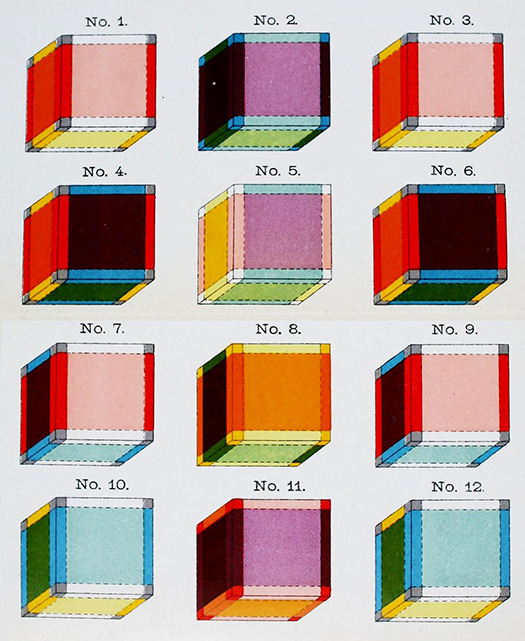
Because we are third-dimensional beings, it is very difficult for us to imagine a fourth-dimensional space or object. Adding to that difficulty is the fact that when we draw geometrical concepts on paper, the best we can create is a two-dimensional approximation. It is hard enough to illustrate third-dimensional solids and space, much less any dimensions higher than that. The bulk of Hinton’s Fourth Dimension, therefore, is devoted to creating representational models of fourth-dimensional concepts, both on paper and also using an assortment of cubes, presumably crafted of wood or cardboard. Just as a cube is the three-dimensional equivalent of a square, the fourth-dimensional equivalent of the cube is a tesseract, in which the boundaries of the cube expand along a fourth axis invisible to our three-dimensional senses. To illustrate this concept, Hinton has come up with a very ingenious but extremely complicated system of color-coding the faces, edges, and corners of cubes that any earnest student, not just a mathematician, can use to visualize the movement of four-dimensional bodies through our three-dimensional space. At the end of the book, Hinton presents an even more complicated scheme for verbally notating all of these geometrical elements, so overly complicated in fact that one questions his sanity.

There is also a philosophical element to Hinton’s study. For thousands of years, philosophers, most notably Plato, have pointed out that we only know as much of the universe as we can learn through our senses, which only give us a limited and distorted view of reality. Plato proposed that there was a truer and higher world beyond our sensory perception. While I’ve always thought of Plato’s dualism as somewhat fantastical, his theories of a higher reality can be scientifically feasible if one accepts the idea of higher geometrical dimensions beyond the third dimension in which we live and perceive. In this book, Hinton questions what evidence of a fourth-dimensional existence we might be able to discern in our three-dimensional world. The movement of electricity, the symmetry of living beings, and the vortex motion of fluids are all phenomena that he proposes might be attributable to fourth-dimensional causes. In one interesting chapter, Hinton uses his fourth-dimensional concepts to make a connection between Immanuel Kant’s theory of experience and Charles Darwin’s theory of evolution. In another passage he posits that our bodies exist in the third dimension, while our souls, having come from a higher reality, are born with innate knowledge of the fourth dimension. This, however, feels like an unwelcome leap of faith in an otherwise mathematical discussion.

Though quantum mechanics as we know it hadn’t been conceived in Hinton’s time, it is interesting to think of how Hinton’s fourth-dimensional geometry could explain some of the strange phenomena of quantum physics, such as quantum entanglement. These days anyone studying higher physics or mathematics likely has to have some understanding of higher-dimensional geometry. To that end, Hinton’s The Fourth Dimension is a foundational text, like the Euclid’s Elements of 4-D space. The Fourth Dimension is often a difficult book to comprehend, but it is an enjoyable read for its commendable intellectual ambition and its precocious audacity.

Views of the Tesseract, showing Hinton’s color-coding scheme. This is the only color illustration in the 1906 edition of The Fourth Dimension.


Figure 76, showing Hinton’s plotting of different views of a four-dimensional tetrakaidecagon.

If you liked this review, please follow the link below to Amazon.com and give me a “helpful” vote. Thank you.

Wednesday, January 26, 2022

The World That Couldn’t Be by Clifford D. Simak


Alien wilderness adventure
I have enjoyed very much reading the series of books recently published by Open Road Media entitled The Complete Short Fiction of Clifford D. Simak. Disappointingly, however, that series was projected to be 14 volumes, but they stopped after Volume 12 in 2017, leaving Simak’s complete short fiction incomplete. I have taken it upon myself, therefore, to track down Simak’s remaining short stories and novellas. The easiest of these to find, because it’s in the public domain and can be downloaded for free from Project Gutenberg or Amazon, is The World That Couldn’t Be. This novella was originally published in the January 1958 issue of Galaxy Science Fiction magazine.


An Earthling homesteader on the frontier world of Layard has discovered that one of the planet’s native species of fauna has been eating his crops. Unwilling to resign himself to the loss of agricultural production, the farmer, Gavin Duncan, decides to hunt down the beast, known as a Cytha. Duncan knows nothing about the Cytha, and details about the creature are concealed from the reader, to be revealed gradually over the course of the story. To help him track down the Cytha, Duncan employs one of Layard’s intelligent native humanoid inhabitants to accompany him on the hunt.

The nature of the Cytha is not the book’s only mystery. As the hunting plot is set in motion, Duncan ponders over another puzzling aspect of Layard’s zoology. All life on the planet, including its humanoids, is sexless, that is to say, genderless. Simak uses the pronoun “it” to refer to Duncan’s traveling companion, despite the being’s intelligence. Duncan and his friend, a sociologist, figure the planet’s creatures multiply through some form of asexual reproduction, but no one has ever seen this happen, so the mechanism of that process remains unknown. Perhaps during his venture into the wild Duncan will find the answer to this alien biological puzzle.


The unusual asexual premise allows Simak to propose an alternative theory of evolution that might exist on a far-off world. Simak is very adept at creating fictional sci-fi worlds, so the speculative concepts he introduces here are interesting food for thought, as is always the case with his work. The story’s grand title is a bit highfalutin, however, because the main attraction to this story is really the hunting of the Cytha rather than its theoretical aspects. The World That Couldn’t Be is primarily just a good, suspenseful, pulp-fiction wilderness adventure story, except that this wilderness happens to be on another world and the object of the hunt is uncommon quarry. As Duncan learns about the Cytha, so does the reader, and Simak skillfully parcels out the clues with a pace that keeps the reader interested throughout. This story would not have been sufficient to sustain a full-length novel, but as a novella it delivers a brisk and entertaining read. This work lives up to the quality of writing one expects from classic Simak sci-fi and succeeds in taking the reader on a brief but intriguing journey to another world.

If you liked this review, please follow the link below to Amazon.com and give me a “helpful” vote. Thank you.

Monday, January 24, 2022

Daredevil, Volume 1 by Frank Miller and Klaus Janson


Promising start to an epic run
Back in the early 1980s when I used to stop by the drug store on my way home from school and pick up random comic books off the rotating rack, it was a special day if I walked out with a Frank Miller issue of Daredevil. At that time, Miller’s tenure on Daredevil was probably the most acclaimed title of Marvel Comics’ prolific output. Marvel’s series of trade paperbacks simply entitled Daredevil reprints this epic run. The volumes in this series are attributed to Frank Miller and Klaus Janson, the latter being the ace inker who finished Miller’s pencil sketches. For many years, the two artists comprised an almost symbiotic duo of comics creation. Volume 1 of this paperback series, published in 2008, reprints Daredevil issues 158 to 172, which were originally published from May 1979 to August 1981.


The book opens, however, with two 1979 issues of Peter Parker, the Spectacular Spider-Man in which Daredevil guest stars, drawn by Miller. Bill Mantlo wrote the story, and there is nothing special about it that merits these issues’ inclusion in this collection. Shortly thereafter, Miller took over the art duties on Daredevil with issue #158, while Roger McKenzie handled the writing. Prior to Miller signing on, Gene Colan was the artist for Daredevil. Colan, an old-school anatomist along the lines of Neal Adams, was one of Marvel’s best artists of the ‘70s. I happen to own Daredevil #157, Colan’s last issue before Miller took over, and issue #158 was definitely a step down in visual impact. Miller and Janson had yet to find their mature style, and the artwork is clumsily sketchy compared to Colan’s beautiful work, but still far better than the average Marvel art of the time. Over the course of this volume, however, one can see a definite positive development in Miller and Janson’s art, going from merely sketchy to deliberately stylized as Miller works his way towards the stark style of his later Sin City series. One area where Miller particularly excels in his Daredevil run is in the depiction of physical combat. More than just Jack Kirby-style splash-and-smash panels, Miller’s action scenes actually look like martial arts as practiced by someone of Daredevil’s superhuman abilities.

Miller didn’t take over the writing of Daredevil until issue #168. Prior to that, mostly in the hands of McKenzie, Daredevil faces off against a string of garden-variety tough guys like the Gladiator, the Mauler, and a rather dull outing against the Hulk. When Miller takes over, he gradually amps up the drama. The introduction of Elektra Natchios as Matt Murdock’s college girlfriend is a rather unimpressive debut, but then Miller introduces Daredevil to the Kingpin, which sets off a multi-issue arc that finally showcases Miller at his finest. The last few issues of Daredevil, Volume 1 are five-star comics that grant an enticing look at things to come when Elektra comes into her own, Stick becomes Daredevil’s mentor, and DD fights the ninjas of The Hand.


Marvel published four volumes in this Miller and Janson paperback series, then gathered them together in an “Omnibus” hardcover edition. The first half of Volume 1 holds it back from greatness, but the second half of the book is definitely a treat for classic Miller fans. Miller’s run on Daredevil is one of the shining moments in the history of Marvel, and this is where it all starts. Although there are no doubt better things to come in Volume 2, even Miller and Janson’s early issues are a substantial cut above typical Marvel fare of this time period.

If you liked this review, please follow the link below to Amazon.com and give me a “helpful” vote. Thank you.