Friday, March 11, 2022

The Black Arrow by Robert Louis Stevenson


Standard medieval coming-of-age adventure
Robert Louis Stevenson is mostly thought of today as a writer of adventure novels for boys, such as Treasure Island and Kidnapped. In his lifetime and shortly after his death, however, he was practically worshipped as a literary god by writers of the Victorian and Edwardian eras like Sir Arthur Conan Doyle, Jack London, Joseph Conrad, and Ernest Hemingway. As a fan of classic literature, including some of the aforementioned writers, I keep hoping to discover some hidden Stevenson gem that merits such praise, but with the exception of Treasure Island and The Strange Case of Dr. Jekyll and Mr. Hyde his appeal has thus far eluded me. The Black Arrow, published in 1888, is another coming-of-age adventure for young male readers. Much like Kidnapped, I found The Black Arrow to be rather mediocre fare with nary a hint of genius in sight. Even Stevenson himself didn’t have a very favorable opinion of this book.

The Black Arrow takes place during the War of the Roses, the 15th century conflict between the houses of Lancaster and York, two branches of the English royal family fighting for the throne. As the novel opens, the forces of both parties are gathering for the Battle of Risingham (a fictional battle, I believe?). Young squire Richard “Dick” Shelton doesn’t have an opinion either way, but his guardian, Sir Daniel Brackley, is for Lancaster, so Dick takes up arms for that side. Before the battle begins, one of Dick’s colleagues is killed by an arrow from an unseen archer. The arrow, colored black, bears a note pronouncing a sentence of death on Sir Daniel and three of his closest cohorts. The note also hints that Sir Daniel may be responsible for the death of Dick’s father, which causes the young man to suspect his benefactor and wonder if he is fighting on the right side of this war.


Soon Dick befriends a young man who is really a girl in disguise, in fact the young woman to whom Dick is arranged to be married. Dick is unaware of his companion’s feminine gender, but it is revealed to the reader in the first chapter or two when it would have been better kept as a surprise. The same can be said for the details of Dick’s father’s death, which would have made a good murder mystery had the villains not been revealed early on. Although punctuated occasionally by brief bloody combat, the plot meanders, and many of its turns are predictable. Unlike Jim Hawkins of Treasure Island, Dick never really emerges as an interesting character, so the reader doesn’t care much about what happens to him. Dick also performs some bad acts over the course of the book, and afterwards expresses remorse, but he never satisfactorily atones for his transgressions enough to impart a sincere moral lesson.


The most interesting aspect of the novel is the appearance of Richard, Duke of Gloucester, who would later become King Richard III. This book will mostly appeal to history buffs interested in the War of the Roses, but everyone else will find it quite confusing to keep track of who’s fighting on which side and why it makes a difference. The characters themselves seem to choose their sides arbitrarily, with little knowledge of what they’re fighting for. After indulging in the romantic glorification of chivalrous carnage for most of the book, even Stevenson briefly points out the pointlessness of a war in which men sought reputation and material gain by fighting for a cause they didn’t even believe in. As a depiction of the Middle Ages, The Black Arrow falls far short of the gold standard set by Sir Walter Scott’s Ivanhoe, and even Conan Doyle’s potboiler novels of medieval times (The White Company, Sir Nigel) make for far more compelling reads.

If you liked this review, please follow the link below to Amazon.com and give me a “helpful” vote. Thank you.
https://www.amazon.com/review/RZXI1CCRXOBXK/ref=cm_cr_srp_d_rdp_perm

Wednesday, March 9, 2022

Extinct Languages by Johannes Friedrich


A concise but not elementary overview of Old World epigraphy
Johannes Friedrich was a German linguist and hittitologist (an expert on the Hittites). His book Extinct Languages is a survey of ancient writing systems and the efforts made in deciphering them. (This is generally called epigraphy, but Friedrich’s translator never uses that word.) Originally published in 1954 as Entzifferung verschollener Schriften und Sprachen, the book was published in English translation in 1957. Friedrich begins his book by looking at “The Three Great Decipherments in the Study of the Ancient Orient”: Egyptian hieroglyphics, cuneiform writing, and Hittite hieroglyphics. This occupies the first half of the book, while the latter half is devoted to brief looks at about a dozen other ancient languages in various stages of decipherment. The book is illustrated with drawings or photographs of each script, and Friedrich explains the techniques employed, successfully or unsuccessfully, in deciphering them.

With the exception of the brief mention of an Indus Valley script and its similarity to writing found on Easter Island, the scope of the book is strictly confined to Southern Europe, North Africa, and the Middle East, ranging from Italy (the Etruscans) to Iran (Persian cuneiform). Friedrich never mentions Native American writing such as that of the Aztecs or Maya. The problems encountered and the techniques used in deciphering the Egyptian or Hittite hieroglyphics, however, are similar to those employed in the reading of the Maya glyphs (see Michael Coe’s book Breaking the Maya Code). Friedrich’s book offers an interesting glimpse into what epigraphers do and how they solve these fascinating centuries-old linguistic puzzles.

Given the broad and brisk coverage of each language, I’m guessing that Friedrich intended Extinct Languages to serve as an introductory text for undergraduate students and general readers. It is definitely accessible to amateur linguists and armchair archaeologists, but it’s not an easy read. In the 1950s, educated people were expected to have some knowledge of Greek and Latin, and Friedrich assumes his readers have that linguistic foundation, making some passages difficult for the average English-language reader of today. One thing I found frustrating is that Friedrich doesn’t provide any key to the Latinization scheme he’s using to transliterate these different writing systems into our alphabet. Perhaps he used a method that was the disciplinary standard for his time, but one unfamiliar with that scheme can only take a guess at the pronunciation of these transliterated words.

Obviously there’s been some progress made in the field since Extinct Languages was published. At the time of writing, the Linear B script from the Minoan civilization of Crete had not yet been deciphered. As the book went to press, however, Friedrich added an appendix describing the promising progress made by Michael Ventris towards reading that ancient language. (For more on that, see John Chadwick’s 1959 account The Decipherment of Linear B.) I’m sure advances have since been made in all of the languages discussed in this book, so Friedrich’s 60-year-old survey of the discipline cannot be considered up-to-date. The advantage to this book, however, is the broad range of languages that it covers. In all cases, if you want to learn how a specific script was deciphered, you’d be better off consulting a text that’s solely devoted to that one language. Friedrich’s overview gives enough of an introduction to each language to allow the reader to decide which topics merit following up with further research. For anyone interested in languages, it will definitely pique your interest enough to want to learn more.
If you liked this review, please follow the link below to Amazon.com and give me a “helpful” vote. Thank you.
https://www.amazon.com/review/RVMXCWFC1V2YI/ref=cm_cr_srp_d_rdp_perm

Monday, March 7, 2022

The Grapes of Wrath by John Steinbeck


Compassionate saga of American refugees
I was one of those kids who didn’t want to read The Grapes of Wrath in high school because it was too long, so instead I wrote my book report on Cannery Row. Over three decades later I finally realize what a bad choice I made by depriving myself of one of the greatest books in American literature. Published in 1939, John Steinbeck’s masterpiece tells the story of the Joads, Midwestern farmers rendered destitute by the Dust Bowl, who head for California in hopes of finding work to start a new life. Steinbeck had previously done research amid the migrant workers in California, resulting in several newspaper articles published in 1936 under the heading of The Harvest Gypsies. The living conditions he observed in the migrant laborers’ camps are vividly reflected in his depiction of the plight of the Joads and their fellow migrants. More than just a poverty sob story, however, the novel is a stirring call for compassion and an affirmation of the resilience of the human spirit.

The Grapes of Wrath is a modernist novel that doesn’t ostentatiously wear its modernism on its sleeve. Stylistically, Steinbeck bridges the gap between earlier workingman’s epics like Frank Norris’s The Octopus and Upton Sinclair’s The Jungle and the comparatively more avant garde writings of Ernest Hemingway and William Faulkner. On the surface, the saga of the Joads is a naturalist peasant epic in the mold of Emile Zola or Jack London’s socially conscious works. Steinbeck portrays the extraordinary drama of ordinary people’s lives with a frank and vividly detailed realism. The story of the Joad clan only occupies roughly every other chapter of the book, however. In between the extensive chapters on the family, Steinbeck inserts brief iconic vignettes of America in the 1930s, focusing on typical experiences of poor, working-class, and migrant laborers, such as the purchasing of a used car or a stop at a roadside diner. These glimpses into American life call to mind the nonfiction interludes John Dos Passos inserted into his U.S.A. trilogy. At times, however, Steinbeck’s vignettes are written in a style almost resembling beat poetry. These digressions from the Joad narrative cleverly broaden the book’s scope to a wider segment of humanity and greatly enhance the visceral experience of the story by reinforcing Steinbeck’s depiction of greed and inequality in America.

One thing that surprised me about the book is that on top of everything else oppressing the Joads, the Dust Bowl isn’t the only natural disaster that Steinbeck introduces into the plot. That seemed a bit unnecessary considering the family already faced plenty of socioeconomic perils, from starvation to class violence. To focus too much on the latter, however, might have resulted in a rehash of In Dubious Battle, which this book is not. The Grapes of Wrath does depict class conflict, but it bears a heavier load of compassion and pathos that elevates it to a more universal and profound tragedy of the human condition.

Though it was written in 1939, the social issues brought forth in The Grapes of Wrath are still relevant today. The Dust Bowl may be a distant memory, but American still has its share of migrant workers, wage slaves, and rampant income inequality. The global economy also ensures that most of us in the developed world exploit the equivalent of Joads in other nations around the world without even being aware of it. Over 80 years later, nothing about Steinbeck’s novel is so dated that it fails to accurately reflect human nature or the brutal socioeconomic reality. This is really a book that every American should read. Even those who can’t sympathize with its “red” message ought to appreciate its superb literary merit. In the search for the “Great American Novel,” I personally would still give the edge to Norris’s The Octopus, but I wouldn’t look askance at anyone who would choose to bestow that hallowed title upon The Grapes of Wrath.
If you liked this review, please follow the link below to Amazon.com and give me a “helpful” vote. Thank you.
https://www.amazon.com/review/R2RQYZIEV0IASC/ref=cm_cr_srp_d_rdp_perm

Tuesday, March 1, 2022

The Remaining Short Fiction of Clifford D. Simak


Not quite “Complete”
Since starting this blog a little over a decade ago, one of my most fortuitous discoveries has been the science fiction of Clifford D. Simak (1904-1988). Born in a small town in Southeastern Wisconsin, Simak worked as a journalist and editor for the Minneapolis Star and Tribune while conducting a successful side career as a fiction writer. A prolific author from the early 1930s to the early 1980s, Simak was named a Grand Master by the Science Fiction and Fantasy Writers of America in 1977. 

In 2015, Open Road Media began publishing the series The Complete Short Fiction of Clifford D. Simak, which aimed to reprint all of his short stories and novellas. The series is edited by David W. Wixon, a friend of Simak’s and the executor of his literary estate. I have really enjoyed reading this series and would recommend it to any science fiction fan. There has been, however, one frustrating aspect to reading this series. Though projected to be 14 volumes, Open Road inexplicably stopped after publishing Volume 12 in 2017, leaving two books worth of stories left unreleased. Tired of waiting for Volume 13, I have decided to take matters into my own hands and track down Simak’s remaining short stories and novellas. Luckily, most of these works are in the public domain and can be read for free if you can find them online. Many of the old science fiction pulp magazines have been scanned by the Internet Archive. The same is not true, however, for other genres of pulp fiction. Below are the results of my best efforts in tracking down what’s left of Simak’s complete short fiction.

Science Fiction

Rule 18 (3 stars)
Short story originally published in Astounding Science Fiction, July 1938
In the 25th century, Earth has a football rivalry with Mars. A coach uses science to find a loophole in one of the league’s hard and fast rules. This is a well-written lighthearted piece, but contains some unfortunate racial stereotypes not uncommon for the 1930s.
Available at the Internet Archive

Clerical Error (2.5 stars)
Short story originally published in Astounding Science Fiction, August 1940
An error by a shipping clerk on Earth leaves a scientific outpost on Jupiter stranded without the precious metal it needs to survive, forcing them to launch a hunt for the element on the planet’s surface. This is a rather run-of-the-mill adventure story that just happens to be set on another planet.
Available at the Internet Archive

Masquerade, a.k.a. Operation Mercury (3 stars)
Short story originally published in Astounding Science Fiction, March 1941
An outpost of Earthmen who run a power station on Mercury have to deal with the local inhabitants, shape-shifting beings composed of pure energy. There’s also some confusing stuff about a “space warp” that just seems unnecessary to the plot, which is essentially a thriller along the lines of John Carpenter’s The Thing.
Available at the Internet Archive

Shadow of Life (3.5 stars)
Short story originally published in Astounding Science Fiction, March 1943
A group of archaeologists is conducting a dig on Mars, where the ruins of a great city are all that remain of an extinct Martian civilization, except for a lingering “Martian ghost.” One of the archaeological team is abducted by an alien and taken to other star systems where an evil is revealed that threatens life on Earth. Admirable for its ambitious story, but it kind of loses steam in the end.
Available at the Internet Archive

Infiltration (4 stars)
Short Story originally published in Science Fiction Stories, July 1943
A midwestern county fair sports a sideshow tent devoted to purported Martian animals. Everyone is sure it’s just a hoax until one of the creatures gets loose. Good old-fashioned monster-movie fun.
Available at the Internet Archive

Lobby (4 stars)
Short story originally published in Astounding Science Fiction, April 1944
A story about atomic power, written before Hiroshima. In the near future, one company has discovered the secret to safe and inexpensive atomic energy. The existing power industries, however, will do everything in their power to keep the new technology from being implemented. Remarkably prescient in its depiction of the political behavior of the oil industry.
Available at the Internet Archive

Mr. Meek Plays Polo (4.5 stars)
Short story originally published in Planet Stories, Fall 1944
Sequel to “Mr. Meek - Musketeer,” 1944
Mr. Meek, bookkeeper turned space tourist, stops for fuel at a Wild Western colony on the ring rocks of Saturn, where he is roped into participating in a “space polo” grudge match. A successful comedic effort in an interesting setting.
Available at the Internet Archive

Limiting Factor (5 stars)
Short story originally published in Startling Stories, November 1949
Earth explorers discover strange planets in another star system. Remnants of a technological civilization are present, including a mysterious planet-sized machine, but no inhabitants remain to tell the story of the beings who left these artifacts behind. The scientists investigate in an attempt to reconstruct the details of the alien culture.
Available online at the Luminist Archives

The Trouble with Ants, a.k.a. The Simple Way (5 stars)
Short story originally published in Fantastic Adventures, January 1951
Eventually incorporated into Simak’s 1952 novel City. Thousands of years in the future, after mankind has left the Earth, the planet belongs to robots, dogs, and other animals, who barely remember the existence of man. In this installment of the City saga, ants also become a major player in the planet’s future. 

The Fence (4.5 stars)
Short story originally published in Space Science Fiction, September 1952
In a future world where all of man’s material needs have been satisfied and work is irrelevant, the biggest challenge to mankind is finding a way to occupy one’s time that fulfills the need for dignity and meaning. An interesting dystopia with a surprising twist towards the end.
Available at the Internet Archive

. . . And the Truth Shall Make You Free, a.k.a. The Answers (5 stars)
Short story originally published in Future Science Fiction, March 1953
In a future in which mankind is just one insignificant inhabitant of a diverse galaxy, an interplanetary team of explorers discovers archaeological evidence of the first humans who left Earth thousands of years earlier. A human member of the team hopes the find will shed light on the glory and purpose of mankind. This story is quintessential Simak, a philosophical reconciling of his interest in futuristic sci-fi and his love for a pastoral Midwestern lifestyle.
Available at the Internet Archive

Shadow Show (3 stars)
Short story originally published in The Magazine of Science Fiction and Fantasy, November 1953
Nine Earth scientists are sequestered on an asteroid, where they search for the secret of creating artificial life. In their leisure hours, as a form of psychological therapy, they participate in a sort of dramatic role-playing game in which they telepathically generate characters onto a screen. Simak never succeeds in making you care about the characters or the play. He manages to maintain the reader’s interest in what comes next, but he takes things too far in the end.
Available at the Internet Archive

Lulu (2 stars)
Novella originally published in Galaxy Science Fiction, June 1957
Humorous story about three space travelers who are held captive when their spaceship/computer falls in love with them. Mildly funny at first, but it goes on way too long.
Available at the Internet Archive

The World That Couldn’t Be (4 stars)
Novella originally published in Galaxy Science Fiction, January 1958
Previously reviewed at Old Books by Dead Guys
Available at Project Gutenberg

The Trouble with Tycho (3.5 stars)
Novella originally published in Amazing Stories, October 1960
The narrator is a prospector on the Moon, where there is a sort of Wild West colony of those who hunt down valuable minerals, as well as lichens with medicinal properties. In addition to the lichens, there is life on the Moon in the form of glittering energy beings who are content to offer themselves as pets for the humans. The story involves a treasure hunt into the mysterious Tycho crater. This is a suspenseful adventure tale, but its fanciful depiction of the Moon seems pretty farfetched for 1960, demonstrating just how little we knew about the Moon before the Apollo missions. 
Available at the Internet Archive

Horrible Example (3 stars)
Short story originally published in Analog Science Fiction, March 1961
Millville’s town drunk is content with being the disgrace of the community, until he saves a couple of lives and inadvertently becomes a hero. The sci-fi aspect of the story is best left unspoiled.
Available at the Internet Archive

A Pipeline to Destiny
Short story originally published in HKLPLOD #4, Summer 1963
Originally published in a rare fanzine, this story was rediscovered in later years, but has only been republished in Russian translation. 
I haven’t been able to find a copy.

Buckets of Diamonds (4.5 stars)
Short story originally published in Galaxy Magazine, April 1969
The narrator, a small-town lawyer, is consulted when his Uncle George inexplicably comes into possession of buckets of diamonds, a valuable painting, and other unusual objects. Although George is accused of theft, no one can figure out where the riches came from or prove that they are not his rightful property. A fun story with some interesting sci-fi twists.
Available at the Internet Archive

Epilog (4.5 stars)
Short story originally published in the collection Astounding: John W. Campbell Memorial Anthology, edited by Harry Harrison, 1973
Eventually incorporated into later editions of Simak’s novel City. Follows “The Trouble with Ants” (see above). Taking place tens of thousands of years in the future, this story reveals the fate of Jenkins, the robot protagonist of City. Read the novel, one of Simak’s best.

The Marathon Photograph (4.5 stars)
Novella originally published in the collection Threads of Time, edited by Robert Silverberg, 1974
A woodsy area in Wisconsin serves as a vacation destination for a small community of professors and writers, but no one knows anything about the inhabitants of one conspicuous lodge. When the caretaker is found dead, however, it launches an investigation into the lodge, where some mysterious artifacts are found. Elements of mystery, horror, and science fiction are entwined into an ingenious story full of intriguing ideas.
Available at the Internet Archive

Non-Science Fiction

Jazz (2.5 stars)
Poem originally published in The Fig-Leaf, December 1922
This brief poem was Simak’s first published literary work. He was 18 years old at the time. The Fig-Leaf was a 32-page booklet published in Lancaster, Wisconsin. Maybe a high school publication?
A copy of the poem (but not The Fig-Leaf) is available online at 
https://www.sffchronicles.com/threads/549645/page-32#post-2152473 (scroll down)

A Bomb for No. 10 Downing
Originally published in Sky Fighters, September 1942
Presumably a World War II thriller. I haven’t been able to find a copy.

Smoke Killer
Originally published in Lariat Story Magazine, May 1944
A Western story. I haven’t been able to find a copy.

The Fighting Doc of Bushwack Basin
Originally published in .44 Western Magazine, November 1944
A Western story. I haven’t been able to find a copy.

Monday, February 21, 2022

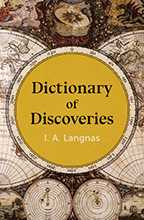
Dictionary of Discoveries by I. A. Langnas


Who’s Who of world exploration
Dictionary of Discoveries
, originally published in 1959, would be more accurately titled Encyclopedia of Discoverers. Author I. A. Langnas (of whom there is little information to be found) has compiled a commendable reference volume chock full of details on history’s greatest explorers, pioneers, cartographers, and conquistadors, from the famous to the obscure. Arranged in alphabetical order, the book is a series of brief biographical sketches on hundreds of historic personages that highlights their areas of exploration and major achievements. Of course, nowadays one can find more information about any of these individuals by looking them up in Wikipedia, but you can’t search for someone you’ve never heard of, which is where this book comes in handy. It is not only a review of the A-list explorers you heard about in elementary school but also introduces the reader to many unfamiliar or forgotten figures. For those who enjoy reading narratives and memoirs of exploration, this book provides a lot of fascinating facts and suggests many avenues for further reading.


The men (and four women) that Langnas profiles in this book run the chronological gamut from the first recorded ancient explorer (Sargon of Akkad, circa 2800 BC) to those active at the time of publication, such as Jacques Cousteau (pioneering undersea explorer) or Leonid Sedov (leader of the team that developed Sputnik). As one might expect, since the Western history of exploration tends to be the history of “the first white guy to go here,” the bulk of the book is populated by Europeans. Langnas, however, does demonstrate a surprising diligence in chronicling adventurers of other cultures as well, including numerous Arab, Jewish, Chinese, and Indian explorers. The discovery of New Zealand, for example, is credited to both the Polynesian traveler Toi-Kai-Rakan (about 1150) and the Dutch explorer Abel Tasman (1640s). When applicable, Langnas does not shy away from mentioning the unheroic aspects of his selections, including cruelties toward the Indigenous.

If you’ve ever wondered who was the first to circumnavigate the Earth (Juan Sebastian Elcano, after Magellan died en route), who discovered Easter Island (Jacob Roggeveen), or who discovered the pygmy hippopotamus (Hans Schomburgh), this is the book for you. For most of the explorers, place of birth and cause of death are provided. The latter category is a continual source of interest, as many explorers were killed by the Natives upon whose lands they intruded, murdered by their fellow conquistadors, or executed for political reasons when they returned home. Unusual ends are often pithily described in blunt detail: e.g. “A mutiny left him a corpse with 49 bullets” (Cornelis Van Aerssen); “Xerxes had him impaled” (Sataspes). Another valuable piece of information Langnas provides is whether the explorer published a narrative of their journey, allowing interested readers to follow up on the book in question. Although the brief sketches in the Dictionary of Discoveries are not comprehensive biographies, they provide just enough information to decide whether you want to learn more about these historic figures and their expeditions.

The book is not free of errors, and much has been learned in the last six decades, so it’s unlikely anyone would cite this book as a reference in a scholarly paper. For the general reader and armchair explorer, however, this is an enjoyable read that reveals many fascinating facts. As one who enjoys reading explorers’ accounts, this book introduced me to many unsung adventurers and generated enough interest to make me want to seek out more information about them.
If you liked this review, please follow the link below to Amazon.com and give me a “helpful” vote. Thank you.
https://www.amazon.com/review/R39BF00WS66GR/ref=cm_cr_srp_d_rdp_perm

Friday, February 18, 2022

Mardi by Herman Melville


Protracted Pacific allegory
Nowadays Herman Melville is best known as the author of Moby-Dick, but in his lifetime he was popularly known as the writer of Typee and Omoo. These two books, adventure memoirs of Melville’s own travels to islands in the South Pacific, established him as a successful author. Melville had higher literary aspirations, however. With his third book he decided to turn away from nonfiction and become a novelist. The result, his 1849 novel Mardi, was poorly received by the critics of his day and is still regarded as one of his least successful efforts.

At first, Mardi seems like just another variation on the plots of Typee and Omoo. The narrator is a crew member on a whaling ship plying the tropics of the Pacific Ocean. Unable to find a profitable population of whales in equatorial regions, the captain decides to head North to the Arctic. Such a journey is not what the narrator signed on for, so he decides to jump ship, accompanied by his new friend, a brawny Nordic fellow named Jarl. After escaping in a small boat, the two figure that if they continue to head West they will eventually run into some tropical islands. The journey is more arduous and protracted then expected. In fact, a quarter of the entire novel is occupied with their wayward drifting before the pair ever reach land. Along the way they encounter a few other characters, but just as the reader starts to get involved with them, Melville pretty much abandons their story line and takes the book in an entirely different direction.


The castaways finally reach an island, where they receive a friendly welcome from the Natives. This island is one of many forming an archipelago the local inhabitants call Mardi. The narrator is given an island name, Taji, and welcomed among the ranks of island kings. Along the way he has found a love interest, named Yillah. Inexplicably, she’s a white woman, probably because the audience of Melville’s day would not have tolerated an interracial romance. One day Yillah disappears, and Taji ventures to the neighboring islands in search of her. This plot development, however, is simply an excuse to send Taji on a Gulliver’s Travels-esque tour of the islands, though the inhabitants of Mardi are not as fantastical as those Gulliver encountered. Rather, Melville uses the various islands to demonstrate various political systems, philosophical beliefs, or moral lessons. One island, for example, is a blatant surrogate for the Confederate States of America. Other islands illustrate the pros and cons of monarchy versus democracy or different denominations of faith. Taji is accompanied on his journey by a handful of local monarchs. At every stop the group engages in spirited philosophical debates reminiscent of Plato’s dialogues.


The text is thick with references to ancient history, classical mythology, and classic literature, all used as metaphors to describe the islanders. Melville also writes in a code of tropical lingo with which the reader must gradually become accustomed. The word “Mardi” is used as a synonym for the world, “Oro” is God, Alma is the name of a Christlike prophet, and so on. Mardi is loaded with beautifully poetic passages of writing, as well as some truly profound thoughts. Each chapter on its own could be studied and quoted for pearls of wisdom, but the cumulative effect of the 195 chapters in total is somewhat of a jumbled mess. Melville just tries to do too much with this novel when he should have spread all these ideas over the course of three or four books. Melville scholars probably love Mardi, because they can no doubt find much insight into the author’s personal philosophy and political views. Most other readers, however, will find Mardi overwhelmingly long, glacially paced, and narratively disappointing.

If you liked this review, please follow the link below to Amazon.com and give me a “helpful” vote. Thank you.
https://www.amazon.com/review/R1T9DUI7O9BOQ7/ref=cm_cr_srp_d_rdp_perm

Wednesday, February 16, 2022

Through the Magic Door by Sir Arthur Conan Doyle


A contagious enthusiasum for classic books
Although Arthur Conan Doyle is primarily known as an author of fiction, he also wrote a couple dozen nonfiction books, most of them about military history or his beliefs in spiritualism and the supernatural. He wrote one book of essays, however, that will appeal particularly to fans of his novels and short stories. That book is Through the Magic Door, published in 1907. Though the title may sound like a children’s fantasy novel, the “door” in question is actually the entrance to Conan Doyle’s personal library. The esteemed author invites the reader into his inner sanctum and introduces him to the most treasured volumes on his library’s shelves.


Unlike a typical work of literary criticism, Through the Magic Door is not only educational but also surprisingly lively and entertaining. Conan Doyle injects witty personal anecdotes into the discussion and occasionally goes off on tangents that are relevant enough to be quite interesting. In addition to a list of Conan Doyle’s favorite books, the reader comes away with an inside glimpse of how those works have influenced the author’s writing career.

Many of the writers covered here are to be expected. Sir Walter Scott and Robert Louis Stevenson, both clearly influences on Conan Doyle’s work, are each given their due consideration. Other chapters are devoted to the usual suspects of the English canon. Thomas Macaulay’s essays, James Boswell’s biography of Samuel Johnson, the diary of Samuel Pepys, and Edward Gibbon’s The History of the Decline and Fall of the Roman Empire are classics that couldn’t go unmentioned in the literary memoir of a 19th-century English gentleman. In addition, however, Conan Doyle brings up some personal choices that are more unfamiliar, at least to the American reader. For instance, he pronounces The Cloister and the Hearth by Charles Reade the greatest historical novel in the English language. (Scott’s Ivanhoe has to settle for second place.) He also extols the merits of George Borrow and George Meredith, the latter of whose novel Richard Feverel is deemed by Conan Doyle “one of the three novels which I admire most in the Victorian era.” Though foreign authors like Balzac, Hugo, Tolstoy, and Melville are mentioned briefly in the text, Conan Doyle mostly reserves his extended discourse for British authors. The exceptions are Edgar Allan Poe and Guy de Maupassant, whom he dubs the greatest and second-greatest artists of the short story.

Conan Doyle doesn’t confine himself to fiction but discusses works of history and science as well. In the former category, he delves as far back as the medieval chronicles of Froissart and de Comines. Having written historical novels on the Napoleonic Wars (The Great Shadow, Uncle Bernac) and medieval times (The White Company, Sir Nigel), it is not surprising that Conan Doyle has a large collection of histories and memoirs pertaining to those eras. Another chapter is devoted to exploration narratives, with an emphasis on Arctic and Antarctic expeditions. The science books he admires also tend to have an element of exploratory adventure to them, such as Charles Darwin’s Voyage of the Beagle and Alfred Russell Wallace’s Malay Archipelago.


I expected to walk away from this book with a short list of recommended readings, but Conan Doyle delivers much more than that. Through the Magic Door was truly an enjoyable reading experience. For the brief length of the book, one feels as if he were Conan Doyle’s personal friend, spending a pleasant afternoon of conversation in the gentleman’s study.

If you liked this review, please follow the link below to Amazon.com and give me a “helpful” vote. Thank you.