A love letter to class inequalityThe English author Walter Besant (1836–1901), though generally not known as a pioneer in the science fiction genre, did publish two novels set in dystopian futures. The Inner House, published in 1888, is one; the other being The Revolt of Man (1882). The Inner House opens with a German scientist calling a press conference in London. He announces that he has discovered a process to stop aging. This means immortality for mankind, at least as far as natural causes are concerned. Those undergoing this process will be frozen at their present age and able to survive for centuries, excepting any fatal accidents.
Flash forward to hundreds of years later. Most of the same characters are still alive. Society (the whole Earth or just England? it’s unclear) is now ruled by a socialist regime governed by an authoritarian intellectual elite, the Holy College. All individualism has been stamped out, all problems have been solved, and a tremendous apathy has settled over mankind. Humans have little interest in doing anything except eating, working, and sleeping. The past has been forgotten, until one young woman starts researching the 19th century. This sparks a small rebellion of disgruntled citizens who want what the past had to offer: individuality, capitalism, and love.
Besant’s intention with The Inner House seems to be a heavy-handed critique of socialism. In that regard, it reads like a precursor to Aldous Huxley’s Brave New World, but without the sense of humor. It’s never convincingly explained how the discovery of immortality would lead to such a bizarre and extreme system of socialism, nor does the apathy and inactivity of the citizens ever seem logical. If they have so much time on their hands, and so little work to do, why wouldn’t they spend that time learning and amusing themselves, or striving for achievements in the arts and sciences? Instead, Besant depicts a very unintentionally cartoony caricature of a socialist society.
These rebels who idolize the past—what do they miss the most? For the women, it’s fancy clothes and shiny jewels. And hey, remember when men used to go off to war and kill each other? That was really cool! The men, of course, miss beautiful women in fancy clothes. What both genders long for more than anything, however, is the beloved British system of inequality. What I hate most about English literature is its relentless reinforcement of an oppressive class system in which one person is born with better “blood” than another. No nation buys into the trickle-down effect of the divine right of kings more than England. Wealthy people are born good and noble. Poor people are born evil. Hard work and education won't save you. Born a servant, always a servant. All Victorian literature endorses this genetic feudalism to some extent, but few authors or novels are as blatant about it as Besant and The Inner House. All of the rebels who so idolize the past are former “gentlefolk” who would no doubt prefer the way things used to be. One of the rebels defiantly scolds the Holy College with “You have made us all equal who were born unequal,” as if that were such a bad thing. (It’s not the “unequal” to which I object, but rather the “born.”) The villain of the novel is a former servant born in poverty, so naturally wicked. The hero is a former gentleman, so naturally virtuous.
Maybe The Inner House was the first novel to show a dystopian future in which individuality was prohibited. Since then, however, there’s been plenty more, and all of them better: Yevgeny Zamyatin’s We (1921), Huxley’s Brave New World (1932), Ayn Rand’s Anthem (1938), and George Orwell’s Nineteen Eighty-Four (1949), to name but a few. Therefore, there’s no reason to read The Inner House. I read it so you don’t have to.
Too ridiculous to succeed on any of its many levelsThe Man Who Was Thursday, a novel by English author G. K. Chesterton, was published in 1908. In the (fictional) London suburb of Saffron Park, two would-be anarchist poets, Gregory and Syme, engage in a snarky debate about anarchy and poetry, in which they essentially accuse each other of being posers. Gregory reveals that he is indeed a true anarchist, and he invites Syme to a meeting of his underground terrorist cell, complete with a basement full of bombs. Syme, in turn, reveals that he is an undercover police detective from Scotland Yard assigned to a special counterterrorist task force designed to thwart the anarchists’ nefarious schemes. As the meeting proceeds, Syme meets the high council of this anarchist ring. Its seven members bear code names drawn from the days of the week: Sunday, Monday, Thursday, etc—hence the title.
Gregory and Syme, the anarchist and the detective, give each other their “word” that they won’t blow the other’s cover or turn the other in to their respective organizations. This is one of those absurd plot twists that Victorian British authors like to work into their stories in order to show off how clever they are and because they’re obsessed with what constitutes a “gentleman.” In reality, an anarchist, in dealing with a mortal enemy, would not consider himself bound by some conventional moral code, and a detective, hopefully, would take the possible loss of thousands of lives more seriously than any adherence to some “gentlemen’s agreement.”
This early plot element is just the start of many instances of ostentatious cleverness that remove the narrative from any semblance of reality. Some scenes in the book are clearly meant to be comical, but overall I’m pretty sure Chesterton intended this to be a suspenseful thriller. Though the novel is subtitled “A Nightmare,” however, it’s so far removed from realism that one can’t take it seriously enough to feel any fear, shock, or thrills from it. In the final two chapters of the book, Chesterton goes in an entirely different direction, abandoning the detective story altogether in favor of a more surreal scenario that seems intended to be profound. There are obvious allusions to God, Satan, Christ, and other Christian imagery, but how it all fits together is a puzzle to me. I don’t feel too bad about not knowing what’s going on, however, because the characters in the novel never know what’s going on either. Something else to note is that there really are no female characters in this book because women apparently don’t factor into Chesterton’s grand Christian-English-gentleman view of the universe.
In summation, The Man Who Was Thursday ostensibly begins as a mystery/thriller about terrorism, but it fails to deliver any thrills. For a while, it ventures into comedy (intentionally or not), but then it ultimately results in some kind of allegory of religious mysticism. It’s quite possible I’m just too lazy to figure this book out, but then again I have little desire to do so when I know the answer is just going to be some Christian sermon. If that’s what Chesterton wants to write about, he shouldn’t dress it up as a detective story. Some literary authorities—Kingsley Amis, Jorge Luis Borges, Michael Dirda—praised this book to high heaven, but I really ended up hating it. It’s just a pretentious and pointless waste of time.
German humor escapes meDespite his Italian-sounding name, Elias Canetti was born in Bulgaria of Spanish and Sephardic Jewish ancestry. Over the course of his life he resided in Austria, Switzerland, Germany, and England and eventually became a British citizen. He won the 1981 Nobel Prize in Literature, a victory claimed by both Bulgaria and the United Kingdom. Canetti wrote his literary works, however, in the German language. His 1935 novel Die Blendung has been published in English translation as Auto-da-Fé and/or The Tower of Babel. The novel takes place in an unspecified European city, though there are a few indications that the characters are speaking German. The term “auto-da-fé” refers to a public punishment inflicted by the Spanish Inquisition, often in the form of burning victims at the stake. Both of the English titles are metaphorical, not literal.
Peter Kien is the Western world’s leading sinologist (scholar of Chinese philology) and the owner of a private library of rare and important books on the subject. He leads a reclusive and regimented life spent mostly within his apartment of four rooms, the walls of which are covered floor to ceiling with books. The first two chapters of this novel start out with great promise. Kien’s intellectual pursuits could possibly serve as the basis for an intelligent and engaging novel. Kien is also an extreme misanthrope who stoically critiques the idiocy of all the human beings he encounters. This dark outlook on mankind also intrigues the reader, who wonders if Kien is just a surly curmudgeon or a potential serial killer.
Auto-da-Fé never lives up to the promise of those first two chapters. It immediately takes a left turn into a slapstick comedy about henpecked husbands and shrewish wives. Like most Nobel laureates, Canetti has received much critical and popular praise. I read several reviews online that made it sound like Auto-da-Fé was not only Canetti’s greatest work but also one of the best novels of the last century. Imagine my surprise, therefore, to find that his novel is terrible! I’m guessing that Canetti was going for an absurdist humor somewhere along the lines of Witold Gombrowicz’s Ferdydurke (1938) or Franz Kafka’s The Trial (1928), neither of which I liked, but Auto-da-Fé is not even absurdist, it’s just asinine. Nor is it the least bit fun. In fact, it is incredibly tedious to slog through insanely long chapters in which the characters grind their way through interminable conversations and capers that amount to nothing. This novel is an even more colossal waste of time than The Tin Drum by Günter Grass, another Nobel-hallowed work of German-language humor that I didn’t get. Late in the book, there is a serious chapter dealing with childhood sexual abuse. It is handled very well, which makes one think that Canetti might actually be a very good writer if he would stay away from comedy.
Perhaps one reason critics and “intellectuals” praise this book is because one of its themes is the love of books. Beyond those first two chapters, however, the books in question are not discussed in any way intelligently. Kien, contrary to his personality and his profession, values all books indiscriminately as if they were just bricks of paper whose contents are irrelevant. Another defiance of logic is the fact that Kien seems to have an unlimited supply of money at hand. If pointless silliness isn’t enough to put you off this book, Canetti also provides many derogatory comments towards women and Jews. Defenders might say, “Those are the characters speaking, not the author.” Canetti himself is of Jewish heritage, so perhaps he’s criticizing anti-Semitism instead of Semitism. However, when three of the main male characters are extreme misogynists, two others are womanizers, the only female character is portrayed very negatively, and the reader has to sit through lengthy sermons about how women are simply evil, isn’t it safe to say the novel itself is misogynistic?
Ridiculous labor novelSo-called radical novels of labor realism were plentiful in early 20th-century American literature, Upton Sinclair’s The Jungle being the most famous example. Published a year earlier than The Jungle, in 1905, The Recording Angel was written by an actual proletariat, Edwin Arnold Brenholtz, who worked as a civil engineer for railroad and mining companies. The story involves a strike at an iron and steel mill in the fictional city of Steelton, Missouri. The title of the novel refers to when one character makes a vow to “the recording angel of God,” which apparently is a thing in Judeo-Christian mythology, but I had never heard the expression before. I enjoy reading the muckraking novels of this period because they provide an interesting look into a time in history when an American socialist movement challenged the trust-holding oligarchs of their day and fought for much-needed reforms (with mixed success). In The Recording Angel, however, the discussion of labor issues is so divorced from reality it’s absolutely bizarre.
For starters, the main reason for the workers’ strike in this book is not low wages or long hours but rather the fact that the management insists upon addressing the laborers by numbers rather than by names. Was that ever really a common problem? And would anyone have cared as long as they had food on the table? Nepotism is another complaint, since the children of the wealthy are granted management positions over more qualified workers. One rich, benevolent stockholder takes the side of the workers and supports them with his financial resources. His son, however, an executive at the mill, is an iron-fisted and abusive employer. Was this really labor’s problem in the early 20th century, that the boss’s son was a jerk? The reasons behind the strike, however, are barely relevant, since the strike hardly plays a role in the plot. Instead, Brenholtz opts for exaggerated melodrama and gives us an attempted murder, a contested will, a blackmailing scheme, and poisonings. The novel also includes a Jules Verne-type science fiction element in the employment of a technological device that would have been brand new and rather rare at the time of the novel’s publication but has now been commonplace for at least a century.
I don’t believe there is a single working-class character in the entire book, just a confusing assortment of lawyers, detectives, politicians, and oligarchs, many of them painted as broadly as a Batman villain. So much of the novel is taken up by interminable conversations between the blackmailer and the capitalist whom he is blackmailing. Chapter after chapter, the blackmailer reiterates the hold he has over his victim. Enough already, we get it. Could you please stop beating this dead horse so we can move on with some semblance of a story? After all that nonsense, the main thrust of the plot climaxes early, which leaves the reader having to plod through half a dozen epilogues.
The word “socialism” is used in this book as a miraculous cure for all societal ills, but The Recording Angel doesn’t actually teach the reader anything about socialism like the works of Upton Sinclair or Jack London do. From reading this novel, one would think that the socialist movement depends on wealthy industrialists who magnanimously decide to bequeath their riches to “the workers’ cause.” The cast of this novel includes at least three such unrealistic benefactors. If that’s what the success of the radical left in America rests upon, then they’ve got a long wait ahead of them before that pipe dream comes to fruition. The Recording Angel is not just a failure within the specific realm of the radical labor novel. It’s an example of bad writing in any genre.
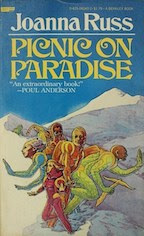
Pointless story about idiots on a camping tripPicnic on Paradise, a science fiction novel by American writer Joanna Russ, was published in 1968. It features a recurring character named Alyx who appears in a handful of Russ’s stories. Alyx is a thief and warrior woman of ancient Tyre (in present-day Lebanon) who was plucked from the past and brought forward by time machine to what would be our future. In this novel, Alyx is assigned by a lieutenant (a lieutenant of what is unclear) to guide several people on a backpacking exercise through the mountainous country of the planet Paradise. None of these people seem to be in the military (two are nuns, for example), so why are they taking orders from a lieutenant? Who knows? The planet Paradise is a nature preserve of sorts, but it is hardly paradisiacal. The mountains are snowy and cold, and the hikers have to face such hazards as freezing to death, falling in crevasses, and attacks by wildlife.
Alyx is the only member of the party who has any experience in this sort of wilderness adventure, and she’s the only one who acts remotely like an adult human being. The rest of the gang behave like children, speak in nonsensical non-sequiturs, and constantly break out crying for no apparent reason. Hardly a page goes by when one of these idiots isn’t weeping. It’s not just the characters that are dumb but the way they are written. Russ’s prose is merely a string of sentences that often make no sense and don’t really belong together in sequence. In the 1960s this might have been seen as creative, but to the intelligent reader of the 21st century it’s just annoying. It’s like listening to a bunch of children in a kindergarten shouting out whatever pops into their heads. The plot doesn’t really go anywhere, and the whole journey seems pointless. If there’s a larger philosophical meaning to this narrative, it escapes me. I question if this can even be considered science fiction because, with the exception of the occasional mention of a raygun or flying machine, it’s really just a camping story, and not a very good one.
I discovered this novel in the Library of America’s collection American Science Fiction: Four Classic Novels 1968–1969. This is the second novel I’ve read from that book, after R. A. Lafferty’s Past Master, and both were just terribly written and utterly pointless. Picnic on Paradise was nominated for a Nebula Award, which makes you wonder about the tastes of such award committees, science fiction critics, and the editors who put together “classic” anthologies. Were the sci-fi literati of that time so hard up for good books that anything remotely “different,” however foolish, is hailed as groundbreaking? I find that hard to believe. Alyx may be a feminist heroine, but doesn’t a feminist heroine deserve a better book than this? Russ may have some decent works in her oeuvre, but this isn’t one of them.
If you liked this review, please follow the link below to Amazon.com and give me a “helpful” vote. Thank you.
Nonsensical take on UtopiaR. A. Lafferty’s science fiction novel Past Master was first published in 1968. I encountered the novel when I purchased the Library of America’s collection American Science Fiction: Four Classic Novels 1968-1969, in which Past Master is included. I’ve come to expect great things from the Library of America, editorially speaking, but in this case I was disappointed by their selection of this work. The editor of the collection talks about Past Master as if it were a seminal work of the science fiction genre, and the book was nominated for Nebula and Hugo Awards, but I just found it terribly annoying, tedious, and pointless.
In the year 2535, on the world of Astrobe, an Earth colony circling another star somewhere in space, a trio of political powerbrokers gather to discuss the fate of their civilization. Astrobe was meant to be a Utopia for humanity, but things aren’t quite working out that way. The prevailing regime on Astrobe faces rebellion from both human and “programmed” (android) inhabitants. What’s needed to save this society is a new leader, a man of honesty and integrity who can inspire Astrobe to keep the dream alive. The Astrobian illuminati have the power to reach back into time and summon forth historical figures from humanity’s past. It is decided that Thomas More, author of the original Utopia published in 1516, would be the best man to lead this new Utopia. Once More is brought to Astrobe, however, not all are in favor of his ascension to the throne, and he faces threats of assassination and enticements toward corruption.
That may sound like a clever premise for a novel, but the result is far less than satisfying. The plot involves some not-so-profound commentary on how Utopias are not all they’re cracked up to be. The drive to implement a universal perfection results in a totalitarian squelching of individuality. Lafferty merely tells us this, however, rather than really showing us through thoughtful narrative and imagery, as do better dystopian novels like George Orwell’s 1984 or Ayn Rand’s Anthem.
The bulk of the book is occupied by whimsical excesses. I guess because this is a science fiction universe, Lafferty thinks that anything goes, with no rules, so there’s no reason to make any sense. The book reads as if the fictional world he’s creating is just made up as he goes along. More is introduced to a motley crew of characters with goofy names, some of whom have special powers—witches, wizards, immortals, transmigrants—with no logical justification. The narration is a tapestry of nonsensical sentences, while the dialogue is a running banter of non-sequiturs. Although there are intentional moments of humor here and there, it doesn’t seem as if the novel is intended as satire. Instead, the prose simply comes across as silly without being funny. Much of the text just seems like unnecessary wordplay, which may have been more palatable in the era of beat poetry but now feels like a waste of time.
Perhaps critics and experts of the genre consider Past Master to be a classic of New Wave science fiction, but I found nothing in it to merit such praise. I prefer sci-fi that has some logic to it, even if it establishes its own logic, rather than just a willy-nilly stream of words that only add up to style without substance.
If you liked this review, please follow the link below to Amazon.com and give me a “helpful” vote. Thank you.
Prof. Challenger betrayed for spiritualist propaganda
Outside of his Sherlock Holmes stories, the most famous recurring character in the works of Sir Arthur Conan Doyle is Professor Challenger, the bearded, blustering scientist who led the expedition to The Lost World. Conan Doyle featured Challenger in three novels and two short stories. Unfortunately, with the exception of The Lost World, none of them are regarded very highly. The Land of Mist, published in 1926, is the third novel in the Challenger series, which follows Challenger’s second adventure, 1913’s The Poison Belt. The two short stories were published later, but I believe they are prequels to The Land of Mist.
One of the things (among many) that makes this novel so disappointing is that Challenger is merely a guest star in this book and only present for small portions of the narrative. The story centers around Ned Malone, journalist and sidekick from The Lost World. Professor Challenger’s daughter Enid Challenger is also a reporter and plays a major role in the story. Malone and Enid are assigned by a newspaper to co-write a series of articles on the spiritualist movement. Though both begin as skeptics, they resolve to keep an open mind while investigating possible paranormal phenomena at a series of seances where mediums claim to receive communications from the dead. (Gee, I wonder if the two reporters will fall in love.) Lord John Roxton, another supporting character from The Lost World, also appears in a couple chapters.
Conan Doyle wrote many works on spiritualism and the paranormal, both fiction and nonfiction. He was a firm believer in the supernatural world and gave pubic lectures on the topic. Sometimes he even managed to craft an entertaining story around the subject, such as in The Parasite. The Land of Mist, however, reads more like one of his lectures than one of his entertaining stories. As Malone and Enid attend more seances and meet more mediums, they become more convinced of the veracity of spiritualist claims. Meanwhile, mediums are being persecuted in London for their beliefs. If they could only convert a confirmed materialist into seeing the truth and beauty of the spirit world, it would go a long way towards popularizing spiritualism for the good of the masses. Thus, Ned and Enid conspire with the spiritualists to convince Professor Challenger to attend a seance where he will see the light and become converted. By following this course, Conan Doyle betrays the integrity of his own character in order to push his spiritualist propaganda.
Conan Doyle was also a church-goin’ man, so he does not view spiritualism as a departure from the Bible. In fact, a few of the ghosts who appear in this story have actually met Christ, and the prophets mentioned in the Bible were nothing but mediums who received messages from the dead. The spiritualists’ belief system, as sketched by Conan Doyle in this novel, is an absurd house of cards built on convenient rationalizations. When a seance fails to achieve results, for example, it is because a skeptic in the room disturbs the energy. In addition to messages from beyond the grave, Conan Doyle asserts physical manifestations such as ectoplasmic apparitions, spirit photography, and poltergeists. Even those who believe in ghosts and TV mediums who speak to the deceased will find many of the Victorian Era spiritualist beliefs to be ridiculous.
Besides all the pseudo-science, this is just a poorly written story, boring for most of its length, that can’t make up its mind whether it wants to be an essay or a melodrama. Conan Doyle presents a dull catalog of dozens of paranormal occurrences he’s read about, which leaves room for only the thinnest of stories, every turn of which is predictable. Although Conan Doyle has every right to write about his supernatural beliefs, he should have left Professor Challenger out of it.
If you liked this review, please follow the link below to Amazon.com and give me a “helpful” vote. Thank you.
https://www.amazon.com/review/R1YHS9EV6DZ9QD/ref=cm_cr_srp_d_rdp_perm
Moronic mystery in Manitoba
 Michigan author James Oliver Curwood specialized in the writing of Northwesterns, a genre comprised of wilderness adventures set in Canada and Alaska. In this genre, Curwood was second only to Jack London in terms of popularity and financial success. His 1910 novel The Danger Trail, however, gives no indication that such success was deserved. This mystery adventure novel set in northern Saskatchewan and Manitoba is an irksomely tedious and witless affair.
After years of hard work, engineer John Howland finally gets his big break when he is hired to manage the completion of the Hudson Bay Railroad. Construction on this railway across Manitoba from Le Pas to Churchill began in 1910, but you won’t learn that from Curwood’s book because it has very little to do with the actual railroad. The novel opens with Howland, a Chicago native, reporting for duty in Prince Albert, Saskatchewan. There he meets a beautiful and mysterious woman named Meleese, a damsel in distress who asks for his assistance. She lures him into the woods, where he is jumped, knocked unconscious, and tied up by a gang of thugs led by a shifty Frenchman named Jean Croisset.
This sort of thing happens to Howland not once but four or five times over the course of the novel. Through chapter after chapter of capture and escape, he occasionally encounters Meleese, who tells him he must return southward, or he will be killed. He repeatedly asks her what she means. Who wants to kill him and why? She refuses to answer, and Howland seems OK with that, as he never presses her enough to get a satisfying response. It is not OK for the reader, however, who has to sit through these monotonous and unproductive exchanges. Howland refuses to run from his persecutors and instead decides to pursue them into northern Manitoba. From there, most of the story consists of altercations between Howland and Croisset in which the two relentlessly threaten each other with “I will kill you,” yet neither manages to make good on his promise.
Howland may be a macho he-man outdoorsman and pugilist, but when it comes to love he is as virginal and ingenuous as any heroine of a Harlequin Romance novel. He falls in love with Meleese at first sight, even though she keeps luring him into deadly traps. There is no conflict between the two characters, no snappy banter or sexual tension. Like a stray lamb, he simply devotes himself to her from the start, blindly and blandly.
Curwood doesn’t seem to realize that there is more to building suspense than simply keeping the reader in the dark. He doesn’t parcel out any clues, so the reader simply has no idea what is going on until all is explained in the second to last chapter. Even that explanation turns out to be a bust when the motivation for all this abduction and violence proves totally pointless. Other than maybe one or two well-written fight scenes, The Danger Trail really has nothing going for it. I have read Hardy Boys mysteries with more complex and intelligent plots.
Curwood has written better books than this, among them The Gold Hunters and The Alaskan. His work is nowhere in the same league with London’s, however, and this book is far inferior to the Northwesterns of Stewart Edward White (The Blazed Trail) or Harold Bindloss (The Lure of the North).
If you liked this review, please follow the link below to Amazon.com and give me a “helpful” vote. Thank you.
https://www.amazon.com/review/R3ULI2SFH91WYF/ref=cm_cr_srp_d_rdp_perm
70 grueling chapters on love and marriage
 |
| Henryk Sienkiewicz |
The novels of Polish author Henryk Sienkiewicz, winner of the 1905 Nobel Prize in Literature, generally fall into two categories. First there are his historical epics, for which he is best known to English-language readers. Among these include Quo Vadis, set in ancient Rome, and his trilogy of Polish war novels: With Fire and Sword, The Deluge, and Pan Michael. Secondly, we have his novels of modern Poland, a category that includes Children of the Soil, published in 1894. Although I consider myself a fan of Sienkiewicz, this is the worst work of his that I’ve ever read. This grueling examination of love and marriage proceeds at a sluggish pace without delivering any profound insight to justify its overly protracted length.
Warsaw businessman Stanislav Polanyetski travels to a country estate in order to collect a debt from his distant relative, Pan Plavitski. Polanyetski, commonly referred to in the text as Pan Stas, vaguely remembers playing on this farm as a child with Plavitski’s daughter Marynia. When he meets Marynia again, he finds that she has grown into an attractive woman. He immediately realizes that he is at an age where he should be thinking about taking a wife, and that Marynia would make a fine one. Through a stupid miscommunication, however, Stas and Marynia end up offending rather than courting one another. Disgruntled at his thwarted romantic dreams, Stas then makes a bonehead business transaction that puts the Plavitskis’ estate in jeopardy, a mistake which he must then spend many chapters trying to rectify. This faux pas feels like a rom-com contrivance designed to put obstacles in the way of a couple that are inevitably meant to be together. Sienkiewicz then introduces a dying child into the story as another contrivance to bring the two closer. What’s worse, upon winning Marynia’s love, Stas immediately starts flirting with other women, making him a difficult protagonist to sympathize with. After a while, even Sienkiewicz seems to grow tired of Stas and Marynia and feels the need to introduce a younger couple whose tortured romance predominates the second half of the book. A large ensemble cast of characters, many of whom feel unnecessary, are on hand to represent varied attitudes toward marriage, adultery, bachelorhood, spinsterhood, widowhood, etc.
One of the most disappointing things about this novel is its title. “Children of the Soil,” coupled with the book’s extensive length, would lead one to believe that this is an agricultural epic, like Knut Hamsun’s Growth of the Soil, for example, or Pearl S. Buck’s The Good Earth. There is nary a peasant in sight here, however. The characters in this book may own country homes and buy and sell fields and forests, but none of them have ever picked up a shovel in their lives. This is strictly a book about rich people’s problems. Over the course of the novel it becomes exhausting to listen to these characters complain about their fluctuating incomes when their idea of destitution is being excluded from a certain social circle.
In English translation, this novel amounts to about 675 tightly packed pages, comprising 70 mostly lengthy chapters. I’ve read very long books before, including a few by Sienkiewicz. He may have seen this as his Anna Karenina, but there is nothing in the story to merit the exorbitant length of this text. Every chapter is overly stretched out and padded with unnecessary filler, making it feel like a colossal waste of time. Those wishing to read one of Sienkiewicz’s works on modern Poland would be better off going with In Vain or Without Dogma. The latter is pretty good, while the former is rather mediocre but certainly better than Children of the Soil.
If you liked this review, please follow the link below to Amazon.com and give me a “helpful” vote. Thank you.
https://www.amazon.com/review/R39OMMCEIAK5V6/ref=cm_cr_srp_d_rdp_perm
Idiotic adventure with unlikable characters
 Rex Stout is best known as the author of the Nero Wolfe detective stories, but he also wrote adventure fiction outside the mystery genre, including his novel Under the Andes, which was originally published in the February 1914 issue of the pulp magazine The All-Story. I’m usually up for a vintage two-fisted adventure from the pulp fiction area, but this novel proved to be a dismally disappointing exercise in idiocy.
The hero of the story is Paul Lamar, a man of the world who is filthy rich for no apparent reason, to the point where he doesn’t think twice about throwing away a million dollars. Paul is so perfect at everything he does and so confident in his manliness he makes James Bond seem humble. He couldn’t possibly make a mistake, which is why he needs a little brother, Harry, who is just as macho as Paul but not quite as smart. They both get mixed up with Desiree Le Mire, a French dancer who alternately serves as femme fatale and damsel in distress. Desiree is obviously Stout’s vision of feminine perfection, which is disturbing. Stunningly beautiful, she behaves like a trashy gold digger, yet inexplicably manages to take high society by storm in every city she travels. Once she and the boys venture away from civilization, Stout has her topless for most of the book. She comes onto both Paul and Harry, and both are dumb enough to adore her.
The trio decide to explore the Andes not for any scientific expedition or rescue mission but rather just to avoid ennui, because they are bored with yachts and casinos. They venture into a cavern where they find the remnants of a legendary lost tribe of Inca who sought subterranean refuge centuries before. What a great premise for a “lost world” thriller! Unfortunately, Stout isn’t at all interested in the former glory of the Inca civilization. Instead, he depicts the Inca’s descendants as having devolved into brutish, ape-like troglodytes too stupid to even speak. Once underground, Paul and Harry proceed at every opportunity to beat and stab the captors who are feeding them, even though they have no escape route or plan for survival. The Inca are so dumb they don’t even recognize a knife until it’s plunged into their chests. Somehow Paul can read an Inca quipu, even though the smartest anthropologists still haven’t figured out how to do it. The book is mostly a maze of indiscriminate caverns and unrelenting spear thrusts, all capped off with one of the most asinine epilogue twists of all time.
Although the story takes place almost entirely underground, Stout gives little consideration to the problem of light. Four or five early chapters take place in total darkness, during which Stout asserts that human eyes can adjust to a total lack of light, then uses that as an excuse to describe subterranean sights in detail as if they were bathed in the light of day. The Inca have lamps in their quarters, which must be inexhaustible because the heroes spend weeks wandering through a labyrinth of uninhabited caverns without any mention of lamps, torches, or fire. Jules Verne or Edgar Rice Burroughs would have come up with some contrivance like phosphorescent rocks, but Stout doesn’t bother to give it any thought.
Even fans of vintage adventure fiction have to admit that the old pulp magazines were filled with a lot of garbage, of which Under the Andes is a perfect example. Despite whatever name recognition Stout may have garnered from his mystery writing, this terrible mess is not worth your time.
If you liked this review, please follow the link below to Amazon.com and give me a “helpful” vote. Thank you.
https://www.amazon.com/review/R102UD3BZXKTX/ref=cm_cr_srp_d_rdp_perm
Lame and tedious mad scientist tale
 Originally published in the April 1953 issue of Other Worlds Science Fiction, Myshkin is a science fiction novel by David V. Reed, who is perhaps best known as a writer of Batman comics in the ‘50s. In this mad scientist tale, the narrator, Lieutenant Henry Bannerman, returns from service in World War II and looks up his former roommate, a man known only as Myshkin. Bannerman finds that his old friend has gone somewhat off his rocker by devoting all his time and energy to the creation of a new invention. Remarkably, the machine that Myshkin has created is, for all intents and purposes, a 3D printer. It scans any object placed within its “cage” and creates a miniature duplicate composed of whatever raw material is fed into the machine. Myshkin goes beyond mere replication, however, pushing the envelope of what this 3D printer can do, until one of his creations gets out of hand and becomes dangerous.
While the basic premise of the novel is fine, Reed takes the story in directions that are merely frustrating and annoying. The book is incredibly poorly written, consisting almost entirely of dialogue in the form of convoluted, pun-riddled Who’s-on-First? routines that go nowhere and aren’t the least bit funny. All the action takes place in two apartments, where a series of unlikable, unfunny characters are constantly and pointlessly entering and exiting, to the extent where it’s difficult to keep track of who is where and what’s actually happening in the story. The cast includes two female characters whose sole purpose is to be sexy and stupid. A large portion of the narrative is given up to a Sherlock Holmes-style locked-room mystery revolving around how and why a bundle of clothes has been moved. Everyone eventually ends up fighting over a chemical compound, the value of which is unclear.
Science is almost entirely absent from this science fiction. The series of events that takes place is nonsensical and asinine. Never is any attempt made to offer an explanation for the fantastical happenings until the very end, where Reed provides a brisk and half-baked wrap-up. Myshkin is a tedious ordeal to read, neither intelligent nor entertaining. Though it was a respect for vintage pulp fiction that led me to read the novel in the first place, Myshkin represents the nadir of the sci-fi produced in the pulp era, a reminder that this was a time when newsstands were crammed with so many fiction magazines that just about anything could get published.
Great playwright, terrible play
 |
| Eugene O’Neill |
Eugene O’Neill, winner of the 1936 Nobel Prize in Literature and highly regarded as one of America’s greatest playwrights, has a good 10 or 12 masterpieces in his body of work. Amidst all the greatness, however, lie quite a few shorter and lesser-known works of variable quality. Fans of O’Neill’s work might derive some pleasure in investigating some of these obscure dramas. You never know what you’re going to get, and the element of surprise adds to the enjoyment. His 1924 play entitled Welded, however, is one case where that strategy definitely does not pay off. This dismal three-acter might just be the lauded playwright’s worst effort.
Welded is the portrait of a marriage between a playwright, Michael Cape, and his actress wife, Eleonore. Given the subject matter, there’s likely an autobiographical component to this story, but one shudders to think what O’Neill’s wife must have done to him to produce this disaster. In the first act, the couple have a vicious argument. Michael has a very romantic conception of what the ideal marriage should be like, and he has little tolerance for any instance when his own wedlock should fall short of this perfect love. Needless to say, Eleonore finds it hard to live up to such unreasonable standards of blissful devotion. Michael is so insecure about their relationship’s imperfections that he is insanely jealous, and the fact that his wife had relations with other men before he met her is something he just can’t deal with. Furthermore, Eleonore’s acting career is built upon the plays that Michael wrote for her, so he has that to lord over her. By the end of the first act, the two are flinging insulting invective back and forth, and the end of their union seems imminent. In act two, man and wife each immediately go out and carry on exactly the way one would expect clichéd representatives of their genders to behave.
Though likely intended to be a deep study of marital dynamics, Welded reads more like the transcript of a role-playing session in couples therapy gone wrong. An inordinate amount of text is taken up with stage directions, all body language and pregnant pauses, to the point where after a while the two leads aren’t even allowed to complete a sentence. They frequently just shout each others names—“Michael!”, “Nelly!”—or their annoying nicknames for each other—“My lover!”, “My Own!” Though O’Neill is known for his realistic depictions of dysfunctional families, this marriage is overwrought with the high-falutin’ histrionics of a pair of pretentious Romantic poets. The most realistic character in the play is a prostitute who unintentionally and thanklessly acts as the voice of reason.
Welded probably would have added up to about an hour on stage. It would take two extremely attractive actors to make that hour tolerable, and to read it off the page is a very tiresome ordeal best avoided. Think of it this way: I read it so you don’t have to.
If you liked this review, please follow the link below to Amazon.com and give me a “helpful” vote. Thank you.
https://www.amazon.com/review/RT48ZFLR2BD3D/ref=cm_cr_srp_d_rdp_perm
Not enough deviation in this derivation
 As a frequent reviewer on Amazon, authors or their representatives sometimes ask me to review their books in exchange for a free copy. This is the first time I’ve ever said yes. I am an enthusiast of all things related to the great American author Jack London, so when Carl Waters’s 2015 book The Call of the Wild Werewolf was brought to my attention, it was difficult to resist. Unfortunately, it has left me wishing I had politely declined.
In London’s original 1903 novel The Call of the Wild, a dog named Buck is kidnapped from Judge Miller’s California ranch and impressed into service as a sled dog in the Yukon during the Klondike Gold Rush. In Waters’s variation on the tale, Buck is the son of Judge Miller. He is likewise kidnapped, and then transformed into a dog by the bite of a werewolf. This anthropomorphizing of Buck is what intrigued me about The Call of the Wild Werewolf, as it seemed like a premise full of possibilities. Once Buck becomes a dog, however, he seems to lose most of his human intelligence and behaves exactly like London’s Buck. It’s unclear what the point was of making this Buck human in the first place, since he’s almost an exact duplicate of his predecessor.
The authors of this novel are listed as Jack London and Carl Waters, and for a good reason. For the vast majority of the book, Waters makes almost no alterations to London’s original text, other than to substitute the word “werewolf” for instances of “wolf” or “dog.” There’s one other change later in the book, involving the substitution of one letter, but I won’t give it away because it’s the only thing that could possibly qualify as a spoiler in this otherwise familiar story. Despite the title, Waters never really explores the werewolf idea. In the book’s second paragraph, we learn that a sort of vampire mafia is responsible for kidnapping humans and turning them into work dogs. What sort of horrific deed do these vampires require of their enslaved werewolf subjects? Delivering the mail! Just like in London’s book!
I wish I could use one of those plagiarism detection software programs to compare the two texts and see how identical they are. I bet at least 95% of this book is London’s original text. Of course, Waters is not a plagiarist and has done no wrong. He can do what he wants with London’s work because it’s in the public domain. But what is the point of publishing a work that contains so little original content? Waters doesn’t fundamentally alter the plot or meaning of London’s original work, and the use of the word “werewolf” in itself is not entertaining. If you want to read a five-star book, read the original The Call of the Wild. Waters’s slight variations to the text are not worth your time, money, or notice.
What makes this derivation even more unnecessary is the fact that someone’s already done a mash-up of Jack London and werewolves, and to far better effect. The Secret Journeys of Jack London is a series of young adult novels by Christopher Golden and Tim Lebbon in which a young London encounters monsters and paranormal phenomena in the Klondike. These books certainly aren’t masterpieces, but at least they’re original. The first volume, subtitled The Wild, is really pretty good and pays clever homage to London’s life and literature. I don’t recommend them wholeheartedly, but The Secret Journeys are certainly more readworthy than The Call of the Wild Werewolf.
If you liked this review, please follow the link below to Amazon.com and give me a “helpful” vote. Thank you.
http://www.amazon.com/review/R3JGXHVCO6MTQ7/ref=cm_cr_rdp_perm
The Ugly American conquers the Himalaya
 The Fighting Fool, a novella by Perley Poore Sheehan, was first published in the July 1932 issue of the pulp magazine Thrilling Adventures. It is one of a series of adventures that Sheehan wrote featuring Pelham Rutledge Shattuck, a character who also goes by the moniker of Captain Trouble. I don’t believe this is the first adventure in the series, at least I hope not, because it alludes to a big, complicated back story that’s almost unintelligible. Shattuck is an American drifter who is kicked out of Russia for reasons too convoluted to explain here. He ends up in the Himalaya, where he stumbles upon a remote village, the inhabitants of which are Tibetan. In short order, Shattuck assumes leadership of the tribe, basically by pointing a gun at someone and demanding it. As is unfortunately all too typical of the pulp fiction of this era, the submissive natives are more than willing to hand over authority to a random stranger with a white face. Of course his coming was foretold by a mystical prophecy, so they bestow upon him the sword of Kubla Khan and worship him as their savior.
Beyond the political incorrectness of all this, it’s just not good storytelling. It’s fun for the reader to see the hero triumph over adversity. When success is just handed to him on a silver platter because he happens to be a macho and savvy American, where’s the fun in that? Later in the story when Shattuck goes into battle, his opponents seem to fall at his feet without much trouble, once again depriving the reader of any thrills or suspense. The purpose of this story seems to be to elevate Shattuck into a position where he will lead an army in his next adventure, but a more difficult and circuitous route to that end would have been nice.
It’s really hard to like a story in which the main character is such a jerk. Shattuck embodies the arrogance and rudeness of the “Ugly American” in a foreign land. Perhaps the best that could be said for him is that he appears to be an equal opportunity jerk, showing no respect for anyone and ordering everyone around regardless of race, color, or creed. The nickname of “Captain Trouble” is self-styled, yet he insists that others call him by it. At other times he adamantly demands they refer to him by his Tibetan name, Shada-khan. “Say it! Repeat it!” Is this obnoxious behavior supposed to be cool? Even by 1932 standards, I find that hard to believe.
Sheehan’s confusing prose doesn’t help the uninspired plot. It’s often difficult to tell who’s getting punched or who’s stabbing whom. Even those who enjoy classic adventure fiction have to admit that a lot of what came out of the pulp era was mediocre at best, and much of it was just plain garbage. Once in a while you come across a real gem that deserves to be reprinted and preserved for posterity, but The Fighting Fool isn’t one of them.
If you liked this review, please follow the link below to Amazon.com and give me a “helpful” vote. Thank you.
http://www.amazon.com/review/R2E3VRRK4A7D03/ref=cm_cr_rdp_perm
Best avoided by even the most avid London fan
 Jack London is primarily known as a novelist and writer of short stories, but during his brief but prolific career he did find time to dabble in poetry, drama, and even film. Given the fame and respect he achieved during his lifetime, one would think the theatrical world would have been clamoring to see this great author’s works upon the stage. Unfortunately for him, however, that was not the case, and none of his efforts for the stage proved successful. London wrote a handful of plays, roughly half of which were based on previously published short stories. Though The Acorn Planter, originally published in 1916, is not one of these recycled stories, it nevertheless provides a rehash of many of the common themes that permeate London’s books.
The cast of the Acorn Planter is composed mostly of members of the Nishinam Indian tribe of California. The core of the allegorical ensemble consists of Red Cloud (the philosopher chief of the tribe), Shaman (who symbolizes religion), War Chief (self-explanatory), and Dew-Woman (representing womankind in general). Eventually the Nishinam encounter the Sun Men, a group of white explorers. Hundreds or thousands of years may pass between acts, but the characters remain the same, that is to say, the archetypal roles are seamlessly filled by the descendants of the characters in the preceding act. The play’s dialogue is almost exclusively written in poetic verse, either in the form of songs or of call-and-response chanting between the aforementioned characters and the chorus of tribespeople.
In The Acorn Planter, London essentially takes an idea that could be summed up in three or four sentences and stretches it out to about a 45 minute play, while adding little emotional resonance to justify such protraction. One can imagine a stage populated with scores of white people dressed in loin cloths, uttering London’s verse in their best stoic Indian voices, to the delight of an equally white audience at some turn-of-the-last-century chautauqua. The main thrust of the play’s message is to once again assert that it was the destiny of the white man to conquer the Native American. The Acorn Planter appends to this argument the added hypothesis that if the Natives had only greeted their white conquerors with love instead of violence, they would not have been massacred. The play’s only redeeming quality is an underlying affirmation that regardless of death and destruction the cycle of life goes on. Sprouting acorns replace fallen oaks, and newborn babies replace their fallen elders.
Unless you are a true completist attempting to read London’s entire body of work, avoid The Acorn Planter at all costs. Even the most diehard London fan won’t find much enjoyment in it. It is probably the least read-worthy piece of literature he ever wrote. Thankfully, The Acorn Planter was never produced for the stage, and after reading it one can see why.
If you liked this review, please follow the link below to Amazon.com and give me a “helpful” vote. Thank you.
http://www.amazon.com/review/R1U11XATJ91Y63/ref=cm_cr_rdp_perm
London’s Worst
 I have been an enthusiastic reader of Jack London’s work for 25 years, and have read about three-quarters of his writings. With the advent of the Kindle, and the easy availability of even his most obscure books, I have set myself the task of finishing his complete works. Never have I regretted that decision so much as when I undertook the grueling ordeal of reading Hearts of Three.
In his introduction to the work, London explains that this book was originally written as the scenario for a film serial by Charles Goddard, and London was hired to write a novelization of Goddard’s story outline. It’s hard to believe that an outline was ever written, for it reads as if London just made the book up as he went along. Though this may be a collaborative work, the reader need not fear that the book may not have enough London in it. This novel certainly bears the inimitable stamp of its famous author, particularly in its ever-present preoccupation with race.
Francis Morgan, a rich New York playboy, bored with the stock market, decides to venture down to Panama to search for the long lost treasure of his dead grandfather. Once he arrives, he meets a long lost cousin, Henry Morgan, a laid back beach comber. The two are the spitting image of one another, distinguishable only by the presence or absence of moustache, a plot device that provides all the entertainment value of a bad Jackie Chan or Jean Claude Van Damme movie. Both men fall in love with the same woman, Leoncia Solano, and the three set off together to find the treasure. By the way, Henry is wanted for murder, and an inordinate amount of time is spent freeing him from the authorities. Not until chapter 13 does the book finally become the sort of Indiana Jones-style adventure story that it purports to be. Eventually the treasure hunt runs its course, and in its final chapters the book devolves into a dull drama about stock trading.
If you were to summarize the action of each of the 29 chapters in two or three sentences, Hearts of Three might sound like an exciting book. Unfortunately, the narrative is horribly clogged up with pointless digressions, inane conversations, and London’s questionable views on race. Each new character is introduced with a racial pedigree, then subsequently defined by the stereotype that accompanies that pedigree. More than one character laments that his bad fortune is the result of being punished by God for engaging in an interracial relationship. Of course, London makes it clear early on that Leoncia Solano is not really Spanish but adopted, thereby rendering it acceptable for the two Anglo-Saxon heroes to woo her. Despite his fascination with race, his knowledge of Panamanian ethnography is a little sketchy. London uses the word “Maya” as a blanket term to encompass all Mesoamerican native peoples. One of the Mayan characters reads a quipu, or knotted string of cords, which was not a Mayan invention at all but rather an information transmittal device employed by the Inca.
London throws a lot of lowbrow slapstick humor into this book in an attempt to make it a crowd pleaser, yet he also wants to make it clear that he’s an intellectual, so he has all the characters speak in flowery, poetic language, with literary references and Yoda-esque syntax. Hearts of Three is easily the worst London book I’ve ever read (though there are still a few out there I haven’t touched yet). The only pleasure one derives from reading this novel is similar to that of witnessing a train wreck, or watching a horrible old movie that’s “so bad it’s good.” Thankfully, this is one film concept that never made it to the silver screen.
If you liked this review, please follow the link below to Amazon.com and give me a “helpful” vote. Thank you.
http://www.amazon.com/review/R2ISJBUM42HIOB/ref=cm_cr_rdp_perm
A dreary dialogue between romance and reason
 The Kempton-Wace Letters, originally published in 1903, is an epistolary novel, meaning it is written entirely in the form of letters between fictional persons. The book is a collaborative work by Jack London and Anna Strunsky, who each write in the guise of one of the two titular characters. Strunsky takes the part of Dane Kempton, an elder poet and man of letters residing in London. The words of Herbert Wace, a young sociologist in Berkeley, California, are penned by Jack London. When Wace informs his mentor that he is going to be married, Kempton expresses dismay that the young man has not waxed more rhapsodically over the merits of his future wife. Kempton feels that marriage should be founded on an all-consuming romantic fervor, while Wace holds the more practical view that marriage should only be undertaken with a well-chosen, compatible mate who will make a good life companion and mother for his children. The book consists of the dialogue between these two gentlemen, Kempton championing romantic love while Wace advocates the importance of reason in forming a successful relationship. Their debate could easily be summed up in a few paragraphs, but London and Strunsky stretch the conversation out to book length for the sole purpose of indulging themselves in flowery language and literary allusion. This exercise in pointless verbosity results in a book only a hundred-year-old poet could love.
Habitual readers of London will recognize some of the familiar Darwinian themes that often show up in his works. Some of his more scientific passages, in which Wace explains love as the end result of millions of years of behavioral evolution, are really quite well-argued. He takes his rampant rationalism too far, however, when he suggests concepts that come uncomfortably close to eugenics, like “when we [mankind] come scientifically to breed the human.” Though at times London’s letters contain a kernel of scientific insight, the contributions of Strunsky are almost unintelligible. Kempton’s arguments for romantic love could charitably be called philosophical, but for the most part are merely sentimental. Kempton responds to Wace’s evolutionary theories with poetic paeans to the love-muse. The two aren’t even speaking the same language, resulting in bewilderment and boredom for the reader.
The two correspondents spend so much time referencing philosophers and poets that only a few fuzzy details are given regarding their personal lives, which makes it even more difficult to care about them or what they have to say. Kempton is described as a father figure to Wace, a former friend of his parents, and possibly his former professor. Wace has a sister, Barbara, who apparently lives in London with Kempton. She is married to a man named Earl, who is so briefly mentioned it’s as if the reader is expected to have prior knowledge of his existence. It’s frustrating for the reader to try to ascertain the ambiguous relationships between the characters based on the sparse, tiny crumbs of information occasionally tossed out by the authors.
In real life, London was in love with Strunsky and proposed marriage to her, though she turned him down. Whether or not a marital collaboration between the two would have been successful is debatable, but the book they coauthored can definitely be declared a failure. Even the most enthusiastic followers of London and his literature will find no pleasure in this tedious book.
If you liked this review, please follow the link below to Amazon.com and give me a “helpful” vote. Thank you.
http://www.amazon.com/review/R2HBL2EDSKYHBI/ref=cm_cr_rdp_perm
Introduces Bewilderment
 This is the second book I’ve read in the Introducing series, having first read the volume on Jean-Jacques Rousseau, which I found to be well-written, interesting, and helpful. The Introducing series promises succinct, in-a-nutshell overviews of a variety of scholarly topics, combining concise text with graphic art. Upon picking up this volume on Kant, I could tell right away the art was horrible and would offer little help in elucidating the subject matter. However, I purchased the book anyway, solely for its text, based on my experience with the Rousseau volume. Unfortunately, Introducing Kant proved to be a major disappointment.
The reason philosophy is not commonly read by the general public is because it utilizes heavy amounts of field-specific jargon that hinders the understanding of the average uninitiated reader. The reason one buys a volume from the Introducing series is to avoid that very jargon. If difficult terminology is necessary, then it should be clearly defined before being implemented. Apparently Christopher Kul-Want did not get the memo. Though Kant’s philosophical writings are notoriously difficult to understand, Kul-Want seems determined to give the master a run for his money. I pity the students of undergraduate philosophy courses who may be assigned this book as a text. The only portions of the book that are clearly understandable are the brief passages offering historical and biographical details. The examination of Kant’s thought, primarily focused on his three Critiques, is rendered in prose that is largely unintelligible. Kul-Want presupposes a knowledge of theory and a familiarity with philosophical jargon on the part of the reader that is inappropriate for this venue.
I’m not qualified to argue with Kul-Want’s conclusions concerning Kant. Perhaps among his peers this book is considered a revelation. The fault here really lies with the publisher. Shame on Icon Books for including this as part of their Introducing series. The purpose of these books should be to summarize and to simplify. Introducing Kant fails its intended audience. The only readers who will understand this book are those who already have a thorough understanding of its topic. The rest of us, hoping for an education on Kant, are left to scratch our heads.
If you liked this review, please follow the link below to Amazon.com and give me a “helpful” vote. Thank you.
http://www.amazon.com/review/R3Q0ZR7M9M372T/ref=cm_cr_rdp_perm