Showing posts with label Hungarian. Show all posts

Monday, May 12, 2025

Fatelessness by Imre Kertész


Impassive account of Nazi concentration camps
Hungarian author Imre Kertész (1929-2016) won the 2002 Nobel Prize in Literature. To this date, he is Hungary’s only Nobel laureate in literature. Kertész’s debut novel Fatelessness, published in 1975, is about a 14-year-old Hungarian Jewish boy and his experiences in Nazi concentration camps during World War II. Although Kertész once asserted that Fatelessness was not an autobiographical novel, the story closely parallels events in the life of the author, who himself at 14 was imprisoned in the same concentration camps as the novel’s narrator. No doubt the vivid descriptions of life and death in the camps is informed by Kertész’s own first-hand experiences.

As the novel opens, the 14-year-old narrator György Köves is living in Budapest with his father and stepmother. The father has just received an order to report to a Nazi labor camp in a few days. The night before his departure, family and friends gather for a goodbye dinner. Everyone, with the possible exception of György, suspects there is a good chance the father may not return from the labor camp, but no one wants to say it out loud. After the father leaves, György gets a work permit for employment at a petroleum refinery on Csepel Island in the Danube. He likes the work well enough, and he’s happy to be employed. One day, however, the bus that shuttles him from Budapest to the island is stopped by police. György and his coworkers, all Jews, are asked to exit the bus and assemble at a nearby holding station to have their papers examined. The workers see this as merely a bureaucratic inconvenience, until they are detained overnight and then informed that they will be sent to a work camp in Germany. They and many other Jews are then packed and locked into train cars for a three-day journey without a drink of water.

The destination is Auschwitz. The narrator is eventually transferred to Buchenwald and then to a third camp named Zeitz. While today those place names inspire horror due to the atrocities committed there, in Kertész’s narrative, the Jewish internees (or at least the teenagers among them) are very unsuspecting of the camps’ ultimate purpose. During his train ride to Germany, György actually looks forward to arriving at a new work camp. Hopefully the food will be good and the beds comfortable. It never appears to bother him that his family doesn’t know what happened to him, and he may never see them again. Perhaps this is an indication of the Hungarian mindset at the time, having been under the yoke of Germany and the Nazis for some years prior. By this time, the Jews were probably accustomed to oppression, but they were not expecting the mass extermination that was awaiting them at the camps. György eludes execution because he is a male of an age suitable for slave labor.

The tone of this novel is oddly unlike any other Holocaust narrative I’ve ever encountered. The overall feeling is one of abject and even bemused resignation. The narrator describes horrible things he’s seen but never expresses horror, outrage, anger, and very rarely fear. He does complain about hunger and pain, but with an emotionless air of weary acceptance. Kertész is not writing a tearjerking drama here; it reads more like investigative journalism. György speaks almost as if he deserved this treatment, or it was a fate he was powerless to resist. Over time this seems to build into a self-criticism by Kertész, most blatantly in the final chapter, that the Jews were somehow complicit in their tragedy by not being outraged enough, by indulging in too much passive acceptance, as epitomized by György. Of course, that’s only my gentile interpretation of Kertész’s intent, for what it’s worth, which might not be much. After reading Fatelessness, however, I understand more than I did before. Kertész’s rather deadpan descriptions of what went on at Auschwitz and Buchenwald hit me with the reality of the concentration camps more powerfully than many of the more overtly emotional Holocaust dramas that I’ve come across.  

Thursday, May 11, 2023

Eyes Like the Sea by Mór Jókai


Portrait of a lady in revolutionary Hungary
Hungarian author Mór Jókai (1825–1904) is a giant in the history of his nation’s literature and played a prominent role in Hungary’s political landscape during his lifetime. His novel Eyes Like the Sea was originally published in 1860 under the Hungarian title of A tengerszemű hölgy. This is an autobiographical work narrated by Jókai himself, in which he tells of his childhood playmate and first love, Elizabeth—also called Bessie—a beautiful woman with “eyes like the sea.” In adolescence, Bessie spurns Jókai’s affections, and each eventually marries someone else. Jókai grows up to be a practicing lawyer, but his real vocation lies in the arts. Though he has some talent as a painter, he achieves fame as a man of letters. The two childhood friends continue to connect over the years, and the book is mainly a chronicle of Bessie’s life through Jókai’s eyes. The author relates details of his literary and political careers, but much of the book is told through Bessie’s voice in a series of flashbacks and anecdotes.

If this book is strictly autobiographical, then one has to feel sorry for Jókai’s wife, who is only mentioned occasionally as “my wife,” while he gushes over Bessie, with whom he is clearly infatuated. Some poetic license seems apparent in the narrative, however, as Bessie’s adventures often read more like fairy tale than fact. Much of the story takes place during the failed Hungarian Revolution of 1848 and its immediate aftermath. Jókai was an outspoken advocate for the rebels, for which he was subsequently persecuted by the Austrian Empire. The war episodes in the book, however, feel overly romanticized, sanitized, and replete with rich people’s problems (Jókai and Bessie being aristocrats). One can imagine people starving and slaughtered in the streets of Budapest, but Jókai chooses to tell us about the troubles Bessie has transferring her funds from one bank to another. As a war novel of two lifelong loves, Eyes Like the Sea bears some resemblance to a Hungarian version of Boris Pasternak’s Doctor Zhivago, with Jókai and Bessie the counterparts of Zhivago and Lara. Jókai’s novel is not anywhere near as well-written as Pasternak’s Russian epic, however. You don’t feel the impact of the war, and you don’t feel much for the (platonic) lovers either.

Over the course of the book, Bessie works her way through several husbands and lovers. I suppose one could see her as a strong woman navigating her way out of necessity through a nineteenth century world restrictive of women’s rights. Mostly, however, she just comes across as flighty and fickle, latching on to any man within reach, often for all the wrong reasons. In his telling of her love life, Jókai puts his heroine into some pretty strange situations, including bizarre episodes of wife-swapping. I would imagine some of these relationships might have been risqué by Victorian Era standards, but to today’s reader they often just seem goofy and unrealistically melodramatic.

I enjoy reading literature of various nations in order to get a sense of different histories and cultures. In this case, however, I felt like I was in over my head. I suspect few English-language readers know much about Hungarian history, and that lack of knowledge will prove a problem here. The reader is expected to have detailed knowledge of the historical events discussed, and even the literary references and the sense of humor are distinctly Hungarian and will be opaque to most outsiders. The English translation by R. Nisbet Bain doesn’t help much. One can overlook such cultural disorientation when the characters are compelling and sympathetic, but unfortunately Jókai doesn’t really accomplish that here.
If you liked this review, please follow the link below to Amazon and leave me a “helpful” vote. Thank you.

Monday, November 14, 2022

Life and Works of Alexander Csoma de Körös by Theodore Duka


Inadequate biography of a fascinating life 
Alexander Csoma de Körös
Alexander Csoma de Körös (1784-1842) is the founder of Tibetology. A Hungarian philologist, he was one of the first Western scholars to venture into Tibet, learn their language, and read their texts. His journey East and his cultural and linguistic studies are really quite fascinating. Unfortunately his biography, Life and Works of Alexander Csoma de Körös by Theodore Duka, doesn’t really do justice to its subject. Due to a lack of concrete information on Csoma, this account of his life is rather boring and repetitive, but it is likely the best source we have for shedding light on the journeys, discoveries, and eccentric personality of this intrepid linguistic explorer.

Born in the town of Körös in Transylvania, Csoma was of Székely origin, a Hungarian ethnic group in Romania. As a young scholar, he decided to research the origins of the Hungarian people. He believed they were descended from the Huns, who came from Asia to make frequent raids into Eastern Europe. This naturally directed his studies Eastward. Today we know that most European languages evolved from a prototypical Indo-European tongue. In his peregrinations Eastward, Csoma was essentially tracing this linguistic family tree backwards to India, where he marked similarities between the Hungarian language and Sanskrit. Eventually he became fascinated with Tibet and Buddhism, and the Tibetan language became the primary focus of his studies and the field in which he made important contributions. Csoma was a gifted polyglot with a facility in many languages, among them Hungarian, Romanian, Greek, Latin, Hebrew, French, German, English, Slavonic, Turkish, Arabic, Persian, Sanskrit, Bengali, Pashto, Hindustani, Marathi, Tibetan, and Russian.


Despite his formidable achievements, Csoma was a very modest man, and didn’t write much about himself or his travels. The result of this is a paucity of information on the man. Duka based this biography mostly on a series of letters, many reproduced verbatim, between Csoma and officials of the English government in India who financed his travels. In these letters, Csoma summarized his studies, much like a professor today might write a grant report to a funding agency. Much of the correspondence discusses the stipend granted to Csoma by the English, some of which he refused to accept. In India and Tibet, Csoma lived a very ascetic existence similar to the Buddhist monks with whom he studied. He resided in small cells, sleeping on the floor, surviving on tea and rice, and devoting all his time to his studies. He seemed to be addicted to self-denial, eschewing not only luxuries but also what most would consider bare necessities, perhaps viewing himself as a martyr to knowledge. Out of gratitude to his English benefactors, Csoma published his research in English, including the first Tibetan-English dictionary.


While the biography feels sparse, one thing Duka does very thoroughly is summarize Csoma’s writings, perhaps too thoroughly for all but Csoma’s peer Tibetologists. About the last quarter of the book is devoted to this extensive annotated bibliography of Csoma’s published research.


I enjoy reading biographies of scientists, explorers, and ethnographers because they allow one to live vicariously through the subject’s travels and discoveries. That’s difficult to do with Life and Works of Alexander Csoma de Körös, because the person in question never shared his experiences of world travel, only his scholarly research. Even so, I’m glad I read this to learn more about this interesting historical figure. Thankfully, I also have a healthy interest in foreign languages, because this book will probably only appeal to those who do.

Wednesday, March 23, 2022

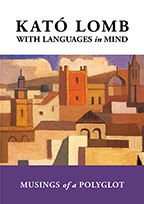
With Languages in Mind: Musings of a Polyglot by Kató Lomb


Meandering, repetitive grab bag on languages and language learning
Kató Lomb was one of the twentieth century’s most accomplished polyglots (a speaker of many languages). Learning languages was her great love, and she did it well enough to work as a professional interpreter in sixteen tongues. Lomb also wrote books on language learning and interpreting, three of which are available for free download as pdfs on the website of The Electronic Journal for English as a Second Language (TESL-EJ). One of those books, With Languages in Mind: Musings of a Polyglot, was originally published in Lomb’s native language of Hungarian in 1983. The contents are aptly described by the subtitle as “Musings.” The book is comprised of 35 chapters, each from one to a dozen pages in length, in which Lomb shares thoughts, anecdotes, and her expert wisdom on languages, their interesting peculiarities, and how to learn and teach them.

This book will appeal to both language educators and language enthusiasts. For members of the latter category (like myself), Lomb does not provide a “fluent in 30 days” wonder scheme for how to learn languages quickly, but she does describe her preferred methods and acquired habits for studying and practicing new languages. She also advises teachers on how her methods could be incorporated into language education to improve student enthusiasm and success. Interspersed throughout the book are humorous anecdotes and horror stories of Lomb’s work as a simultaneous interpreter at various academic and political conferences. There isn’t really much rhyme or reason to the organization of the book; it is just a haphazard pouring forth of linguistic minutiae as the expert pontificates on her love of languages in a lively and for the most part accessible manner. Some topics Lomb discusses include the importance of context in learning vocabulary, the growing tendency in many languages towards the use of more and smaller words, general differences in speech patterns between males and females, and the purported value of learning Latin. To illustrate the points made in each chapter, she often cites examples from the linguistic characteristics of English, German, Hungarian, French, Spanish, Russian, and Japanese.


Lomb wrote her books in Hungarian primarily for a Hungarian audience. Thus the text includes many references, puns, inside jokes, and historical anecdotes that can only be truly understood by a native Hungarian. The English translator Ádám Szegi and/or the editor Scott Alkire explain these Hungarian-specific comments with footnotes, but much of the humor and import of such comments is lost to the English reader. This is an issue common to all of Lomb’s writings, but With Languages in Mind is by far the most Hungarian-centric of the three Lomb books I’ve read (the other two being Polyglot: How I Learn Languages and Harmony of Babel: Profiles of Famous Polyglots of Europe). In regard to her native tongue, some topics Lomb covers include the qualities of Hungarian that make it a beautiful literary language, the effect of the World War II fascist regime on the language, and generational changes in Hungarian over time.


The editor points out that some of the content in With Languages in Mind has either been pulled verbatim or slightly altered from the earlier published Polyglot: How I Learn Languages. Having read Polyglot previously, much of the content of With Languages in Mind did feel like a rehash, though I still enjoyed Lomb’s enlightening linguistic musings the second time around. Of the three Lomb books mentioned above that are freely available in English, With Languages in Mind is the least essential read. The other two books, Polyglot and Harmony of Babel, are more interesting, better organized, and cover more compelling ground.

If you liked this review, please follow the link below to Amazon.com and give me a “helpful” vote. Thank you.

Monday, September 13, 2021

Tales from Jókai by Mór Jókai


Lukewarm Hungarian goulash
Mór Jókai
Mór Jókai (also known as Maurus Jókai) is the Hungarian equivalent of Victor Hugo or Leo Tolstoy. That is to say, he is widely considered his nation’s greatest man of letters, at least prior to the 20th century. Tales from Jókai is a collection of short fiction in English translation by this distinguished Hungarian author. This volume was published in 1904, the year of Jókai’s death. According to the book’s introduction, Jókai published over 300 volumes worth of writings, including over 200 novels. With any artist so prolific, there’s bound to be some masterpieces and some failures among his works. Tales from Jókai is evidence of this, as the seven short stories and two novellas included are an assortment of the good, the bad, and the indifferent.

To open the volume, the editor, British linguist R. Nisbet Bain, provides a pretty extensive biographical essay on Jókai, but the reader practically needs a master’s degree in Hungarian history to understand all of it. Hungary is a nation that has spent much of its history occupied by conquerors, whether the Ottoman Turks of centuries past or the Austrians of Jókai’s lifetime. Life under tyranny is depicted in many of the stories, sometimes even to satirical effect. If any common thread could be said to unite the selections, Jókai seems to have a fascination with concocting creative means of torture and execution, a recurring theme in several of the stories.


Readers hoping that a volume of Hungarian fiction might shed some light on the history and culture of the nation in question may be disappointed to find that few of the selections are actually set in Hungary. Instead, the stories take place in locations as diverse as Ottoman Turkey, the Polish-Lithuanian Commonwealth, ancient Carthage, and the mythical land of Atlantis. Much like Poland’s Henryk Sienkiewicz, Jókai was a romanticist with a taste for fairy tale and fable. The function of these tales is not to serve as realistic historical fiction, but nevertheless some nuggets of European history can be gleaned from the romantic plots. The selections cover a diverse range of genres, including science fiction, fantasy, horror, comedy, and military adventure.


Many of the short stories fail to impress, but luckily the lengthier novellas are more successful in captivating the reader’s interest. In “The Red Starosta,” the book’s best selection, the son of a nobleman and the son of a minister go off to study at a university together. After graduation, the minister’s son is amazed to find how much lowlier is his lot in life is than that of his aristocratic friend. In this entertaining and surprising story, Jókai makes fun of class distinctions, but he ultimately relents in his irreverence to conclude with a socially acceptable ending. The second novella, “City of the Beast,” is an unexpected journey into the realm of science fiction. On a Mediterranean voyage, a merchant from Tyre and his Carthaginian wife are blown off course and land at a pre-sunken Atlantis. Much of the novella is a utopian and/or dystopian description of Atlantean society. With a devout Jew as protagonist, however, Jókai ultimately turns the story into a fable of faith that contrasts the Sodom of Atlantis with the righteousness of Jehovah.


Since this is the first book by Jókai that I’ve read, it’s hard to say how indicative this grab-bag of stories is of his writing as a whole. While the two novellas were pretty strong showings, the collection as a whole is rather mediocre and didn’t really live up to the author’s reputation. If anything, this volume demonstrates that Jókai is more successful in long-form fiction, which would lead me to recommend one skip his short stories and hunt for a masterpiece among his novels.


Stories in this collection
The Celestial Slingers
The Compulsory Diversion
The Sheriff of Caschau
The Justice of Soliman
Love and the Little Dog
The Red Starosta
The City of the Beast
The Hostile Skulls
The Bad Old Times

If you liked this review, please follow the link below to Amazon.com and give me a “helpful” vote. Thank you.
https://www.amazon.com/review/R3KC8H0JZMO0ZA/ref=cm_cr_srp_d_rdp_perm

Friday, August 14, 2020

Harmony of Babel: Profiles of Famous Polyglots of Europe by Kató Lomb


Not quite what the subtitle promises, but still educational
During her lifetime, Kató Lomb (1909-2003) was one of the world’s most renowned polyglots (a master of multiple languages). Languages were not only her passion but also her vocation. After earning a PhD in chemistry, she discovered her love for languages and pursued a successful career as an interpreter and translator, including simultaneous interpreting at scientific and political conferences. She was also an advocate for language learning and wrote four books on the subject. Her last book, Harmony of Babel, was published in 1988. The subtitle Profiles of Famous Polyglots of Europe leads one to believe that the book will consist of biographical sketches of renowned multilinguists, but such profiles comprise less than half the book. The rest is a discussion of languages and language learning techniques similar to the material featured in Lomb’s first book, Polyglot: How I Learn Languages.

Early in the book, Lomb provides biographical sketches of six great polyglots of the past. The best-known is Cardinal Giuseppe Mezzofanti (1774-1849), a Vatican scholar who was famous for his facility with dozens of languages, even though he never left Italy. Mezzofanti gets the most coverage, at 26 pages, while the shortest profile is less than a single page in length. The depth seems to be determined by the amount of information available on each person, which in some cases is pretty scant. Lomb only cites one or two references for each biographical sketch.

The bulk of the book is taken up by Lomb’s “Imaginary Round Table of Polyglots.” She interviewed 21 living (in 1988) polyglots and combined their answers to her list of questions into a sort of mock symposium on linguistics and language learning. Some, like Lomb, work as interpreters and translators, but others include linguists and philologists, reporters, poets, an archbishop, and the grandson of Emperor Franz Joseph von Habsburg. All are European except for one American and one Japanese. Each of these polyglots gets their own introductory profile, and it is fascinating to read how they learned their languages and how they use them. In the mock discussion that Lomb has compiled, they all provide interesting perspectives and tips on language learning, but they agree on very little.

Though her works have been translated into multiple languages, Lomb is Hungarian and wrote the book for a Hungarian audience. Consequently, Harmony of Babel includes an essay entitled “Why Is Language Instruction Ailing in Hungary?” In her writing, Lomb often makes references to Hungarian authors, poets, painters, and politicians, which actually makes the book more interesting to an American reader with little knowledge of Hungary, its history, or its arts and letters. The editor of the English-language edition provides helpful explanatory footnotes when needed. The book ends with a transcript of an interview of Lomb by a Hungarian TV host in which they engage in an in-depth discussion on the profession of interpreting.

A pdf file of this book, and two other Lomb books, can be downloaded for free from the website of The Electronic Journal for English as a Second Language. The primary audience for this book is language educators, but self-educating language enthusiasts will also find much useful wisdom. Given the subtitle, I was disappointed Harmony of Babel didn’t have more biographical information on historic polyglots. It turned out to be more of a miscellaneous grab bag, but I still enjoyed the read and gained a lot of insight into language learning methods.
If you liked this review, please follow the link below to Amazon.com and give me a “helpful” vote. Thank you.
https://www.amazon.com/review/R7J5EMGN3QFEO/ref=cm_cr_srp_d_rdp_perm

Friday, July 3, 2020

Polyglot: How I Learn Languages by Kató Lomb


Anecdotes and tips from a master multilinguist
Hungarian author Kató Lomb (1909-2003) has been called “the world’s most multilingual woman” and “possibly the most accomplished polyglot in the world.” After earning a PhD in chemistry, Lomb taught herself 16 languages well enough to work as a professional translator and interpreter in all of them, including Russian, Chinese, and Japanese. Lomb was also one of the world’s first simultaneous translators (like the ones who talk in the United Nations headphones). After achieving renown as a polyglot (master of many languages), Lomb wrote four books about languages and language learning. Her first book, Polyglot: How I Learn Languages, was published in Hungarian in 1970. An English translation can be downloaded for free from the website of TESL-EJ: The Electronic Journal for English as a Second Language.

The intended audience for Polyglot includes those who teach themselves foreign languages, those who teach languages to others, and those thinking of becoming professional interpreters. I fit into the self-taught category, but nowhere near the level of Lomb’s achievements. This book can be read by language learners of any skill level, even beginners, but one must have an avid curiosity for languages to find it interesting and useful. This book is for people who want to do more than just learn travel phrases, but who actually wish to read texts, have meaningful conversations, and go beyond mere memorization to learn the actual mechanics of a foreign language.


Despite the subtitle, only a few of the chapters really function as a how-to manual for language learning. This book is really a combination of Lomb’s personal anecdotes, learning tips, and educated reflections on languages. Even so, there is still plenty of concrete practical advice for those wishing to learn foreign languages. In addition to her own expertise as a polyglot, Lomb draws upon the work of educators who have researched the most efficient and successful methods of language instruction. First and foremost, Lomb dispels the myth that language learning is easier for children and that adults are too psychologically immutable to learn foreign languages effectively. Not only is she herself living proof that this is incorrect, having acquired almost all of her languages as an adult, Lomb also cites research opposing this assumption. In discussing her personal methods of language learning, Lomb enumerates her “Ten Commandments of Language Learning,” as well as a list of ten “dont’s” of language study. In a brief nutshell, her methods promote the deciphering of books (fiction, for example) over textbook learning, thus emphasizing the acquiring of words and phrases in context rather than memorizing vocabulary lists. Obviously there’s more to it than that, but too much to summarize here. Lomb also offers advice to those thinking of pursuing a career as a translator or interpreter.


Not surprisingly, Lomb credits enthusiasm and time invested as the most important factors for success. She obviously made language learning the most important activity in her life, and one would have to do the same to achieve her level of success. Those wishing to learn one or two languages rather than 16, however, need not be intimidated by Lomb’s methods. There is no panacea for acquiring fluency in an unfamiliar tongue, but Lomb’s insights and practical knowledge will surely prove helpful to readers with more than a passing interest in foreign languages. The advice she offers here is more rational and realistic than so many of the “learn in 30 days” methods on the market. In addition to her linguistic erudition, Lomb writes with a charming personality and sense of humor that makes the book an enjoyable read. I look forward to reading more of her works.

If you liked this review, please follow the link below to Amazon and give me a “helpful” vote. Thank you.
https://www.amazon.com/review/R36S69SGP093J2/ref=cm_cr_srp_d_rdp_perm

Saturday, May 28, 2016

The Scarlet Pimpernel by Baroness Emma Orczy


An archetypal hero, but a so-so debut
The Scarlet Pimpernel, an adventure novel by Hungarian-born British author Baroness Emma Orczy, was published in 1905. It is based on her 1903 play of the same title. The story takes place during the French Revolution. The new Republican government of France is rounding up aristocrats to lop off their heads with the guillotine. Much to the chagrin of these bloodthirsty revolutionaries, a mysterious Englishman has been rescuing those destined for the blade and spiriting them off to Britain where their heads remain firmly attached to their necks. The identity of this daring savior is unknown. He is referred to by the name of the flower he uses as his signature—the Scarlet Pimpernel.

The book kicks off to a great start with the titular hero pulling off some ingenious capers that baffle and infuriate his French antagonists. They never know where or when this master of disguise will show up to snatch potential victims from their clutches. Unfortunately, the book doesn’t maintain this high level of excitement, and drags quite a bit in the middle. Those expecting the sort of swashbuckling one finds in the movie versions will be disappointed. The Scarlet Pimpernel doesn’t actually appear much in the book. He is an elusive legend, always off in the wings somewhere. We know of him mostly through references made by other characters. Though written in the third person, we experience the story primarily from the point of view of Marguerite Blakeney, the French-born wife of an English nobleman, who through plot twists better left unsaid is tasked with discovering the secret identity of the Pimpernel. By 1905 standards, Marguerite may have been a strong and independent female protagonist, but by 21st-century standards, she’s still a damsel in distress. By centering the story around her, Orczy leads the narrative into heavy melodrama. Marguerite spends much of the novel fretting over her marriage, her brother, and the whereabouts of the Scarlet Pimpernel.

Of all the literature set in the French Revolution, this is the most overwhelmingly anti-Revolutionary work I’ve seen. It’s not just about saving people from the guillotine; Orczy is advocating the salvation of the very class hierarchy that spawned the conflict in the first place. She barely acknowledges the Republican cause or the concept of democracy. Orczy, an aristocrat herself, thinks France should have retained the British system where gentleman are born gentleman, servants are born servants, peasants are born peasants, and everyone keeps their place. Such feudalistic conservatism could be overlooked if the novel were fun, but it’s not quite fun enough. The identity of the Pimpernel is truly a mystery at first, but soon becomes obvious. Orczy herself reveals the secret about halfway through. The climactic confrontation between the Pimpernel and his French nemesis is far less exciting than the exploits alluded to earlier in the novel. There’s an intended surprise twist that’s painfully obvious, and the Pimpernel’s success hinges on some unbelievably stupid moves on the part of his pursuers.

The Scarlet Pimpernel is a great character, but his debut novel is merely good at best. Judging from this book, I prefer the adventures of Pimpernel knockoffs like Johnston McCulley’s Zorro or Bob Kane’s Batman. Orczy wrote a whole series of sequels, and I suspect there’s probably a good story among them somewhere. If nothing else, this novel deserves to be praised for the profound influence it’s had on later generations of heroes. For that, fans of adventure fiction owe Orczy a great debt.
If you liked this review, please follow the link below to Amazon.com and give me a “helpful” vote. Thank you.
https://www.amazon.com/review/R2Q7MMTTVMQCJQ/ref=cm_cr_rdp_perm

Monday, November 17, 2014

Stories by Foreign Authors

A series overview
In 1898, the publisher Charles Scribner’s Sons put out a ten-volume series entitled Stories by Foreign Authors. Each book in the series is a collection of four to six works of European short fiction in English translation, focusing on a different country or region. The breakdown of the ten volumes is as follows. All ten books have been reviewed individually at Old Books by Dead Guys. Click on the links below to read the full reviews.

1. Stories by Foreign Authors: French I
2. Stories by Foreign Authors: French II

3. Stories by Foreign Authors: French III
4. Stories by Foreign Authors: German I
5. Stories by Foreign Authors: German II
6. Stories by Foreign Authors: Spanish
7. Stories by Foreign Authors: Russian
8. Stories by Foreign Authors: Scandinavian
9. Stories by Foreign Authors: Italian
10. Stories by Foreign Authors: Polish, Greek, Belgian, Hungarian

Altogether the ten volumes contain 51 stories by 48 authors, providing a broad and varied overview of European literature in the 19th century. The selections are a pleasant mix of household names (e.g. Zola, Balzac, Tolstoy), Nobel laureates (Bjørnson, France, Heyse, Maeterlinck, Sienkiewicz), lesser-known luminaries, and a few writers who have since faded into obscurity. The best books in the series are the French and Scandinavian volumes. The worst volume, by far, is the Russian volume. Though it features four literary superstars, the editors may well have chosen the most boring stories from each. Despite this one disappointment, the other nine volumes each have their own hidden treasures. If you are interested in classic literature—Romanticism, Naturalism, early Realism—this series is a great way to sample and discover new authors you may not have encountered before.

These books are in the public domain and can be read online and downloaded for free at various sources. For some unexplained reason, Project Gutenberg and Amazon do not have the three French volumes, though they do have the other seven. Wikisource has several volumes, including the French:

http://en.wikisource.org/wiki/Stories_by_Foreign_Authors

If you’re intimidated by the thought of reading ten volumes, you don’t have to, because Old Books by Dead Guys has already done it for you! Below is a list of the ten best stories in the series. These are the ones you just can’t miss.

“Christian Gellert’s Last Christmas” by Berthold Auerbach
from Stories by Foreign Authors: German II
When a peasant is touched by a passage of verse, he makes a pilgrimage to a local university to thank the author in person.

“The Massacre of the Innocents” by Maurice Maeterlinck (Belgian)
from Stories by Foreign Authors: Polish, Greek, Belgian, Hungarian
After a farmer is robbed and his wife and daughters killed, the enraged inhabitants of a Belgian village attack the Spanish soldiers responsible for the act.

“San Pantaleone” by Gabriele D’Annunzio
from Stories by Foreign Authors: Italian
When the sky inexplicably turns blood red, a mob of fanatically religious folk seek solace in their priest, their relics, and their superstitions.

“The Necklace” by Guy de Maupassant
from Stories by Foreign Authors: French I
A poor woman longs for the luxury and status of a high-class life. When her husband is invited to a ball by his employers, she sees the chance to live her dream, if but for one night.

“Laurette or the Red Seal” by Alfred de Vigny
from Stories by Foreign Authors: French III
An old soldier recalls a story from his naval days when he captained a ship transporting prisoners to the penal colony of Cayenne, Guiana.

“When Father Brought Home the Lamp” by Juhani Aho (Finnish)
from Stories by Foreign Authors: Scandinavian
When a poor family becomes the first in their town to purchase an oil lamp, it becomes an immediate status symbol, elevating them in the eyes of their neighbors.

“The Philosopher’s Pendulum” by Rudolph Lindau
from Stories by Foreign Authors: German I
After having lived a life of disappointment and heartbreak, a man adopts a personal philosophy by which he expects nothing and therefore feels nothing.

“The Substitute” by François Coppée
A petty criminal, raised in reform schools and prisons, decides to turn his life around, gets a real job, and forms a close bond with a new friend.

“Moors and Christians” by Pedro Antonio de Alarcón
from Stories by Foreign Authors: Spanish
The owner of a historic estate finds an old parchment on his property. He suspects it to be a treasure map, but, unable to read Arabic, he must first have it translated.

“The Railroad and the Churchyard” by Bjørnstjerne Bjørnson (Norwegian)
from Stories by Foreign Authors: Scandinavian
Two close friends suddenly find themselves at odds in a power struggle over local politics. Matters reach a boiling point with the proposal of a new railroad through town.

I have recently learned that this series was a follow up to two previous series published by Charles Scribner’s Sons, Stories by American Authors and Stories by English Authors. Together they add up to twenty more volumes of 19th-century literature, all available for free download from Amazon or Project Gutenberg. Look for them in upcoming posts at Old Books by Dead Guys.


Wednesday, August 20, 2014

Stories by Foreign Authors: Polish, Greek, Belgian, Hungarian by Henryk Sienkiewicz, et al.


The underdogs of European literature
Maurice Maeterlinck
This book is part of the Stories by Foreign Authors series, a ten-volume collection of European short fiction in English translation published by Charles Scribner’s Sons in 1898. While previous volumes in the series were devoted to French, German, Spanish, Russian, Scandinavian, and Italian authors, this book is a mixed bag of stories from the “leftover” nations of Europe. While the countries represented here may not be as renowned for their literature as some of the aforementioned nationalities, these writers prove that they certainly deserve to be regarded alongside their A-list counterparts.

Poland’s Henryk Sienkiewicz is the first of two Nobel laureates featured in the book. His story “The Light-House Keeper of Aspinwall” takes place in a coastal locale near the Panama Canal. When the local light-house keeper dies, a fitting replacement is found in the form of an aged Pole who has adventured far and wide in the world and now longs for a place of repose. The main character is intriguing and appealing, and Sienkiewicz’s prose has rarely been more elegant. The story is very good, though it does fall prey to over-sentimentality towards the end.

Next up is Greek author Demetrios Bikélas with “The Plain Sister.” Out of gratitude for a friend, a bachelor professor considers marrying the eldest daughter of a merchant, thereby clearing the way for his friend to marry her younger sister. This is a light-hearted story that’s pretty predictable from beginning to end, but the reader will be charmed by the likeable characters and touching moments of humor.

Belgium is represented by two authors, the first of which is Nobel Prize winner Maurice Maeterlinck. Nicknamed “the Belgian Shakespeare,” Maeterlinck is known as a poet and dramatist, but here he proves to be an excellent fiction writer as well. His story “The Massacre of the Innocents” is by far the most powerful in the book. In the Flemish village of Nazareth, a cycle of violence and retaliation escalates between the Belgian villagers and their Spanish conquerors. It’s a brutally realistic and heartbreakingly tragic tale of terrorism in the age of sword, pike, and torch. In the second Belgian entry, “Saint Nicholas Eve” by Camille Lemonnier, a poor Flemish boatman and his family celebrate the titular holiday. The scene is so blissful and picturesque the reader can’t help but suspect that an unexpected tragedy will darken the mood. This has the makings of a good story, but something seems to have been lost in the translation, as scenes that should feel emotionally charged end up coming across as awkward and clumsy.

The book concludes with “In Love with the Czarina,” by Hungarian author Maurice Jokai (or Mór Jókai, in his native tongue). It is based on the true story of Jemeljan Pugasceff (a.k.a. Yemelyan Pugachev), a Cossack who falls in love with Catherine the Great. After her husband Czar Peter III dies, Pugasceff ignites a rebellion in an attempt to capture the crown of Russia and take her for his bride. This story is reminiscent of the military epics of Sienkiewicz, such as With Fire and Sword. Though it starts and ends well, in between it grows a bit tedious with the minutiae of troop movements.

Stories by Foreign Authors is a great series that brings to light quite a few authors of a century ago that are largely forgotten today. While the classic fiction of France and Russia still enjoys a large English-language audience, this volume reminds us that there are treasures of European literature to be discovered off the beaten path as well.


Stories in this collection
The Light-House Keeper of Aspinwall by Henryk Sienkiewicz 
The Plain Sister by Demetrios Bikélas 
The Massacre of the Innocents by Maurice Maeterlinck 
Saint Nicholas Eve by Camille Lemonnier 
In Love with the Czarina by Maurice Jokai 

If you liked this review, please follow the link below to Amazon.com and give me a “helpful” vote. Thank you.
http://www.amazon.com/review/RS2LPO3MV5QO2/ref=cm_cr_rdp_perm