Showing posts with label Prairie Print Makers. Show all posts

Monday, December 12, 2022

Norma Bassett Hall: A Catalogue Raisonné of the Block Prints and Serigraphs by Joby Patterson


American master of the color woodcut
American artist Norma Bassett Hall was born in Oregon, educated in Portland, Chicago, and Scotland, and lived and worked in Kansas and New Mexico. She and her husband Arthur W. Hall were founding members of the Prairie Print Makers, a printmaking society based in Kansas. His medium of choice was etching; hers was the color woodcut. Through the influence of British teachers, Norma learned the traditional Japanese techniques of the art form and become one of the true masters of the medium in North America, along with California’s Frances Gearhart, New Mexico’s Gustave Baumann, and Canada’s Walter J. Phillips. Hall’s exceptional body of work is on impressive display in the book Norma Bassett Hall: Catalogue Raisonné of the Block Prints and Serigraphs by Joby Patterson, published in 2014 by Pomegranate Books.


Norma created her first relief prints in 1922 as part of a collaborative portfolio with Arthur entitled Some Prints of Cannon Beach, in which both artists depicted the scenery of the Oregon coast. Many of Norma’s early prints, however, were inspired by her travels in Europe, most notably images of the towns and countryside of France. By the time of the Great Depression, regional realism became a prominent movement in American art, and Norma and Arthur both concentrated on the landscapes of Kansas and New Mexico. It was in New Mexico that Norma began to work in serigraphy, or silkscreen printing, another medium in which she excelled. The Halls became active members of the art scenes in Santa Fe and Taos, as both printmakers and teachers, although, as Patterson explains, by the time they arrived in the Southwest the New Mexican art scene was already waning. By the end of their careers, the sort of representational art that the Halls were making, influenced by impressionism and Japanese prints, had fallen out of favor as more abstract modes of expression became fashionable. Perhaps it is for this reason, as well as the fact that she never lived and worked in America’s major urban art centers, that Norma’s superb prints aren’t better known. For art lovers who appreciate the landscape art of the regional realist period, this book stands as a testament to the enduring beauty, aesthetic sophistication, and superb craftsmanship of her art.

I’m a sucker for a catalogue raisonné. As an amateur printmaker myself, when I buy a book on a printmaker, I like to see as many prints as I can, preferably an artist’s entire output if possible, even if the images are postage-stamp size. This catalogue raisonné does display a career’s worth of those little images, but it also delivers plenty of full-page reproductions as well, all in full-color when applicable (Norma also did some black and white prints). The biography is equally rewarding. Though her work was highly esteemed by her peers, Norma was not a household name nationwide. It’s often difficult to dig up information on such lesser-known artists, but Patterson has clearly done her homework and turned over all the right stones. This book provides a satisfyingly comprehensive retrospective of Hall’s life and work that does justice to the memory of this unsung master artist.


I greatly appreciate this book both as a print enthusiast and as a Kansan. In my modest collection of books on printmakers, I would consider it one of my most valued volumes. For those interested in color woodcuts, particularly the American manifestation of the art form, this is really an essential portfolio of images. Within the same area of interest, I would also recommend the book Gustave Baumann: Nearer to Art and any book you can find on the Canadian master Walter J. Phillips.


If you liked this review, please follow the link below to Amazon.com and give me a “helpful” vote. Thank you.

Prints by Norma Bassett Hall


Gattières - France


Old Sycamore


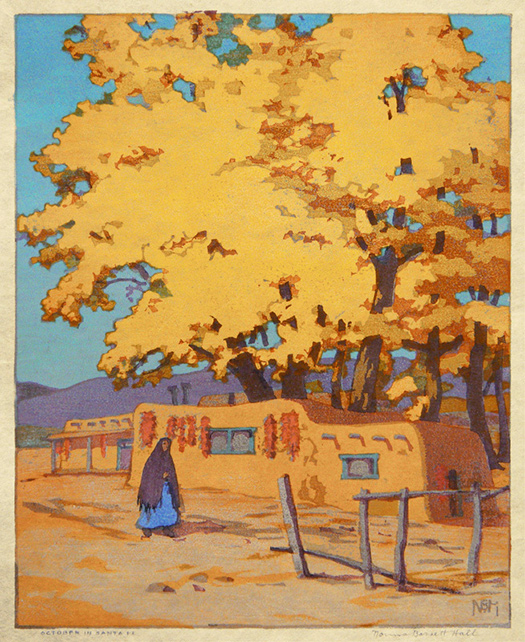
October in Santa Fe

Friday, May 27, 2022

The Prairie Print Makers by Karal Ann Marling, Elizabeth G. Seaton, and Bill North


Just the gift prints
The 2001 book entitled The Prairie Print Makers was published in association with a traveling exhibition of prints curated by ExhibitsUSA, a program managed by the Mid-America Arts Alliance, headquartered in Kansas City. The Prairie Print Makers was an organization founded by ten Kansas artists in 1930 for the purpose of staging exhibitions of prints and promoting graphic arts in the media of lithography, etching, and relief prints. The group eventually grew to include over 100 artists from all over the United States and Canada, including some of North America’s finest printmakers. The majority of its members produced art in a realist or regionalist style, with landscapes, nature studies, and images of rural life being common subjects.

The text of this book consists of three short essays by cultural historian Karal Ann Marling and art historians Elizabeth G. Seaton and Bill North. The latter two are both curators at the Beach Museum of Art at Kansas State University. In addition to providing a very brief overview of the group’s formation and its activities, the essays provide some insightful context on how the Prairie Print Makers fit into the American art scene of their time, growing out of a need for inexpensive art during the Great Depression, and how they eventually disbanded as abstract expressionism rose to prominence.

In addition to active members (the artists invited to join the group), the Prairie Print Makers had associate members. These were not artists but rather patrons and supporters of the arts, print collectors, and so on. In exchange for a modest annual membership fee, these associate members would receive a gift print each year. The Prairie Print Makers produced 34 of these gift prints from 1931 to 1965 (they skipped 1963), usually printed in editions of 200. The exhibition by ExhibitsUSA consisted of these 34 gift prints, and that is what is illustrated in the book. Each gets a full-page reproduction. Four are color prints, the rest black and white. Seeing all the gift prints assembled in one location is nice, but it’s kind of a lazy way to put together an exhibition on the Prairie Print Makers. A few of the gift prints were made by artists who clearly were not among the organization’s best. There are also examples of great artists turning in merely good work, sometimes not in their medium of expertise. One matter I’ve never found explained, in any source on the group, is how these gift prints, and the artists who made them, were chosen. Other than a concerted effort at variety in subject and style, there seems to be no rhyme or reason to the selection. Was it a competition, or did the board just delegate an artist to do the job each year? If the latter, on what basis were they chosen?

Each gift print is accompanied by a short write-up, mostly consisting of biographical information about the artist. One of the most valuable aspects of this book is that it lists bibliographical references for most of the artists whose work is included in the volume, which brings the reader’s attention to some sources that are more informative than this one. Though Seaton’s and North’s essays are pretty good, the brief text of the book provides only the barest-bones overview of the Prairie Print Makers. A more thorough and attractive introduction to the Prairie Print Makers is the 1984 book of the same title by Barbara Thompson O’Neill, George C. Foreman, and Howard W. Ellington. It goes into much more detail on the formation of the group and the careers of its founding members, and the images chosen for reproduction are among the best works of some of the more important artists in the group.
If you liked this review, please follow the link below to Amazon.com and give me a “helpful” vote. Thank you.
Prints reproduced in the book


Birger Sandzén, A Kansas Creek, lithograph, 1931


Norma Bassett Hall, La Gaude – France, color woodcut, 1943


Luigi Lucioni, Theme in White, etching, 1955

Thursday, May 19, 2022

In the Middle of America, Printmaking and Print Exhibitions: C. A. Seward and Friends, Wichita, Kansas, 1916-1946 by Barbara Thompson


Kansas’s impressive legacy of graphic art
When you think of important and influential art centers in America, chances are Kansas doesn’t pop into your head. In her 2013 book In the Middle of America, however, author Barbara Thompson reminds us that the city of Wichita was a thriving center of printmaking in the early 20th century. Thompson, an independent art historian, is also the granddaughter of C. A. Seward, an accomplished printmaker who was the driving force behind the Wichita arts scene and its particular interest in printmaking. Seward, a founder of the Prairie Print Makers and its most active member, organized many print exhibitions in Kansas and facilitated the exchange of prints and printing knowledge between Kansas printmakers and artists elsewhere in the United States and Canada. In the Middle of America, Printmaking and Print Exhibitions is the joint exhibition catalog for four concurrent printmaking exhibitions held in Wichita in 2013. In this book Thompson provides a wealth of detail on the history of the Wichita arts community and Seward’s activities to advance and promote art in the media of lithography, etching, and block prints.

In conjunction with his involvement in the Prairie Printmakers and the Wichita Art Association, Seward assembled a series of print exhibitions in Wichita from 1921 until his death in 1939. Thompson catalogs the prints that appeared in these exhibitions and discusses the artists, inside and outside of Kansas, who made them, including some of the most highly regarded printmakers in America and Canada at the time. In addition to an overall history of the regional printmaking movement in Kansas, Thompson provides biographical sketches of 79 printmakers and examples of their work. These biographies are not comprehensive but rather emphasize the artists’ connections to the Wichita arts scene. Thompson also looks into the impact made on American printmaking by the Western Lithograph Company, a commercial printer that, under Seward’s direction, diversified into producing prints by fine art lithographers.

Thompson’s writing is very informative and her research extremely thorough. The design of the book, however, is not great. It looks like it was typeset in Microsoft Word, and the long lines of Times Roman are not easy on the eyes. Instead of full-page photos, this book opts for many smaller images, around 1.5 x 2.5 inches each. I’m fine with that decision, because it provides more prints to view, but the way all the images are shoved into the gutter of the book does not make for comfortable browsing.

If you are looking for an introduction to the Prairie Print Makers, filled with big beautiful pictures, this is probably not the book for you. You would be better off reading Thompson’s 1984 book with George C. Foreman and Howard Ellington entitled The Prairie Print Makers, or the 2001 book of the same title authored by Bill North, Karal Ann Marling, and Elizabeth Seaton. In the Middle of America is a book for those who already have some prior knowledge of Kansas’s great printmaking history and are looking for more intricate and arcane details, of which Thompson amply delivers. This book will appeal to a very particular audience of readers: artists and collectors who appreciate realistic early modern printmaking and Kansans and Wichitans interested in the history of their state and/or city. Readers like me who fit into the specific intersection point of that Venn diagram will enjoy this book very much and find it loaded with valuable information.

Prints reproduced in the book


Lloyd C. Foltz, Among the Mines, block print, 1931


Birger Sandzén, Utah Poplars, lithograph, 1930


Gustave Baumann, Mountain Pool, block print, 1922

Tuesday, May 3, 2022

C.A. Seward: Artist and Draughtsman by Carole Gardner, et al.


Middle America’s printmaker extraordinaire
Born on a ranch in sparsely populated central Kansas, Coy Avon Seward (1884-1939) grew up to become one of his home state’s most accomplished artists, achieving national and international acclaim. Printmaking was his medium of expertise, and he also worked professionally in the printing and graphic arts industries. Not only was Seward a founding member of the Prairie Print Makers, he was the guiding force behind the organization’s formation and its operations over the first decade of its existence. Seward exhibited his lithographs, etchings, and block prints in America and Europe and received many awards for his work. The book C.A. Seward: Artist and Draughtsman was published by the Spencer Museum of Art at the University of Kansas as the catalogue to their exhibition of Seward’s prints in 2010.

The book contains two biographical essays on Seward. The first is written by three of his grandchildren: Carole Gardner, Barbara Thompson, and David Thompson. Barbara Thompson, under the name of Barbara Thompson O’Neill, previously wrote the book The Prairie Print Makers, which although brief is probably the best available overview of that group’s history and a beautiful little book to boot. I don’t know if she is a professional art historian, but she writes like a good one. Seward’s three grandchildren have compiled a very comprehensive chronicle of the artist’s career that also shows revealing insights into his generous and enthusiastic character. Seward was not only a great artist but also very active in many arts organizations, staging print exhibitions, and teaching and promoting other artists. Reading about his career in the early 20th century makes one nostalgic for the days when representational landscapes were better appreciated and successful careers were built on talent, hard work, and goodwill among fellow artists.

The second essay is by Spencer Museum curator Kate Mayer. Unfortunately, much of her chapter repeats what was in the first essay. That’s not a criticism of her writing but rather the fault of whoever edited the book. More attention should have been paid to avoiding redundancy.

Among the appendices is a catalog raisonné of all of Seward’s prints, though it is brief and only states the most basic data like title, date, and size. Not all of his 171 prints are pictured in the book, but more than 150 of them are. The most (and perhaps only) disappointing aspect of Seward’s superb body of work is that he only made a dozen block prints. From those few examples (including the gorgeous book cover), it is evident that he was a master of the linocut, at least in regards to landscapes. One can only wish that he had made more of these beautiful relief prints, but he preferred lithography and etching, and excelled at both.

The Spencer Museum of Art consistently produces books of very fine quality, and this publication is no exception. Seward’s prints look fabulous in these pages, and any fan of his work should seek out this book, which can be viewed for free online at the Spencer Museum’s issuu site. The prevailing history of art in America tends to stress that all worthwhile accomplishments were made within the creative spheres of New York, Chicago, or Los Angeles. However, there is a whole other history of exceptional artists who excelled in every corner of America, particularly during the heyday of regional realism. Seward is one such lesser-known modern master, and this lovely and well-executed book is a testament to the fact that talented artists on the Great Plains could compete with their big-city brethren.
If you liked this review, please follow the link below to Amazon.com and give me a “helpful” vote. Thank you.

Prints by C.A. Seward


Mountains and Desert, lithograph, 1929


Land of Mystery, linoleum cut, 1930


Washerwoman’s Alley, etching, 1932

Wednesday, March 6, 2013

Birger Sandzén: An Illustrated Biography by Emory Lindquist


A befitting monument to Kansas’s greatest painter
Birger Sandzén (1871-1954) is widely regarded as the preeminent artist in the history of the state of Kansas. Born and educated in Sweden, he emigrated to America in 1894 to accept a teaching position at Bethany College in Lindsborg. He taught there for over 50 years, and remained in Lindsborg until his death. He had a profound impact on the development of the arts in Kansas, yet his influence spread far beyond the borders of the state. He produced a prodigious output of paintings and prints which were exhibited both nationally and internationally.

Despite its subtitle, this volume is not a biography in the traditional sense. It is a retrospective tribute in which biography plays a small part. The events and accomplishments of Sandzén’s life are not related chronologically, but rather organized thematically into a series of essays. The first three chapters are biographical in nature, but successive chapters focus on individual aspects of his career such as teaching method, travel, family and friends, painting technique, printmaking, critical response to his work, and the establishment of the Birger Sandzén Memorial Gallery at Bethany College. In the treatment of his subject, author Emory Lindquist is relentlessly laudatory. He has not come to bury Sandzén, but to praise him. From reading this book one would suspect that Sandzén never committed a sin, no one ever had anything bad to say about him, and the only hardship he ever faced was death itself. Two mind-numbing chapters of excerpts from exhibition reviews cite heaps worth of adulation, garnished with less than a handful of sentences even remotely critical of the artist’s work.

Nevertheless, I enjoyed this book in spite of its lack of objectivity. What Lindquist does well is capture Sandzén's infectious excitement and enthusiasm for art and education. Despite isolating himself in a remote outpost on the prairies, Sandzén managed to execute works of art that rivaled those produced in the great art centers of the world and earned the respect of critics worldwide. Though he devoted himself to interpreting the landscapes of Kansas, the Rocky Mountains, and the Southwest, he never became an American regionalist painter. He built his own individual style upon a tripod of Nordic traditions, French impressionism, and German expressionism. Sandzén brought high artistic and intellectual standards to a small town in central Kansas, and with the help of friends and colleagues established at Lindsborg his own little Parnassus on the Plains.

This volume is heavily illustrated with both historical photos of the artist and pictures of his work. To those unfamiliar with Sandzén’s art, his painting style could best be described as a combination of Van Gogh with a fatter brush and Monet on steroids. No printed page could ever do justice to Sandzén’s brilliant colors, but the 49 color plates included here succeed admirably. The 26 black and white figures reproduce his prints and drawings absolutely beautifully. In addition to presenting a lovely gallery of the artist’s work, this book is the most authoritative resource we have on Sandzén and his inspiring accomplishments as an artist and educator. For that, it is a book to be respected and treasured.


Landscape with Four Trees, 1920, oil on canvas, 35.625 x 47.75"

Hour of Splendor, Bryce Canyon, Utah, 1928, oil on canvas, 80 x 60"


Republican River, 1945, linoleum block print, 16 x 12"

For more information on Birger Sandzén, and more images of his work, see the web site of the Birger Sandzén Memorial Gallery at Bethany College in Lindsborg, KS: http://www.sandzen.org/

If you liked this review, please follow the link below to Amazon.com and give me a “helpful” vote. Thank you.
http://www.amazon.com/review/RB8FB0O8YNQTH/ref=cm_cr_rdp_perm

Monday, March 26, 2012

The Prairie Print Makers by Barbara Thompson O’Neill, George C. Foreman, and Howard W. Ellington


A fine tribute to Kansas’s greatest artists
This beautiful little volume, a slim 60 pages, may be the best book available on the Prairie Print Makers. Officially formed in 1930, this confederation of print makers was founded by ten Kansas artists: C. A. Seward, Birger Sandzén, Leo Courtney, Charles M. Capps, Lloyd C. Foltz, Herschel C. Logan, Clarence Hotvedt, Edmund M. Kopietz, Arthur W. Hall, and Norma Bassett Hall. The book begins with an introduction describing the formation, mission, and activities of the group, along with a brief synopsis of its history. This is followed by short biographies of the ten founding artists. Most of the founders started out as graphic artists working for print shops in Wichita or Topeka, with the notable exception of Sandzén, an art professor born and educated in Sweden who became one of the greatest artists ever to call Kansas home. The art that the Prairie Print Makers produced was of a regional realist style. They worked in all print media: woodcut, linocut, etching, aquatint, drypoint, lithography, and even serigraphy in the later years. Their by-laws stated that art produced for the organization should be derived from nature, thus landscapes of Kansas were prevalent, but many of the artists also had connections to the Taos, New Mexico art scene, so southwestern imagery was also common. Eventually the group grew to include artists from all over the U.S. and even Canada, including Luigi Lucioni, Stow Wengenroth, Clare Leighton, and Maynard Dixon. The book does not discuss these later members in detail, only lists their names, but it does include about a dozen images from artists outside the original ten.

This brief 9 x 12" saddle-stitched booklet is well designed and printed in two colors, black and tan, on high quality paper. The 72 illustrations are reproduced big and beautiful in black and white, with some duotones. (Norma Bassett Hall was the only founding member to print extensively in color.) This book was published by a gallery in Wichita, and for that reason is probably intended to serve more as a collector’s guide than a biography of the group. Thus the accounts of the artists are entirely positive with copious details of their accomplishments, sometimes reading more like resumés than biographies, but they are penned in a sufficiently lively style that genuinely inspires enthusiasm for these artists and their accomplishments.

The Prairie Print Makers produced some of the finest art ever to come out of the American midwest. They deserve a full-length scholarly monograph with 200 full-page illustrations. Until we get that, this is the best reference on the subject. The authors did an admirable job with this book. It is a valued volume in my collection.


Birger Sandzén, Smokey River, lithograph, 12 x 18"


Herschel C. Logan, Fodder in the Shock, blockprint, 5 x 7"


Charles M. Capps, Moonlit Mills, aquatint etching, 7.5 x 9.5"


For more information on the Prairie Print Makers, and more images of their work, see the web site of the Spencer Museum of Art at the University of Kansas in Lawrence:
http://www.spencerart.ku.edu/exhibitions/ppm/

If you liked this review, please follow the link below to Amazon.com and give me a “helpful” vote. Thank you.
http://www.amazon.com/review/R2623DD69XO359/ref=cm_cr_rdp_perm