Showing posts with label Mexican. Show all posts

Monday, October 5, 2026

In Indian Mexico by Frederick Starr


Pushy American studies the Natives
I’ve traveled around Mexico quite a bit and developed an avid interest in that country’s history, art, and natural beauty. I don’t get down there much anymore, but I do frequently read books on Mexico. Unfortunately, there isn’t a whole lot of Mexican literature available in English translation, not old books by dead guys anyway. There are, however, plenty of old travel narratives by Europeans and Americans who visited that country, beginning with the early reports of Spanish colonists and continuing up through the Mexican Revolution. In Indian Mexico, by Frederick Starr, is one such travel memoir. Starr was an anthropologist and ethnologist with the American Museum of Natural History. He made five or six trips to Mexico between 1896 and 1901 to gather data on the Indigenous inhabitants of the country. He published his findings in several scientific volumes aimed at an audience of scholars. In Indian Mexico, published in 1908, is the so-called popular narrative of his travels aimed at the general reading public.

The goal of Starr’s expeditions was to take measurements, photographs, and plaster casts of Natives of the “pure blood Indians” in different parts of the country in order to compile an ethnographic physiological profile of the various tribes or nations in Mexico. He travelled all over the country with a small team that included an interpreter, a photographer, a plaster worker, and usually one or two Indian laborers as assistants. Starr’s studies brought him to many small and remote villages, although all of the Indians were familiar with Whites and assimilated into the Spanish colonial culture to varying degrees. In hindsight, the ethnographic techniques of Starr’s party seem rather amateurish, but their documentation was well-intentioned and at least served as a forerunner for later, more extensive research. Many pictures taken by Starr’s photographer are included in the book. The quality of printed photographs wasn’t so great in 1908, so it’s hard to make out much detail, but you get a basic feel for the scenery, the dress of the native inhabitants, and their religious festivals.

In a typical chapter, Starr and his crew arrive in a predominantly Indian town. His first comment is that everyone is drunk. Armed with letters of introduction from provincial governors and other “jefes,” Starr expects the locals to treat him like a visiting dignitary, and he becomes petulant when they don’t. He then sets about measuring and photographing the inhabitants. If anyone decides they don’t want to be measured, Starr threatens to tattle to the governor and have them imprisoned. Eventually, Starr always gets his way, as he smugly relates. Almost every chapter has one of these chest-thumping episodes. Starr clearly wants the reader to think he’s a cool tough guy, but it just comes across as pathetic. Aren’t these people’s lives hard enough without him ordering them around like some Great White Lord? The whole book is a self-aggrandizing manual on how to coerce poor Indians into doing what you want.

Starr does, on the other hand, provide decent descriptions of the scenery he encountered in his travels. He explains the different handicrafts, folk arts, and agricultural productions of each Indian group he visits, and also describes in detail the typical garments worn in each village. The first half of the book is mostly the gripes of a bitchy traveler, as mentioned above, but the second half of the book is an improvement and provides more information on local customs and culture. This isn’t one of the best Mexican travel narratives I’ve read, but I still did experience some vicarious wanderlust from Starr’s tour through old pre-Revolution Mexico. For alternatives, I would suggest Alexander von Humboldt’s Political Essay on the Kingdom of New Spain (1811), the brief Travels to Oaxaca by Nicolas-Joseph Thiéry de Menonville (1812), and The Ancient Cities of the New World by Désiré Charnay (1887).

One thing about Starr that I admire is that he edited and published an anthology of 19th-century Mexican literature entitled Readings from Modern Mexican Authors (1904). English-language readers get hardly any opportunities to learn about Mexico’s pre-Revolution writers, and Starr’s anthology may be the best and perhaps the only on-ramp to that subject. 

Friday, April 3, 2026

The Night Visitor and Other Stories by B. Traven


Ten well-drawn tales of Mexico
The information we have on author B. Traven’s life is sketchy. The name is a pseudonym, and he deliberately kept his real identity a secret. Journalists and literary scholars have connected him to prior aliases, but I don’t think his actual birth name has ever been ascertained with certainly. He was born in Germany and emigrated to Mexico in 1924. Traven wrote all of his literary works in the German language, and most of his fiction is set in Mexico or elsewhere in Latin America.

The Night Visitor and Other Stories, a collection of Traven’s short fiction, was published in 1966 by the American publisher Hill and Wang. Some of the volume’s ten stories had been previously published in a German-language collection entitled Der Busch, published in 1928. One story, “The Cattle Drive” is an excerpt from Traven’s debut novel The Cotton-Pickers (1926). As is typical of Traven’s work, all of the stories in this volume take place in Mexico.

Two of the stories included here are longer and more substantial than the other eight. In “The Night Visitor,” an American farmer in Mexico loses himself in his neighbor’s extensive library and becomes obsessed with pre-Columbian Mexican history. “Macario” has the feeling of an old Mexican folktale that Traven has adapted for modern readers through some O. Henry-esque storytelling. The title character, a poor, overworked woodchopper, has one great desire in life: to eat a roasted turkey all by himself. This humorous story takes some wonderfully unexpected turns. In both these selections, Traven inserts some supernatural elements that create a Twilight Zone effect. He doesn’t overdo it, however, to the point where these tales venture into the horror or fantasy genres. Of the book’s shorter entries, the aforementioned “The Cattle Drive” and the comical “When the Priest Is Not at Home” are both very vividly rendered and engaging stories.

The American writer whom Traven most calls to mind, stylistically and philosophically, is Jack London. London spent a few years in Alaska and the Yukon Territory during the Klondike Gold Rush and was able to parlay that experience into half a career’s worth of novels and stories. He brought the Klondike alive for armchair readers who would never venture there. Traven does the same for Mexico. Both writers depict their chosen settings in a naturalistically realist style but draw romantic touches from regional folklore and legends. London was a socialist; Traven an anarchist. Both often feature proletarian themes and critiques of capitalism in their fiction. Later in his career, London did travel to Mexico and wrote one excellent story set there, entitled “The Mexican.” Traven, however, is the best writer of fiction about Mexico who’s not actually Mexican. Katherine Anne Porter might be his only real competition in English-language literature.

Traven’s writing on Mexico is more than just typical tourist fare. He really makes an effort to understand and interpret the culture, mindset, and spirit of the Mexican people, including the nation’s Indigenous inhabitants. As a Mexicophile myself, I appreciate that Traven gives Mexico the same attention and consideration that countless other authors have given to Paris or London. Traven’s work sometimes resembles the writings of the great Mexican author Juan Rulfo, whose landmark collection of short stories, The Burning Plain, was published in 1953. In general, the stories here in The Night Visitor are more lighthearted than Rulfo’s, but they share a similar grittily authentic, sometimes eerie atmosphere and a respect for the Mexican peasant, the Indian, and the working man. For an American reader, it is surprising that it takes a German author to reveal Mexico to the non-Latino. These enchanting stories make one wonder why more authors from the U.S. haven’t ventured south of the border for literary inspiration.

Stories in this collection

The Night Visitor
Effective Medicine
Assembly Line
The Cattle Drive
When the Priest Is Not at Home
Midnight Call
A New God Was Born
Friendship
Conversion of Some Indians
Macario

Thursday, April 2, 2026

A Brief Account of the Destruction of the Indies by Bartolomé de las Casas


Speaking truth to power in the 16th century
Perhaps a half a dozen contemporary book-length accounts of the Spanish conquest of Latin America have survived. These accounts now serve as foundational texts in Latin American history. Much of what we know about the early days of conquest and colonization come from just a few narratives, such as Bernal Díaz del Castillo’s True History of the Conquest of New Spain, the autobiographical Journey of Álvar Núñez Cabeza de Vaca, and the Narrative of Some Things of New Spain by an anonymous member of Hernán Cortés’s army. Indigenous accounts of this period are even scarcer. One Spaniard, however, did stand up for the Native peoples of the Americas and documented their experience of oppression and genocide under the Spanish conquerors.

Bartolomé de las Casas (1484–1566) was among the first Spaniards to arrive in the New World. His father, who had served on one of Christopher Columbus’s voyages of exploration, brought his family across the Atlantic in 1502 to become colonists on the island of Hispaniola. At first, Bartolomé de las Casas lived on a farm with slaves and participated in raids and massacres of the Native population. In 1514, however, he had a change of heart and began campaigning to end slavery and the abuse of the Indigenous people of the Americas. He had been ordained a secular priest in 1507 and entered the Dominican order in 1522. De las Cases wrote A Brief Account of the Destruction of the Indies in 1542 and, during one of his trips back to Spain, presented the document to King Charles V of Spain and members of the Council of the Indies in hopes of influencing policy changes in Spain’s governing of the Americas. The Brief Account was published in book form in 1552.

The book is divided into chapters based on geographic location, starting with Hispaniola, Cuba, and other Caribbean islands. Mexico is divided into several chapters according to the provincial divisions of the time. Nicaragua, Guatemala, Venezuela, Peru, and the Rio de la Plata region (near Buenos Aires) are all covered. In each district, de las Casas details how the Spaniards subdued, persecuted, and tortured the Native population. De las Casas traveled to quite a few of these locations himself, so much of his testimony is based on first-hand knowledge. Some chapters, however, are drawn from letters or previous documents written by other sympathetic clergymen. De las Casas cites a lot of population and death statistics, but his figures should be taken with a grain of salt considering the difficulty of achieving accurate numbers in those times.

The historical importance of this document is immeasurable, but is it a pleasant read? Of course not. It’s horrifying and demoralizing, but that goes with the territory of this subject matter. De las Casas, as an author, also has some shortcomings. If you’re expecting an eloquent philosophical essay condemning slavery, like someone might have written in the Enlightenment Era, you’ll be disappointed. The text is basically just a catalogue of atrocities listed one after the other, with very little pausing for reflection and almost no conclusive summation. Some of the more interesting passages relate how groups of Indians fought back against the conquistadores. Although such efforts were ultimately crushed, they do indicate that the Native Americans were not merely passive and ignorant victims. One odd authorial choice that de las Casas makes is to omit the names of the perpetrators of these war crimes. Instead, he’ll use phrases like “a certain tyrant” or “this captain” or “that pirate.” In some cases, one can tell when he’s talking about Columbus, Hernán Cortés, or Ponce de Leon, for example, but one would have to be a professor of Latin American history to identify all of the unnamed persons he accuses in this book.

De las Casas has his share of critics. One measure he advocated to lesson the oppression of the Indians was to increase the African slave trade. Whether or not the Brief Account really brought about tangible changes in Spanish America, his speaking truth to power and exposing these crimes is commendable. If nothing else, we owe de las Casas a debt of gratitude for the historical documentation he has provided of this time and place.   

Monday, February 9, 2026

Aslan Norval by B. Traven


Late-career oddity
B. Traven, real name unknown, was a German author who emigrated to Mexico but continued to write in the German language. He was mostly active during the 1920s and ‘30s, and most of his fiction is set in Mexico or Latin America. After not publishing much of anything during the ‘40s and ‘50s, Traven’s final novel, Aslan Norval, was published in 1960. He died in 1969. Aslan Norval is not only a couple decades removed from Traven’s better-known works but also quite different in style and subject matter. This novel is set in the United States, mostly New York, and features a Korean War veteran as its protagonist.

In the opening chapter, Clement Beckford, the veteran in question, is hit by a car. Although not seriously injured, he is rushed to the hospital and forced to undergo medical examinations so the hospital can rake in some insurance dollars. Luckily for Beckford, the motorist who struck him is a beautiful billionairess who wants to make up for his inconvenience and minimal pain and suffering. This woman, named Aslan Norval, invites him to lunch and inquires into his situation. Since returning from the war, Beckford is down on his luck. He can’t find a decent job or get a useful education. He tells her that what he’d really like to do is hydrological engineering—the construction of dams and canals. Within a few days, he finds that the wealthy woman has established a new company in his chosen field and installed him as president. She then reveals her grand plan to build a canal across the United States, thus circumventing the need for the Panama Canal, which is inconveniently located in a foreign nation. Rather than reveling in the generosity of his benefactress, Beckford can’t help but think that she has an ulterior motive. Either she wants to have an affair with him, he surmises, or she wants to set him up as a patsy in some fraud scheme.

Traven always emphasizes anarchist, leftist, and socialist themes in his work, and Aslan Norval is no exception. In this late-career offering, however, his political message is less pointed and more scattershot. In the opening chapters, he manages to satirize and/or complain about the insurance industry, for-profit hospitals, ambulance-chasing lawyers, veterans’ benefits, and higher education. Later he turns his attention to the Panama Canal project, Congressional corruption, defense spending, foreign aid, the arms race, the space race, and Cold War paranoia. His critical darts are dispersed all over the board, so he never really hits the bullseye with any of them. His sense of humor also seems to have suffered with the passing of time. Slapstick and sarcasm are distributed in a haphazard, willy-nilly fashion. The result is something that reads less like classic Traven and more like one of Upton Sinclair’s lesser efforts.


Despite the odd humor, there is somewhat of an odd film noir atmosphere to this book, with Aslan Norval as the femme fatale. At first, Traven seems to want you to root for Beckford and Norval, but he then has them both behave in unethical ways that makes you like them less. There are a couple of “love” scenes in this book that are rather creepy and off-putting. Overall, the plot is not well constructed, dragging in some portions while fleeting in others. Aslan Norval almost reads like a novel that was left unfinished at the time of the author’s death. You wonder why Traven chose to waste the second-to-last chapter dwelling on a pointless romantic subplot instead of building the canal story towards a conclusion. Then he wraps up everything way too quickly and unsatisfactorily in the final chapter. In general, I really like Traven’s writing, so this book was not a worthless read for me, but it certainly isn’t anywhere near as good as those Latin American novels (The Cotton-Pickers, The Treasure of the Sierra Madre, The Bridge in the Jungle) that he wrote in the ‘20s and ‘30s.

Wednesday, June 4, 2025

The White Rose by B. Traven


Home sweet hacienda 
The German author who went by the pen name of B. Traven (real name unknown, or at least unconfirmed) made a career out of writing fiction set in Mexico and Latin America. In novels such as The Cotton-Pickers and The Treasure of the Sierra Madre, Traven painted socially and politically realistic images of life in Mexico in the years immediately following the Revolution. His works often express his anarchist views by criticizing American imperialism and the capitalist exploitation of resources and people. In his novel The White Rose, Traven continues to explore these themes. The White Rose was originally published in Germany in 1929 and wasn’t published in English translation until 1979.


In the state of Veracruz, Mexico, near the state capital of Jalapa, lies la Rosa Blanca, the White Rose, a beautiful hacienda run according to generations-old Mexican traditions. The owner of this fertile land is neither a Spanish colonist nor a White opportunist, but a man of Indian (Native Mexican) heritage, Jacinto Yañez, who presides over the land that was his father’s, his grandfather’s, his great grandfather’s, and so on. Several multi-generational families live on and work the lands of Rosa Blanca, all of them likely related to Jacinto by blood. He presides over this extended family like a benevolent godfather, and though the work is hard and modern comforts are few, the people are happy. The Condor Oil Company, an American firm, has bought up all the surrounding land to drill for oil. They want Rosa Blanca in order to fill the empty hole in their lucrative dominion. No matter how much money they offer Jacinto, however, he refuses to sell, insisting that though by law he may be the official owner of the hacienda, it is his moral obligation to steward the land and pass it along to his descendants. This refusal to play ball really sticks in Condor’s craw, and they are not used to taking no for an answer.


The first two chapters of the book, in which la Rosa Blanca and its inhabitants are introduced, immediately draws you into the pleasant life of this hacienda. Traven really understands Mexican culture and is able to capture the philosophy and mindset of a Mexican perspective. No other White author writes about Mexico with the same insightfulness and authenticity as Traven (and unfortunately, too few Mexican authors have been translated into English). He has obviously spent some time in that country, not just as a tourist but as a drifting laborer, not just in cities but in rural areas as well, among both capitalists and peasants, and his experiences inform his fiction. When this novel is set in Mexico, it’s a superb five-star read.


The problem is, most of the story doesn’t take place in Mexico, but in San Francisco. Traven devotes more chapters to the American capitalists and their oil company than he does to the Mexican farmers or their hacienda. The bulk of the book is a character study of Mr. Collins, the president of Condor Oil. At least four or five chapters are solely devoted to his extramarital affairs (Traven seems to imply, maybe not intentionally, that capitalism and its excesses are the fault of womankind). There are also a few dry chapters on stock market manipulation. These portions of the book are more predictable and less enlightening than Traven’s perspective on Mexico. They read more like an average Upton Sinclair novel than a Traven book.


All that said, I am a big fan of Traven’s writing, both as a Mexicophile and as a lover of realist literature. I am usually quite impressed by his work and have yet to be truly disappointed. The White Rose is not as excellent as The Cotton-Pickers, The Treasure of the Sierra Madre, or The Bridge in the Jungle, but it is still a very good novel. Traven deserves commendation for this eye-opening indictment of the injustices of economic imperialism in Latin America at a time when few European or American writers were concerned with such matters.

Monday, February 10, 2025

The Bridge in the Jungle by B. Traven


Life and death in a tropical village
I only discovered B. Traven about a year ago. Since then, I’ve read four of his novels, and three out of the four have been superb. The Bridge in the Jungle is the best one yet. It was first published in German in 1928, then in English translation in 1939. Traven was born in Germany and worked as a sailor for a while before settling in Mexico in the 1920s. It is unclear how long he lived there, but almost all of his books take place in Mexico. The Bridge in the Jungle is set in an unspecified location in Central America, though that term may be used vaguely enough here to encompass Chiapas in Southern Mexico, where Traven was known to have spent some time. Traven published a series of a half a dozen novels known as his Jungle series. Confusingly, however, The Bridge in the Jungle is not part of that series, but rather a precursor to it.


The novel is narrated by an American drifter who is once referred to by the name of Gales. (Traven readers will recognize Gerald or Gerard Gales, the name Traven commonly applied to his protagonists, though his Gales books don’t necessarily constitute a series.) This narrator visits his fellow American friend Sleigh, who lives in the middle of the jungle with his Indian wife and a few head of cattle. A bridge built by an oil company crosses a river there. Next to the bridge is a water pumping station owned by the railroad. Gathered around the bridge is a poor and tiny riverside village comprised of a few squalid huts and ramshackle houses, including Sleigh’s.

Gales and Sleigh attend a party that’s being held in the village near the pump station. It’s an impromptu dance held in someone’s front yard. Villagers of all ages attend, bringing food or musical instruments or whatever else they can contribute. At first, it takes a while for this party to get off the ground. The promised musicians are no-shows, and Gales and Sleigh are clearly disappointed. For a while, it seems like this is what the book is going to be about: a bummer of a party in the middle of nowhere. The occasion is disrupted, however, when an unforeseen crisis befalls one of the families of the village. The nature of this catastrophe is best left unsaid here, to avoid spoiling too much of the plot. What the novel relates, however, is how the entire population of the village accepts the stricken family’s troubles as their own and comes to their aid and support.

This is not a feel-good story, however. It is a vivid immersion into the reality of life among the rural poor in a developing country. I’ve traveled enough in Mexico to appreciate the gritty realism of Traven’s depictions of that country. While I may be merely a dilettante tourist, he was the real deal who lived the life of the drifters about whom he wrote (see also The Cotton-Pickers and The Treasure of the Sierra Madre). The village depicted in The Bridge in the Jungle is no doubt based on a community among which Traven lived for some time, and his vivid recollections bring this world to life. He doesn’t just describe the trappings of these people’s environment but also lets the reader in on their thought processes and philosophy of life. Here, as in all of his books, Traven includes some pro-socialist, anti-imperialist comments, but such social criticism plays a minor role in a story that is much more personal than political.

While reading The Bridge in the Jungle, I couldn’t help wondering how a writer like Hemingway is immortalized with a Nobel Prize while Traven is allowed to fade into obscurity. This novel is more powerful than anything I’ve read by Hemingway and at least as profound as William Faulkner’s As I Lay Dying, without all the annoying stream-of-consciousness wordplay. Traven’s writing delivers the unvarnished realism of a John Steinbeck or Jack London but without any of their literary pretensions. The more I read of his work, the more impressed I am by the perceptive naturalism and plainspoken style of his storytelling.

Monday, December 9, 2024

Ramona by Helen Hunt Jackson


If a Brontë sister wrote about colonial California
Ramona
, a novel by Helen Hunt Jackson, was a huge success when it was published in 1884, and it has never gone out of print since. Though hardly a well-known work of American literature nowadays, except perhaps in the state of California, hundreds of thousands of copies of the book have been sold. This novel was instrumental in formulating the cultural identity of California: the romance of the Spanish missions, chivalrous Mexican aristocracy, and noble, industrious Indians. Ramona likely inspired the creation of Zorro, just about every Ricardo Montalban movie, and many a work of Mission Revival architecture in the Golden State. Jackson was an outspoken advocate of Native American rights, and Ramona was a vehicle through which she lobbied for that cause. In many ways, what Uncle Tom’s Cabin was to African Americans and slavery, Ramona was to Native Americans and the California genocide of the late 19th century.

The novel takes place shortly after the end of the Mexican-American War. The California Gold Rush is underway, as well as a land rush. Since the United States has recently taken over much of Mexican territory, including California, white Americans are moving to the West Coast in droves and driving Mexicans and Indians from their homes. In Southern California lies the Moreno ranch, run by the widowed Señora Moreno and her son Felipe. The Morenos are well-to-do Californios (Hispanic Californians), but their estate has dwindled significantly since the recent U.S. victory in the war. Residing with the Morenos is Ramona, the illegitimate child of Señora Moreno’s brother-in-law and his Native mistress. When Señora Moreno’s sister died, she entrusted the infant Ramona into her sister’s care, and Ramona has been raised in the Moreno household as a foster daughter ever since.

Though no formal arrangement has been made, it is pretty much taken for granted by all that Ramona will someday wed her foster brother Felipe. At the time of the story, both are in their late teens or early twenties. When a band of Temecula Indians comes to the Moreno Ranch to assist with the sheep-shearing, however, Ramona falls in love with Alessandro Assís, a handsome, hard-working Native American respected by all. The young couple decide to marry. When Mother Moreno finds out, she goes ballistic. Refusing to allow her foster daughter to marry an Indian, she drives Alessandro off the property and threatens to imprison Ramona in a convent. Ramona is firmly resolved, however, that she will spend the rest of her life with Alessandro even if she has to abandon her comfortable home and live among the poor and persecuted Indians.

Jackson gets overly melodramatic at times, but not excessively for her time period. The novel includes some unrealistic depictions of mental illness, people dying of sadness and the like, which was common to books of this era. The reader also has to endure the unreasonable Victorian code under which any woman who holds hands with a man is considered a wanton hussy. The story is quite realistic, however, in its handling of racial and social issues following the Mexican-American War. The white settlers did steal the land from the Indians and the Mexicans (who had previously stolen it from the Indians), and Jackson doesn’t mince words about it. This isn’t a John Steinbeck-quality novel by any means, but Ramona is probably better than at least half of Pearl S. Buck’s novels, and she won the Nobel Prize. Though Ramona is a romance, and in many ways a myth, it is very well-written and engaging, with memorable characters that the reader grows to care about. The book quite effectively conveys the plight of Native Americans, and its popular success must have had quite an impact on public opinion regarding Indian affairs. Ramona was an important book for its time. It deserves at least a mention in American literature courses, instead of the obscurity into which it has fallen.  

Wednesday, November 20, 2024

El Norte: The Epic and Forgotten History of Hispanic North America by Carrie Gibson


Pride and prejudice, from the Spanish conquest to the Trump administration
Since Christopher Columbus first landed in the New World, Hispanics and Hispanic culture have had a profound effect on the development of North America. (Columbus was born Italian, of course, but exploring on behalf of Spain.) In the United States, however, this Hispanic influence has been downplayed in the historical narrative of the past five centuries, in favor of an Anglo-centric view of the U.S. as a nation founded by and for non-Hispanic whites. Journalist Carrie Gibson strives to correct that Anglo-biased view in her 2019 book El Norte, a history of North America that emphasizes the triumphs and tribulations of Hispanics in the U.S., Mexico, Central America, and the Caribbean, plus a tiny bit about Canada. (I use the term Hispanic here as Gibson does in the book, meaning of Spanish descent, regardless of racial identification.)


Gibson begins the historical narrative, not surprisingly, with Columbus and the subsequent conquistadores, Hernán Cortés’s conquest of Mexico City, and the initial Spanish explorations in Florida and the Caribbean. A lot of this may be familiar to those with a basic knowledge of Latin American history, but Gibson fleshes out the main plot with plenty of interesting details. Then follows a couple centuries of settlement in the United States. In this section, there is an awful lot about the British, the French, and the early Anglo colonists, which makes one wonder at first what’s so Hispanic about this Hispanic history. Instead of paying the usual attention to the 13 colonies, however, Gibson concentrates more on Florida, Texas, New Mexico, Arizona, and California, areas with a more prominent Hispanic presence. Heck, the Spaniards even made a play for Vancouver Island.

As the narrative moves forward in time, El Norte reads less like a typical American history textbook and more like a people’s history of the Hispanic ethnicity. Those Texan heroes who died at the Alamo, for example, are revealed to be unruly squatters who, wanting to establish slavery in Texas, rather impolitely attacked their Mexican hosts. The Mexican War of Independence from Spain is followed by the Mexican-American War, a conflict in which the United States was clearly the greedy, belligerent aggressor. The resulting treaty transferred half of Mexico’s territory to the U.S., after which the whites commenced unjustly driving out the Hispanics (after both stole the land from Native Americans, of course). Half a century later, the Spanish-American War was yet another imperialist power-hungry land grab by the U.S. that set in motion repeated waves of oppression and revolt in Cuba and Puerto Rico through the 20th century. The book ends with the first Trump administration and the devastation of Puerto Rico by Hurricane Maria. We now live in an America where Trump’s biggest campaign promise is to drive Hispanic immigrants out of the United States, and Hispanics continue to be the targets of white xenophobic rhetoric (yet, oddly enough, a lot of them voted to give Trump a second term).

Without excusing the atrocities of conquistadores or Latin American dictators, Gibson celebrates Hispanics’ contributions to American history and culture. She gives credit where it’s due, as well as blame. She also highlights the resilience of Hispanics in the face of Anglo oppression and discrimination. On the one hand, you admire them as tenacious freedom fighters. On the other hand, the fact that they’ve repeatedly been forced to fight for their rights inspires sadness and anger. Nevertheless, El Norte is not a woke exercise in white guilt. Gibson provides a very objective and well-researched account of historical events. Just as we’re all familiar with the accomplishments of those white Founding Fathers of the Eastern Seaboard, the Hispanic history of America is a part of our national heritage that all Americans should know and understand.

Friday, August 9, 2024

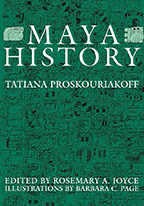
Maya History by Tatiana Proskouriakoff


For expert epigraphers only
Russian-American scholar Tatiana Proskouriakoff is one of the stellar names in the field of Maya studies and was an instrumental contributor to the decipherment of the Maya’s written language. The book Maya History, a summation of her life’s work, was incomplete at the time of her death and published posthumously in 1993. Prior to Proskouriakoff, the prevailing view among Maya scholars was that the hieroglyphic carvings left behind by the Maya civilization were largely devoted to astronomical, calendrical, and mythological content. Proskouriakoff, on the other hand, proved that the Maya carvings were historical records of political events and dynastic lineages. Although the Maya’s written carvings were not completely deciphered, Proskouriakoff was able to recognize the names and titles of rulers and enough verbs to connect royal family trees and diplomatic relations between various Maya city-states. In Maya History, Proskouriakoff examines almost every Mayan stela catalogued during her lifetime, as well as lintels, staircases, and other carved monuments. She presents her findings largely in chronological order while bouncing back and forth between just about every Maya city in Guatemala and Southern Mexico.


This is an important and fascinating book, but it’s not for general readers. Here’s a typical sentence: “The second hand glyph holds a ‘hook-scroll’ (T19), associated with death expressions, and refers to a rare ahau compound such as that inscribed on a vessel from the Tzakol III burial 22 at Uaxactun (R. E. Smith 1955:2:Fig. 7)”. Proskouriakoff’s intended audience of university professors would have had access to a library of books with illustrations and photographs of Mayan stelae and texts, as well as J. Eric S. Thompson’s catalog of Maya glyphs (where one would find the “T19” mentioned above, for example). Very few illustrations of stelae are actually included in this book (though many single glyphs are pictured alone), so she’s constantly describing monuments that the reader can’t see. Dates are all presented in Maya notation (e.g. 9.12.9.17.16 5 Cib 14 Zotz’), which is no surprise, but no Gregorian equivalents are given. To fully understand everything in this book, one would need not only a faultless understanding of the Maya calendar but also a professional familiarity with all the archaeological sites discussed, or at least a wealth of PhD-level reference materials with illustrations of every stela. Proskouriakoff’s scholarship is sound, but this book could really use a publisher that will go the extra mile to illustrate it to the extent it deserves.


While Proskouriakoff outlines a great deal of Maya chronology in this book, she continually admits that much of what she is stating is speculative or unresolved. The reading of Maya hieroglyphs has no doubt come a long way since much of Maya History was written. Since then, I’m sure that many of Proskouriakoff’s conjectures have been confirmed, but probably a few have been proved erroneous. This book is really more about the process of decipherment, however, than the results. The amount of actual historical information in this book could have been summarized in a two- or three-page chronological table (unfortunately it isn’t). The bulk of the text, on the other hand, is Proskouriakoff’s explanatory examination of Maya glyphs and text.


Proskouriakoff’s Maya History is a five-star book in the history of Maya studies. For the general reader, however, it’s not a five-star reading experience. For nonacademic readers like myself looking for a deeper dive into the arcane details of this subject, I would recommend Forest of Kings by Linda Schele and David Freidel. Like Maya History, it combines historical narrative with a detailed examination of glyphs and iconography, but it’s more accessible to the general reader and more generously illustrated.

If you liked this review, please follow the link below to Amazon.com and give me a “helpful” vote. Thank you.

Tuesday, May 7, 2024

The Golden Cockerel and Other Writings by Juan Rulfo


Rediscovered works from a Mexican master
In the Mexican literary scene, it is a general consensus that Juan Rulfo is that nation’s greatest author. In fact, Rulfo is widely respected throughout Latin America, and is often credited as being the precursor and inspiration to the Latin American Boom that took place in world literature in the 1960s and ‘70s, in which such writers as Gabriel García Marquez, Mario Vargas Llosa, Carlos Fuentes, and Jorge Luis Borges rose to prominence. What Rulfo achieved in impact makes up for what he lacked in prolificacy. As far as most readers know, he only published one novel, Pedro Páramo, and one volume of stories, El Llano en Llamas (The Burning Plain). Editor and translator Douglas J. Weatherford, however, brings our attention to the fact that Rulfo did write another short novel, El Gallo de Oro (The Golden Cockerel), which was published in 1980 after having been adapted into film in 1964. The Golden Cockerel and Other Writings, published in 2017, presents Weatherford’s English translation of this “lost” novel by Rulfo, along with several short pieces by Rulfo that were published after his death in various Mexican publications.


The Golden Cockerel tells the tale of Dionisio Pinzón, a dirt-poor resident of the town of San Miguel del Milagro. Hampered by a lame arm, he can’t even perform manual labor, so as an act of charity he is granted the job of town crier. Among his duties is serving as announcer at the local cockfights. One evening, after a fight, the owner of the defeated bird is just about to put his wounded animal out of its misery, when Dionisio Pinzón steps in and asks him to reconsider. The man gives his unwanted bird to Dionisio Pinzón, who takes the golden rooster home and nurses it back to health. From that moment, Dionisio Pinzón’s life changes for the better, in luck and in love. He travels from town to town with his golden cockerel, raking in riches from the fighting prowess of his beloved bird. He also wins the heart of a beautiful cabaret singer. With his newfound riches, however, Dionisio Pinzón undergoes a change from simple, likable peasant to a man consumed by greed.

Unlike the more blatantly modernist style of Pedro Páramo and The Burning Plain, the writing of The Golden Cockerel is not overtly experimental or surrealist in its structure and storytelling. Rulfo relates the story in straightforward language, but with his own unique voice and humor. The plot has the quality of a folktale or fable, like a modern Mexican version of some semi-supernatural cautionary tale of Balzac’s, such as The Magic Skin. The most enjoyable quality of the novel is the blunt naturalism and gallows humor with which Rulfo depicts his native land. He doesn’t romanticize Mexican culture but certainly displays an affection for it that is contagious. Rulfo gets the reader to care about this time and place, these people, in a way similar to how García Marquez brings rural Colombia to vivid life in One Hundred Years of Solitude.

The “Other Writings” in this volume are a mixed bag of short-shorts, including a poem (“The Secret Formula”), correspondence with a loved one (“A Letter to Clara”), an autobiographical piece (“My Father”), and a bit of travel writing (“The Castillo de Teayo”). A couple of the short stories bear a warmth and humor similar to The Golden Cockerel (“A Piece of the Night” and “The Discoverer”) while a few others have a dark, spaghetti-western atmosphere that would have been right at home in The Burning Plain (“He Was on the Run and Hurting” and “Ángel Pinzón Paused”). A few of the pieces are too brief to really amount to much. In all cases, however, Rulfo’s stellar literary talent shines. The Golden Cockerel isn’t quite as impressive as Rulfo’s two better-known books, but it’s still worthy of this highly esteemed Mexican master. Rulfo fans lamenting his paltry output will be delighted by the long lost writings in this volume.


Stories in this collection

The Golden Cockerel
The Secret Formula
Life Doesn’t Take Itself Very Seriously
A Piece of the Night
A Letter to Clara
Castillo de Teayo
After Death
My Aunt Cecilia
Cleotilde
My Father
Same as Yesterday
Susana Foster
He Was on the Run and Hurting
Ángel Pinzón Paused
The Discoverer

If you liked this review, please follow the link below to Amazon.com and give me a “helpful” vote. Thank you.

Wednesday, April 17, 2024

The Treasure of the Sierra Madre by B. Traven


Riveting and realistic adventure novel
The Treasure of the Sierra Madre
is the second novel by B. Traven, a German author who lived for years in Mexico, where most of his fiction is set. The novel was first published in German in 1927, then published in English translation in 1935. This is by far Traven’s most famous book, due largely to the 1949 film adaptation, which won three Academy Awards. The movie is quite faithful to Traven’s novel, so if you’ve already seen that film, don’t expect any plot surprises here. Nevertheless, the book is every bit as riveting as the movie, thanks to Traven’s skillful and suspenseful writing. Even though the novel was published over two decades before the film adaptation, Traven’s dialogue remarkably reads as if it were written for Humphrey Bogart and Walter Huston. If you haven’t seen the movie, how lucky you are that you get to experience this story for the first time in its original form.


The story opens in Tampico on the Gulf Coast. Traven introduces us to the white underbelly of this Mexican city—an assortment of unemployed gringo drifters who wander from town to town, looking for work with oil companies, mining companies, and other resource extraction industries (almost all of which, in the 1920s, would have been owned by American and European corporations). Two such drifters, Dobbs and Curtin, meet while looking for work. When spending the night in a fleabag flophouse, they meet an old prospector named Howard who regales them with stories of a lost gold mine. Sick of the grind of dead-end short term jobs of back-breaking labor for low pay, Dobbs and Curtin decide they want to try their hand at gold-hunting, and they invite Howard to be their partner and mentor. The three venture into the mountains of the Sierra Madre where they have some luck finding a promising dig site. As Howard points out, however, finding the gold is easier than getting it out of the ground and carrying it somewhere safe.

Adventure novels were ubiquitous in the early 20th century, but The Treasure of the Sierra Madre is one of the few that rises to the level of great literature. The story is very realistic and deliberately unromanticized. Only in three flashback stories-within-the-story does the narrative venture into something approaching folklore and legend. Traven’s depiction of Mexico bears the mark of someone who has been there and lived this drifter’s life. This is no tourist’s outsider vision of the romantic tropics. The Mexicans in the book are illustrated with the same perspicacity as the leading trio of American characters. Going back to Jack London and beyond, so many thousands of stories have been written about what gold does to a man’s mind and morals that the premise has become cliché. None of those stories, however, are as psychologically authentic as what Traven presents here. His characters think and behave like real flawed human beings, not storybook heroes and villains. With his intelligent insights into human nature and his realistic depiction of life-and-death drama, Traven’s novel reads as if it could have been written by one of the great naturalist novelists like Frank Norris or Emile Zola.

Traven often expresses socialistic, anarchistic, and atheistic views in his writings. Here such ideas are toned down a bit from the more overt statements and satire in his debut novel The Cotton-Pickers. Nevertheless, Traven still manages to work some anti-capitalist, anti-church, and anti-imperialist sentiments into The Treasure of the Sierra Madre. You won’t find much of that expressed in the Bogart film, which is another good reason to read Traven’s original text. Judging by what I’ve read in this novel and in The Cotton-Pickers, Traven is a writer who was way ahead of his time, both in terms of the blunt frothrightness of his realism and the fearlessness with which he deviates from the conservative mainstream literature of his time. Both of Traven’s first two novels are excellent, and I look forward to following his literary career further.
If you liked this review, please follow the link below to Amazon.com and give me a “helpful” vote. Thank you.

Wednesday, April 3, 2024

The Labyrinth of Solitude by Octavio Paz


Insightful analysis of a national psyche
In 1990, Octavio Paz became the first (and only, thus far) Mexican writer to win the Nobel Prize in Literature. His literary output includes over two dozen books of poetry. A volume of essays, however, is likely his best-known work among a worldwide readership. El laberinto de la soledad was first published in 1950. In 1961, it was published in English translation as The Labyrinth of Solitude. As indicated by the book’s subtitle, Life and Thought in Mexico, Paz analyzes the national character and spirit of his homeland, encapsulating not only the political but also the psychic state of the nation at the time of publication.


The original edition of The Labyrinth of Solitude is divided into nine chapters, each of which could be a free-standing essay on one or more aspects of Mexican culture. (Later editions, after 1970, may include an additional essay.) Because the book is now over 70 years old, some of its content may unavoidably be a bit outdated, but for the most part Paz’s observations still bear a timeless ring of truth. This is largely due to the fact that so much of Paz’s elucidation of the Mexican character revolves around the Mexican people’s coming to terms with their past—with their pre-Colombian history, the myths and religion of their heritage, the Spanish Conquest, Catholicism, the War for Independence, the Revolution, and the historical role of women in Mexican society. Born during the Revolution and writing less than four decades after that momentous upheaval, Paz illustrates how the mindset of the modern Mexican was forged from the country’s turbulent history. Paz’s attitude toward the Spanish Conquest, and Catholicism in particular, is not entirely negative and comes across as relatively lenient by today’s standards. We now regard European colonization as unilaterally evil and tragic, but Paz (and others of his era) seem more resigned to the brutal past as if it were an ugly contaminating ingredient that nevertheless proved essential in forging the strong and resilient alloy of an enduring racial and national spirit.

The scope of Paz’s text is not strictly confined to Mexico. Much of what he has to say about the Spanish Conquest and colonialism applies more broadly to Latin America in general. Also, in one of the latter chapters, Paz presents a very interesting and thoughtful perspective on twentieth-century world history, focusing primarily on the political and economic ramifications of numerous third-world revolutions and liberations from imperial colonizers. In the final chapter, Paz also addresses issues of gender roles, women’s rights, love, marriage, and sexuality with statements that shed light on Mexican attitudes but also speak of humanity as a whole. Paz is first and foremost a poet, not a historian, philosopher, or sociologist, so unlike writers in those disciplines he can get away with making bold metaphorical or opinionated statements without necessarily backing up his assertions with hard empirical evidence. Nevertheless, his arguments here are soundly reasoned and articulately stated (at least in the English translation by Lysander Kemp).

I read this book as an outsider with an interest in Mexican culture. I was hoping for insightful glimpses into Mexican life from one of that nation’s greatest intellectuals and men of letters, and in that regard, Paz did not disappoint. This book will no doubt be more meaningful, however, to readers of Mexican or Latino heritage. The Labyrinth of Solitude is a concise yet deep examination of the Mexican cultural and political zeitgeist as it existed almost three-quarters of a century ago. Much has changed in Mexico since then, but many of Paz’s conclusions are still very relevant today.  
If you liked this review, please follow the link below to Amazon.com and give me a “helpful” vote. Thank you.

Friday, March 15, 2024

Incidents of Travel in Central America, Chiapas, and Yucatán by John Lloyd Stephens


Dueling presidents and Mayan ruins
John Lloyd Stephens (1805-1852) was an American diplomat and travel writer. In 1839, President Martin Van Buren appointed him Ambassador to Central America. Soon after, he traveled to Central America to assume his new post. It’s unclear what exactly his mission was, however, since Stephens just seems to travel around doing whatever he wants. Stephens’s journey lasted several months, during which time he also ventured into Mexico. His account of his expedition, Incidents of Travel in Central America, Chiapas, and Yucatán was published in two volumes in 1841. This book should not be confused with his 1843 publication Incidents of Travel in Yucatán, which covers a second trip Stephens made to Mexico.

In 1839, the several nations of Central America were united under one government, the Federal Republic of Central America. When Stephens arrived in Central America, however, the presidency of that government was in dispute between two warring generals, Rafael Carrera and José Francisco Morazán. Stephens doesn’t seem to favor either would-be presidente but rather curries the favor of whichever he happens to be facing at the time. Stephens spends much of the book chronicling the political and military conflict between these two figures. He met with both generals and witnessed some battles fought and atrocities committed by both parties. Although borders may have been different back then, I believe Stephens’s travels took him through every country in Central America except maybe Panama. He doesn’t venture into Mexico until halfway through Volume 2.

Stephens also explored the ruins of several Mayan cities, three of which are discussed at some length: Copán in Guatemala, Palenque in Chiapas, and Uxmal in the Yucatán. Accompanying him on these explorations was the artist Frederick Catherwood, who documented the sites in drawings and paintings. Stephens had no archaeological training, so his discussions of the Maya don’t really hold up to today’s standards. Catherwood, on the other hand, is the real deal. His illustrations of Mayan ruins are quite remarkable in their attention to detail, particularly when you consider he had almost no precedent to build upon. This book contains dozens of engravings of Catherwood’s drawings, but he also published his own book Views of Ancient Monuments in Central America, Chiapas, and Yucatan with color lithographs. I don’t want to overemphasize the archaeological content of the book, however, because it’s really only a small portion of the text. The bulk of the two volumes deals with the politics and military matters of Central America, which will likely be of interest mostly to historians of Latin America.


There’s also quite a bit of complaining about unsavory accommodations, incessant mosquitos, and unsatisfactory hired hands. Stephens is more interested in getting to know wealthy Spaniards than the poor Indigenous population, because the former can offer him better lodgings and dinners than the latter. As an explorer and travel writer, Stephens is no Alexander von Humboldt. You’re not going to get a really liberal and enlightened account of Latin American culture and politics, but Stephens is at least a conscientious observer and chronicler of what he sees.

This book is valuable as an outsider’s historical account of what Central America, Chiapas, and the Yucatán were like during this time period. Much of the information imparted, however, won’t hold much interest for today’s reader. Before reading this book, one really needs to consider if it will be worth roughly 24 hours of your reading time. For those only interested in the archaeological sites, just read the illustrated chapters on the Mayan cities.
If you liked this review, please follow the link below to Amazon.com and give me a “helpful” vote. Thank you.