Showing posts with label Simak Clifford D.. Show all posts

Friday, May 30, 2025

The Novels of Clifford D. Simak

Career overview of a sci-fi grand master
Clifford D. Simak
A few months ago, I finished reading and reviewing the complete works of American science fiction author Clifford D. Simak (1904–1988). Since he’s been a favorite here at Old Books by Dead Guys, I think it’s time for a summary look at his literary career.

Simak was born in Millville, Wisconsin, a small town in the southwest of the state, near Prairie du Chien. For over three decades, Simak worked as a reporter and editor for the Minneapolis Star and Tribune while building a successful career as a fiction writer on the side. Simak published his first short story in 1931 and his final novel in 1986, with a prolific and steady output in between. He won three Hugo Awards (for the novel Way Station, the novellette “The Big Front Yard,” and the short story “Grotto of the Dancing Deer”) and one Nebula Award (also “Grotto of the Dancing Deer”). In 1977, the Science Fiction and Fantasy Writers Association named Simak a Grand Master of the genre, and he has also been honored with a lifetime achievement award from the Horror Writers Association.

Critics have often referred to Simak’s science fiction as “pastoral” because his stories often take place in rural and small-town locales. Rarely is a Simak story set in New York or Washington, DC. The bulk of his fiction is set in Wisconsin and Minnesota. His protagonists, even the nonhuman ones, often take part in outdoor activities like hunting, fishing, camping, and farming. He also wrote quite a few quest novels featuring cross-country treks in which the characters sleep around campfires and live off the land. Also in the write-what-you-know department, Simak often casts newspaper reporters and editors as the heroes in his stories. Despite the frequent small-town Midwestern atmosphere, Simak’s science fiction concepts are as innovative and mind-blowing as any big-city writer. His works run the gamut from laugh-out-loud comical to deadly serious and often engage in philosophical contemplation on mankind’s destiny, our relationship to nature, and our place within the universe. 

In recent years, Open Road Media has released just about all of Simak’s novels in inexpensive ebook editions, so it’s no longer necessary to hunt down old paperbacks in used bookstores or on ebay. Below are brief summaries and ratings of Simak’s 27 novels. Click on the titles below to read the complete reviews.

Short Fiction
This overview of Simak’s novels does not cover his short fiction. Simak’s short stories and novellas are even more consistently good than his novels. The Complete Short Fiction of Clifford D. Simak series collects all of Simak’s fiction into 14 volumes. Each book contains about eight or nine science fiction stories plus one Western story or World War II adventure, genres in which Simak published a few pieces early in his career. The stories in these 14 volumes are not arranged in any kind of chronological or thematic order, so each volume is as good as another, and they are all very good collections. The ebooks often show up for three dollars or less on Amazon.


Novels

Cosmic Engineers (1939) - 3.5 stars
In the year 6948, mankind has colonized other planets in the solar system but has yet to venture to another star. Scientists working in a base on Pluto receive messages from the far-off edge of the universe. One human holds the key to understanding these cosmic messages and communicating with the beings of profound intelligence who sent them. An ambitious debut, though Simak has not yet reached his mature style.

Time and Again (1950) - 4.5 stars
The year is 7990. Humanity has spread throughout the galaxy and conquered a multitude of planets. Twenty years ago, astronaut Asher Sutton was sent to the 61 Cygni star system as one of many advanced scouts sent to make first contact with other worlds. Now, a government functionary is visited by a being claiming to be from the future, who informs him that Sutton will soon be returning to Earth, and when he arrives, he must be killed, or mankind will suffer grave consequences. A complex and ingenious time-travel mystery thriller.

Empire (1951) - 3.5 stars
Centuries in the future, humans from Earth have established colonies, mines, prisons, and industrial plants on all the planets in the solar system. This is made possible by an advanced technology that harvests great quantities of energy from the Sun. The tycoon who holds the monopoly on this energy source is the de facto dictator of the solar system, until a rival billionaire comes up with an alternate and superior source of power. Not one of Simak’s better works, with too much sketchy science and subpar storytelling.

City (1952) - 4.5 stars
The book that Simak is best-known for, City is actually made up of previously published short stories that have been adapted into a unified novel. Simak explores the philosophical question of what would happen if mankind had the benefit of communicating with another intelligent species? How would this help or hinder our development? The narrative encompasses tens of thousands of years in the future history of life on Earth, a future that humanity shares with Martians, robots, mutants, and talking dogs. A complex, epic saga that makes for a challenging read, but worth the effort.

Ring Around the Sun (1952) - 4 stars
The story takes place on Earth, perhaps a few decades in the future. The Cold War is still raging, inspiring fears of nuclear Armageddon. Recently, the American market has been mysteriously glutted by inexpensive goods of impeccable manufacture and unknown origin. Could this abundance of technological wonders be an attempt by some secret cabal to subvert our capitalist system and destroy our economy? 
Despite the title, the novel has nothing to do with space travel. 

Time is the Simplest Thing (1961) - 4 stars
In a not-so distant future, mankind has abandoned space travel. Instead, certain humans have developed the power to explore other star systems through a form of telepathic projection. But what might such a traveler inadvertently bring home from an interstellar journey? This novel is not so much about space or time travel, but more about the paranormal powers of these special individuals. Simak gets a little farfetched here at times, but it’s an exciting adventure novel. 

They Walked Like Men (1962) - 3 stars
A Midwestern newspaper reporter uncovers a sinister plot that threatens the world. The book’s title, as well as an alien encounter in the first chapter, give away that this is a mystery/thriller in which the villains are nonhuman invaders. The aliens are interesting and scary, but their plot to take over the world defies logic. The book contains some thrilling and suspenseful scenes, but overall feels half-baked.

Way Station (1963) - 4.5 stars
One of Simak’s best and best-known works. Enoch Wallace, veteran of the American Civil War, is chosen by an extraterrestrial governing body to serve as a galactic innkeeper for interstellar travelers teleporting through our solar system. His rural Wisconsin home is a layover stop for myriad alien species and cultures. Enoch’s neighbors begin to get suspicious of the fact that he never ages, which leads to the CIA putting him under surveillance. Classic Simak!

All Flesh is Grass (1965) - 3.5 stars
Set in Simak’s hometown of Millville, Wisconsin. A local man is on his way out of town for a fishing trip when his car strikes an invisible, impenetrable barrier. Further investigation reveals that this mysterious barricade completely encircles the town, closing it off from the rest of the world. This plot sounds remarkably similar to Stephen King’s Under the Dome, but Simak beat him to the idea by over 40 years.

The Werewolf Principle (1967) - 5 stars
500 years in the future, a space capsule is found with a John Doe astronaut sealed inside, under suspended animation. When awakened, he has no memory of his past or identity. He is obviously a space traveler from Earth’s past, but how far in the past? The Werewolf Principle is not about werewolves at all but rather about space travelers that are bioengineered to transform and adapt to varying conditions on other worlds. A constantly surprising, entertaining, and though-provoking thriller.

Why Call Them Back from Heaven? (1967) - 4 stars
In the year 2148, scientists are on the verge of cracking the secret to immortality. Billions of people have chosen to have their bodies frozen after death, waiting for a future “revival day” when they will embark on their “second life.” In an already overpopulated world, How will humanity cope when the billions of dead are revived? An innovative and thought-provoking dystopian thriller with interesting philosophical implications. 

The Goblin Reservation (1968) - 3.5 stars
At an unspecified time in the future, space travel throughout other star systems has acquainted mankind with various life forms, some of whom have emigrated to Earth. Time travel is also possible, and a Time College has been established in Madison, Wisconsin, devoted to the study of the past. Humans have also discovered that many of the creatures we thought were mythical or supernatural are in fact real, and many of them now reside in the Goblin Reservation outside Madison. The main plot of the novel deals with time travel, not so much goblins. This is a humorous novel in which Simak throws everything but the kitchen sink. It’s sometimes nonsensical, but it is fun.

Out of Their Minds (1970) - 1.5 stars
A minor celebrity returns to his rural hometown to write a book. When he gets there, he is confronted by all kinds of bizarre and dangerous phenomena, such as a charging triceratops. The title Out of Their Minds could refer to persons who are insane, but in this case it primarily pertains to characters and events from people’s imaginations that manifest themselves in physical reality, literally arising out of their minds. This premise leads to an anything-goes plot that defies all logic and just allows Simak to throw in random imagery without any rhyme or reason. His worst novel, in my opinion.

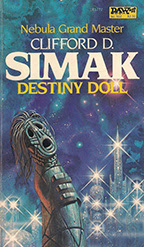
Destiny Doll (1971) - 3.5 stars
a.k.a Reality Doll
A freelance spaceship captain is hired by three individuals to transport them into deep space. One of them has been hearing voices he believes are interstellar transmissions from a long-lost legendary Earth adventurer who is rumored to have found a paradise on a distant unknown planet. The first half of the book is a little too weird-for-weird’s-sake, but it improves over time and offers some interesting philosophical conjectures about the destiny of humankind, multiple realities, and alien intelligences.

A Choice of Gods (1971) - 4 stars
In the year 2135, the vast majority of humanity mysteriously disappears from the Earth, leaving only a few hundred people behind in the vicinity of Minneapolis. These survivors discover that they have stopped aging, and some have developed advanced parapsychic abilities like interstellar telepathy. A band of Native Americans and some sentient, masterless robots round out the cast of this thoughtful post-apocalyptic tale that asks some deep, dark questions about the purpose of mankind.

Cemetery World (1972) - 3 stars
Thousands of years in the future, mankind has colonized many planets throughout the galaxy. Though few humans have set foot on the planet, Old Earth has become an object of fond nostalgia, and billions of people want to be buried there. An artist travels to Earth to create a multimedia piece that encapsulates the essence of Earth. When he uncovers a sinister plot by the Cemetery corporation, who run the funerary tourism industry, the artist is forced to flee for his life. High on imagination but low on logic, this novel is just so-so.

Our Children’s Children (1973) - 4 stars
Five centuries in the future, mankind faces an alien attack. Unable to defeat the invaders, the human race flees their enemies by time traveling to the past, becoming refugees in our present-day world. These unexpected billions place a heavy burden on our already overpopulated and overtaxed world. Though these uninvited visitors are our distant descendants, do we have the means or the wherewithal to help them? Not one of Simak’s best, but it’s a brisk and engaging read.

Enchanted Pilgrimage (1975) - 3.5 stars
The first of three novels that Simak published in the Dungeons & Dragons/Lord of the Rings fantasy genre. In medieval times, Mark Cornwall, a university scholar, discovers a mysterious page of manuscript hidden in the school’s library. When others find out about this discovery, they are willing to kill to get their hands on the parchment. To decipher the text, Cornwall must leave civilization and venture out into the Wastelands. For the journey, he assembles a team of adventurers including a goblin, a gnome, and an intelligent raccoon. I don’t consider this type of thing to be Simak’s forte, but this is the best of his three novels in this genre.

Shakespeare’s Planet (1976) - 4.5 stars
In the 25th century, Carter Horton was sent on a mission to find planets habitable to humans. He awakes from suspended animation to find that a thousand years have passed, and his human crew are dead. The good news is he’s found a habitable planet, but he’s stranded on it. With the help of his robot companion and some local alien inhabitants, can he find a way off of this mysterious world? Rather than settling for mere interspecies conflict, 
Simak emphasizes  friendship and cooperation between intelligent life from different worlds and expresses a kind of interstellar environmental ethic.

A Heritage of Stars (1977) - 3.5 stars
Two thousand years in the future, Earth is now a post-apocalyptic world in which mankind has reverted to barbarism. In a fit of worldwide rage, humans rebelled against their technology and destroyed it. One bastion of intelligent civilization still holds out on the campus of the former University of Minnesota. When a member of this community comes across a millennium-old history mentioning a Place of Going to the Stars, he leaves the safety of the university and heads West on a quest to find this mythical site. This story has its fair share of flaws, resulting in a mediocre work by Simak standards.

Mastodonia (1978) - 5 stars
On a farm in Western Wisconsin, a professor of paleontology discovers a time tunnel through which he can walk 100,000 years in the past. He and his colleague decide that in order to fully explore the scientific research potential of time travel, they must first develop it into a commercially viable business, one centered around prehistoric safaris. First, they declare their prehistoric haven an independent nation, dubbed Mastodonia. The pleasant surprise of this time-travel story is that instead of focusing on adventures with saber-toothed tigers, Simak explores the ethical, legal, and logistical complications of time travel.

The Fellowship of the Talisman (1978) - 2 stars
The second of Simak’s D&D-flavored novels. In this alternate history, it’s the 20th century, but Europe has yet to emerge from the Dark Ages. The progress of civilization has been halted by hordes of evil nonhuman beings known as the Harriers. A manuscript is discovered that purports to be an eyewitness account of the life of Christ. A young nobleman is tasked with delivering this document to a scholar who can translate and authenticate it. Not only is this novel filled with some silly sword-and-sorcery clichés, it also has a very preachy Christian message that’s not even historically accurate.

The Visitors (1979) - 4.5 stars
An immense black box descends upon the small town of Lone Pine, Minnesota, hovering just above the ground. The unexplainable nature of this object leads to speculation that it may be of extraterrestrial origin, but is it a living being or a mechanical probe? The box moves around, “eating” trees and ignoring humans. No one can find a way of communicating with it, until one fly fisherman feels a momentary telepathic bond with the visitor. A riveting close-encounters tale that is really less about the aliens and more about humanity’s reaction to them.

Project Pope (1981) - 3.5 stars
In the distant future, a physician stows away on a spacecraft headed to a planet on the very outskirts of our galaxy. There he finds a society established by robots from Earth, who have created a center of theological research named Vatican 17, complete with a supercomputer as pope. These robot clergy employ humans with telepathic powers to gather information on alien cultures and faiths. When one of the listeners claims to have found Heaven, it causes turmoil within the vatican hierarchy. While investigating the dichotomy between knowledge and faith, Simak both criticizes organized religion and respects spiritual faith.

Special Deliverance (1982) - 3 stars
A half dozen individuals find themselves mysteriously transported to an unknown world. They figure out that they have all been abducted from different universes—Earths with alternate histories. But abducted by whom, and why? Convinced that they have been brought together to undertake some mission by which they might return to their homes, the six characters set out to look for clues to the mysterious purpose behind their involuntary journey. A rather meandering plot in the Twilight Zone fantasy vein.

Where the Evil Dwells (1982) - 2 stars
Simak’s third sword-and-sorcery novel takes place during the Roman Empire. In between the Romans and the Germanic barbarians of the Earth lies a zone called the Empty Land, inhabited by a horde of evil creatures and mystical monsters. A young man embarks on a quest to rescue a holy relic from the Empty Land, accompanied by a motley crew of companions, of course. Typical Dungeons & Dragons fare, and rather boring.

Highway of Eternity (1986) - 3 stars
Two individuals with the inexplicable abilities to see and move through alternate worlds stumble upon an 18th-century English manor house that exists in an isolated bubble outside of time and space. There they meet a group of refugees from the future. The rest of the novel follows them as they hop through time and space fleeing the persecution of a foe that threatens the end of humanity as we know it. This premise is vague enough to allow Simak to throw just about anything into this kitchen sink, and he does, resulting in something that reads more like fantasy than hard sci-fi.


Wednesday, January 24, 2024

They Walked Like Men by Clifford D. Simak


Newspaperman uncovers far-fetched invasion plot
When I was younger, I read a couple of short stories by Clifford D. Simak, but he didn’t really register on my radar until Open Road Media started re-releasing his works in ebook format in 2015. Since then, having really enjoyed Open Road’s series The Complete Short Fiction of Clifford D. Simak, I decided to read and review Simak’s complete works. I was forced to hunt down some obscure paperbacks, but Open Road has finally caught up with me and published just about all of Simak’s work in ebook format. Their most recent release is his 1962 novel They Walked Like Men, which also happens to be my final read in Simak’s extensive catalog of fiction. I probably could’ve ended on a better book, as this is not one of his best novels, but Simak’s science fiction is at the very least considerably above average, and They Walked Like Men is worth the time spent for Simak fans.

While his career as a science fiction author lasted more than half a century, Simak also had a day job as a journalist and editor for the Minneapolis Star and Tribune. His stories often take place in the Midwest, and newspapermen frequently figure as protagonists. In this case, the city is unnamed, but it might very well be modeled after Minneapolis. Parker Graves is a reporter for the city’s daily newspaper. Graves and his fellow journalists cover issues of local importance, such as the closing of the hometown department store or the scarcity of available residential real estate in the metro area. Graves’s girlfriend Joy, also a reporter, gets stuck with more mundane fare like a man who breeds tame skunks for pets. Little did anyone suspect that all these various threads would be tangled in a sinister plot that threatens not only the city but the entire world.

In the novel’s first chapter, Graves has an encounter with an alien creature. In my opinion, Simak jumped the gun a little too early with such a startling reveal, but the title of the novel kind of gives away the general gist of the story anyway. This is a mystery/thriller in which the villains are nonhuman invaders. They Walked Like Men is a very entertaining and engaging novel while you’re reading it, but it’s one of those books that when you get to the end you think to yourself, there were some aspects of that story that were rather dumb. This is not a comedy, though it does have some comedic moments. In fact, this is perhaps one of Simak’s more deadly serious novels. Even though this is science fiction, however, some degree of logical believability is reasonably expected, and this story definitely lacks in the credibility department. The physical aspect of the creatures is conceived and handled very well and leads to some thrilling and suspenseful scenes. Their grand strategy for taking over the world, however, defies logic, not only the logic of our real world but even the rules that the aliens have established for themselves. The plot brings up some thought-provoking issues of economics and politics, but the ideas feel a bit half-baked, as if Simak didn’t thoroughly think them through.


enjoyable read than probably 90 percent of the sci-fi authors out there. Every Simak book is worth reading, though some more than others. If They Walked Like Men comes up as a Kindle Daily Deal, by all means buy it, but make sure you also read some of his better novels like City, Way Station, Mastodonia, The Werewolf Principle, and The Visitors.
If you liked this review, please follow the link below to Amazon.com and give me a “helpful” vote. Thank you.

Wednesday, November 1, 2023

Enchanted Pilgrimage by Clifford D. Simak


The best of Simak’s D&D-ish fantasy novels
Clifford D. Simak is one of my favorite science fiction writers. I set myself the task of reading his complete works and have almost completed that task. In addition to science fiction, Simak also wrote a few novels in the fantasy genre, along the lines of Dungeons & Dragons or The Lord of the Rings. The most obvious examples are The Fellowship of the Talisman and Where the Evil Dwells, but to a lesser extent The Goblin Reservation, Destiny Doll, and a few other Simak novels also contain elements from this fantasy genre. For the most part, Simak’s sword-and-sorcery novels are not my cup of tea. I think he is much better at science fiction, and other writers handle this brand of fantasy better than he. However, of his fantasy works, Enchanted Pilgrimage, published in 1975, is clearly his best foray into the genre.

The story is set in medieval times. Mark Cornwall is a scholar at Wyalusing University. While studying in the university library, he discovers a mysterious page of manuscript parchment hidden in a book. Although he isn’t clear on exactly what the written message means, he is convinced of its importance. Other parties must be convinced as well, because they are willing to kill to get their hands on the parchment. To decipher the meaning of the manuscript, Cornwall ventures on a journey away from civilization, through the perilous Wastelands, to seek out the legendary Old Ones, who may be able to help him understand this mysterious message. Through various circumstances, he assembles a party of traveling companions that includes a goblin, a gnome, an intelligent raccoon, and a hobbit or two (though Simak never uses the word “hobbit,” that’s pretty much what he describes). Together, these brave adventurers face a host of monsters and perils in the Wasteland, while fleeing the murderous pursuers who aim to get their hands on the valuable piece of parchment.

For the most part, this book is a Dungeons & Dragons-style quest narrative, but it does incorporate some science fiction elements towards the end. That’s really what makes this book a cut above The Fellowship of the Talisman and Where the Evil Dwells. The fact that Simak is able to incorporate some of his visionary science fiction concepts into the narrative elevates it above a typical romp through the D&D Monster Manual. The oddest thing about Enchanted Pilgrimage is that the much-coveted sheet of parchment that everyone’s fighting over ends up being rather irrelevant in the end. It merely serves as an impetus to start the adventurers on their journey. What’s most important is the quest, and what they find at the end. The events that punctuate the travelers’ trek are sufficiently exciting and suspenseful to keep the reader keenly interested throughout, and despite the presence of fantastical and mythical beings, what occurs rarely steps outside the boundaries of a reasonable logic that Simak has established for this fantasy world.

Readers familiar with Simak’s body of work will recognize some of the themes and concepts employed here from other books in the author’s oeuvre. Nevertheless, this is a significantly original story that uses those ideas in new ways. Enchanted Pilgrimage is by no means a masterpiece, but it is a good, solid entry in the fantasy genre. Though not among his best works, Simak fans and fantasy enthusiasts alike should find this a fun and entertaining read.
If you liked this review, please follow the link below to Amazon.com and give me a “helpful” vote. Thank you.

Wednesday, August 30, 2023

Buckets of Diamonds and Other Stories: The Complete Short Fiction of Clifford D. Simak, Volume Thirteen


Lucky Thirteen
After making us wait six years since Volume 12 was released, editor David W. Wixon and publisher Open Road Media have finally released volumes 13 and 14 of The Complete Short Fiction of Clifford D. Simak series. During that time, I got tired of waiting for Wixon, so I tracked down and read all of Simak’s remaining sci-fi stories, but it is nice to see the series finally finished, and I am happy to own the complete set of inexpensive ebooks. I read Volume 14 first because it was a Kindle Daily Deal, so I am now wrapping up the series with Volume 13.


Volume 13 collects ten stories by Simak, nine of them science fiction and one a Western. The Western, a novella-length work entitled “The Fighting Doc of Bushwhack Basin,” is one of the longest entries in this volume, but it’s a pretty good one. A town doctor gets tired of patching up gunshot wounds caused by trigger-happy hired guns, so he decides to go after the wealthy rancher who hired them. The dozen-or-so Western stories that Simak published in his career tend to repeat a lot of the same elements, but if you haven’t read one of his Westerns in a while then this is an enjoyably suspenseful adventure.


The main attraction here, however, is the science fiction, and this volume contains at least half a dozen good stories in that vein. Habitual Simak readers will recognize “The Trouble with Ants,” a story that eventually became the penultimate chapter of his novel City. Thousands of years in the future, after mankind has left the Earth, the planet belongs to robots, dogs, and other animals, who barely remember the existence of man. In this installment of the City saga, ants also become a major player in the planet’s future. Like the other stories that went into the making of that classic novel, this is some of Simak’s most visionary and original work.


Volume 13’s title selection, “Buckets of Diamonds,” is like a comedic Twilight Zone episode in which the narrator’s goofy uncle mysteriously comes into possession of great riches. “The Marathon Photograph” entwines elements of mystery, horror, and science fiction into an ingenious story full of intriguing ideas, while “Infiltration” delivers good old-fashioned monster-movie fun. Perhaps the best story in the volume is “. . . And the Truth Shall Make You Free.” In a future in which mankind is just one insignificant inhabitant of a diverse galaxy, an interplanetary team of explorers discovers archaeological evidence of the first humans who left Earth thousands of years earlier. A human member of the team hopes the find will shed light on the glory and purpose of mankind. This story is quintessential Simak, a philosophical reconciling of his interest in futuristic sci-fi and his love of a pastoral Midwestern lifestyle.


“Horrible Example,” “Clerical Error,” and “Shadow of Life” are less successful entries by Simak standards but still pretty good for the genre. It’s hard to find a short story collection where every entry hits the ball out of the park. After having now read all 14 volumes of The Complete Short Fiction of Clifford D. Simak series, however, I can honestly say there isn’t a bad book in the bunch. Volume 13 isn’t the best volume in the series, but if you’re a science fiction fan you really can’t go wrong with purchasing any of these books, especially since they turn up so often as Kindle Daily Deals.


Stories in this collection

Horrible Example
Lobby
The Trouble with Ants
Buckets of Diamonds
The Fighting Doc of Bushwhack Basin
. . . And the Truth Shall Make You Free
Clerical Error
Shadow of Life
Infiltration
The Marathon Photograph

If you liked this review, please follow the link below to Amazon.com and give me a “helpful” vote. Thank you.

Wednesday, August 2, 2023

The Werewolf Principle by Clifford D. Simak


Classic Simak sci-fi (not really about werewolves)
For the last few years, I have been working my way through the complete works of American science fiction author Clifford D. Simak, and I’ve only got a few books left to go. I have to confess I was kind of avoiding The Werewolf Principle because of it’s title. Simak has a fancy for working mythical monsters from folklore and fantasy into many of his books (The Goblin Reservation, for example), not always successfully. It turns out, however, that The Werewolf Principle isn’t really about a werewolf, and it’s an excellent science fiction novel. The book was first published in 1967.


The story takes place on Earth about five hundred years in the future. Andrew Blake has no memory of his past or his identity. He was found in outer space, sealed inside a capsule, under suspended animation. Interstellar travel is not unusual in this distant future, but finding unidentified John Does in outer space certainly is. Blake is obviously a space traveler from Earth’s past, but how far in the past? He could possibly be centuries old. After a period of observation by doctors, Blake is discharged and granted a house in the suburbs of Washington, DC, complete with robot servants, in hopes that someday he will recover his memories. Instead of improving, however, Blake’s mental health seems to be deteriorating as he starts experiencing blackouts, hears voices in his head, and wakes up miles from home with no recollection of how he got there.

The “werewolf principle” is a phrase of scientific jargon coined by Earth’s Space Administration to describe a project involving the bioengineering of humans for space exploration. Through genetic manipulation, scientists have figured out a way to create human explorers that can transform into alien species in order to adapt to the varying conditions on other worlds—gravity, atmosphere, climate, radiation, etc. This is a concept Simak had explored previously in his novel City. There it is just one futuristic concept among many, but here in The Werewolf Principle it is the main focus of the book. Simak really explores this idea fully, following it to unexpected ramifications that lead to a constantly surprising, entertaining, and thought-provoking sci-fi thriller. I will refrain from further discussion of the book’s interesting plot points, however, so as not to spoil any surprises for the reader.

When Simak is in full-on science fiction mode (not fantasy), his stories have a satisfying logic to them. He has a knack for exploring visionary concepts through down-to-earth stories that render the unbelievable believable. Unlike most of Simak’s fiction, this novel is not set in the American Midwest, but nevertheless Simak does take time for some of his trademark scenes of rural life, treks through wilderness, fishing trips, and the like. His visions of the future may be technologically advanced, but he always stresses man’s relationship to nature as a necessity that must be cherished and protected through the centuries.

In the last couple pages of this novel, there is a surprise twist that I could’ve done without, but this book kept me fascinated for 99.5% of it’s length, so in my opinion it still merits a five-star rating. Amid Simak’s prolific and diverse output of works, The Werewolf Principle is a pleasant surprise and one of his better novels.
If you liked this review, please follow the link below to Amazon.com and give me a “helpful” vote. Thank you.

Wednesday, July 19, 2023

Epilog and Other Stories: The Complete Short Fiction of Clifford D. Simak, Volume Fourteen


Capstone to an essential series
At long last, Open Road Media has finally released the final two volumes of The Complete Short Fiction of Clifford D. Simak series. The series was designed to encompass fourteen volumes, but editor David W. Wixon has made us wait six years since Volume 12 was released. In the meantime, I got tired of waiting for Wixon, so I tracked down the rest of Simak’s science fiction stories (all the old pulp magazines have been scanned at the Internet Archive). It is nice, however, to finally see the series reach completion, and Wixon includes a western and a war story that I was unable to find. Because Volume 14 was offered as a Kindle daily deal, I read it before Volume 13.


Simak’s best-known novel, entitled City, was assembled from previously published short stories, and those stories have been distributed throughout the volumes of the Complete Short Fiction series. “Epilog” is an afterword to City that Simak wrote decades later and has since been added to subsequent editions of the novel. Taking place tens of thousands of years in the future, “Epilog” reveals the fate of Jenkins, the robot protagonist of City, and is one of the better stories in this collection.


“Rule 18,” a story about an interplanetary football game, won a retrospective Hugo Award 76 years after its original publication. I think it’s one of the less impressive stories in this volume, however, and it contains some unfortunate racial stereotypes. Among the best entries in Volume 14 is “Limiting Factor,” in which explorers discover the remnants of a technological civilization and attempt to reconstruct the details of the extinct alien culture. I generally wouldn’t consider overt comedy to be among Simak’s strengths, but Mr. Meek Plays Polo is a successful humorous effort in an interesting setting. The title character is a bookkeeper turned space tourist who stops for fuel at a Wild Western colony on the ring rocks of Saturn, where he is roped into participating in a “space polo” match. This volume also contains the novelette “The World That Couldn’t Be,” in which an Earthling homesteader on a far-off planet hunts down the alien beast who is eating his crops. The astrozoological aspects of the story allow Simak to propose an alternative theory of evolution that might exist on a distant world.


The western story in this volume, “Smoke Killer,” is fine but nothing special. Same with the World War II air combat tale, “A Bomb for No. 10 Downing,” which is built on an exciting premise but is too brief for much development. It is interesting to see these stories alongside Simak’s science fiction, but the latter genre is clearly where his talents lie.


To be honest, this isn’t one of the better volumes in this fourteen-volume series, but the series as a whole is so good overall that even a disappointing installment is better than most of the sci-fi anthologies out there. While Simak wrote a few excellent novels, the quality of his short stories on average surpasses that of his longer-form fiction. Thanks very much to Wixon and Open Road Media for publishing The Complete Short Fiction of Clifford D. Simak series. It stands as an impressive monument to this sci-fi grand master’s prodigious talent and boundless visionary imagination.


Stories in this collection

Lulu
Smoke Killer
Shadow Show
Epilog
A Bomb for No. 10 Downing
Limiting Factor
Masquerade
The Fence
Rule 18
Mr. Meek Plays Polo
The World That Couldn’t Be

If you liked this review, please follow the link below to Amazon.com and give me a “helpful” vote. Thank you.

Wednesday, June 14, 2023

Destiny Doll by Clifford D. Simak


Somewhat boilerplate Simak but with a few refreshing innovations
This novel by Clifford D. Simak was published in the Spring 1971 issue of Worlds of Fantasy magazine under the title of Reality Doll. Later that same year it was published in book form as Destiny Doll. Neither title is really indicative of the book’s contents, but Destiny Doll is an improvement over the original title, which makes even less sense. Destiny is a topic of conversation in the book, but the titular doll only plays a small part in the plot. Destiny Doll is now published by Open Road Media, bundled with Cemetery World as a two-in-one ebook.

The story takes place in an unspecified future, after interstellar travel and colonization of other planets has become commonplace. Captain Michael Ross, the narrator, is a spaceship pilot and opportunistic entrepreneur. While stopping over on Earth (though he wasn’t born there), he is approached by some clients who want to hire him to pilot them on a voyage to other worlds. Sara Foster is a big-game huntress who seeks adventure, Friar Tuck (yep, that’s his name) is a brother of some unspecified religious order, and George Smith is a blind man. George has been hearing voices that he believes are interstellar transmissions from a long-lost legendary Earth adventurer who is rumored to have found a paradise among the stars. By following George’s mysterious sixth sense, the travelers are led to a distant unknown planet that appears to be the abandoned home of an advanced civilization, its skyscraping edifices having remained pristinely intact but apparently uninhabited.

I wasn’t too impressed with the first half of Destiny Doll, quite frankly. The things seen and heard on the mysterious planet are a bit too weird for weird’s sake. Early on, for example, the travelers are met by a race of intelligent porcelain hobby horses with rocking-chair feet. Why would such beings exist? It is hinted later that they must have been created by human visitors who would have had memories of such an Earth toy, but no further explanation is given. The world Simak presents here is full of such fanciful details. Though set in a distant future on a distant world, this isn’t hard science fiction but rather just as much fantasy as sci-fi.

Destiny Doll soon settles into a familiar pattern of Simak’s fiction. The human heroes set off with a few robots and/or aliens on a cross-country quest through a harsh landscape (see also A Heritage of Stars, Shakespeare’s Planet, Special Deliverance, Enchanted Pilgrimage, The Fellowship of the Talisman, Where the Evil Dwells). The landscape is largely deserted, just the way Simak likes it, which requires the party to rough it in the wilderness. In Simak’s books, the campfire is the ultimate bonding experience between characters, and this story includes an ample supply of campfires. Simak is sometimes called science fiction’s preeminent pastoralist because of the attention he pays to nature and rural life. Even on distant worlds, he still explores man’s relationship to nature. The second half of Destiny Doll steadily improves as Simak delves deeper into his philosophical conjectures about the destiny of humankind, multiple realities, and alien intelligences. Though it may read a bit like a goofy children’s book at first, Destiny Doll eventually delivers the kind of deep, sensitive thinking one expects from Simak.

One thing that makes this novel more interesting than some of Simak’s other quest narratives is its protagonist. The heroes of Simak’s books are often mild-mannered average joes who rise to the occasion when necessary and face their fears in the end. Mike Ross, however, is atypically more of a macho action hero in the Han Solo mold (pre-Star Wars, though). Destiny Doll is not one of Simak’s best novels, but it’s a good solid piece of work that fans of his will find sufficiently thought-provoking and entertaining.
If you liked this review, please follow the link below to Amazon.com and give me a “helpful” vote. Thank you.

Wednesday, April 19, 2023

Cemetery World by Clifford D. Simak


Earth: interstellar humanity’s burial ground
Cemetery World
, a novel by Clifford D. Simak, was originally published as a serial in three issues of the magazine Analog Science Fiction/Science Fact from November 1972 to January 1973. In 2022, publisher Open Road Media released an ebook that includes both Cemetery World and another Simak novel from the ‘70s, Destiny Doll.


Thousands of years in the future, mankind has colonized many planets throughout the galaxy. The vast majority of people were neither born on Earth nor have they ever visited humanity’s home world. Fletcher Carson, a native of the planet Alden, arrives on Earth for his first visit. Fletch is an artist whose medium of choice is the compositor, a large robotic recording device that captures stimuli for all five of the human senses. Fletch hopes to create a work of art that encapsulates what Earth is really like, not just what’s shown in promotional brochures.


Such brochures are put out by Cemetery, now the largest corporation on Earth. Though few humans have set foot on the planet, Old Earth has become an object of fond nostalgia. Billions of people want to be buried there, which has resulted in an industry of mortuary services and funerary tourism that dominates the planet. The undeveloped areas of Earth, however, those untouched by Cemetery, are still very much like the wildernesses of today. It is this authentic Earth ambience that Fletch hopes to capture in his art with the help of his two assistant robots. Cemetery wants to control humanity’s perceptions of Earth, however, and when Fletch defies their attempts at artistic control he becomes a threat to him that they wish to extinguish.


Like many a Simak novel—A Heritage of Stars, Where the Evil Dwells, and The Fellowship of the Talisman come to mind—Cemetery World is a quest novel, involving not only the flight of fugitives but also a treasure hunt. Much of the plot, therefore, is occupied by traveling and by camping in particular, with various monsters, robots, and ruffians invading Fletch’s campsites. This gives Simak the opportunity to spend a lot of time in the woods, a place he clearly enjoys, as evidenced in many of his novels and stories. Simak may be science fiction’s most outdoorsy writer, the genre’s preeminent pastoralist. As his characters of the future reconnect with nature, Simak asserts the importance of nature and the value of rural life in today’s world.


The idea of Earth as a burial planet is an interesting idea, but Simak doesn’t really explore it thoroughly. Cemetery just becomes another evil corporate empire bent on persecuting the book’s heroes. The commodity they’re dealing in doesn’t really matter much to the story. Simak often populates his books with bizarre beings, and here some of them come across a bit too fanciful. This novel is high on imaginative occurrences but low on any sort of logical (even sci-fi logical) explanation for them.


Cemetery World is not a great book, but it’s not a bad one either. As far as Simak’s bibliography is concerned, this is a middle-of-the-road work amid an exceptional career. Simak fans won’t mind spending the time on it. Those unfamiliar with Simak’s work would be better off reading Way Station, City, Mastodonia, Time and Again, or any of the volumes in the Complete Short Fiction of Clifford D. Simak series.
If you liked this review, please follow the link below to Amazon.com and give me a “helpful” vote. Thank you.

Wednesday, March 8, 2023

Out of Their Minds by Clifford D. Simak


Possibly Simak’s worst
I’m in the process of reading my way through Clifford D. Simak’s complete works. With only a handful of novels left, I come to Out of Their Minds, published in 1970. Though I consider myself a diehard Simak fan, I found little to like in this book. In fact, thinking back over the course of his body of work, I can’t recall another book of his that I liked less than this one. From Chapter 1, I found the story boring and silly, and it never improved over the entire length of the novel.


The narrator, Horton Smith, is a minor celebrity due to his career as a radio and television personality. He is taking a break from that career, however, in order to author a book. In hopes of finding the peace and quiet to devote himself to writing, Smith returns to his hometown of Pilot Knob after a long time away. Like many a small town in Simak’s works, Pilot Knob is a slice of rural Americana inhabited by salt-of-the-earth people with conservative family values. Smith expects the town will have changed some during his years of absence, but he is unprepared for what he encounters when he arrives. On a country road outside of town, his car is run off the road by a charging triceratops. Though some farmers residing nearby welcome him into their home, offering him food and shelter, he inexplicably wakes up in a cave full of rattlesnakes. This is but the beginning of a chain of strange phenomena and dangerous situations that seem to arise out of nowhere to threaten Smith’s life.

The title has a double meaning. The phrase Out of Their Minds could refer to persons who are insane, but in this case it primarily pertains to characters and events from people’s imaginations that manifest themselves in physical reality, literally arising out of their minds. Smith believes there is a parallel world of beings who have sprung from mankind’s imagination and developed independent consciousness and sentience. Usually these beings remain hidden in the shadows, leaving their existence a matter of speculation. When a real-world human finds out that they actually exist, however, as Smith does when tipped off by a dying colleague, these beings from the world of imagination try to kill the aware individual in order to protect their concealment.

That sounds like a whimsical premise that might offer ample opportunity for some fantastical Twilight Zone plots, but Simak tries to justify these beings of pure thought using Darwin’s theory of evolution, which is a poorly thought-out and ridiculous excuse for the author to indulge in whatever strikes his fancy. Anything goes in Out of Their Minds—cartoon characters, the aforementioned dinosaur, and beings from mythical, religious, and historical folklore all come to life. The lack of rules makes for a nonsensical and meandering story that despite the no-holds-barred abandonment of reality is nonetheless quite boring. There is a Civil War scene in this novel for no other reason than Simak seems to have thought, “Wouldn’t it be cool to have a Civil War scene?” Perhaps, but not in this novel, where it clearly doesn’t belong in the same story with gnomes, demons, and dinosaurs.

Simak was a talented and visionary writer in both science fiction and fantasy literature, and he received critical acclaim and awards for his writing in both genres. In my opinion, however, his sci-fi is far superior to his fantasy, and Out of Their Minds isn’t even good fantasy. Though I haven’t quite finished all his books, when all is read and done I suspect that this novel will probably end up being my least favorite of his works.
If you liked this review, please follow the link below to Amazon.com and give me a “helpful” vote. Thank you.
https://www.amazon.com/review/R2SMGD37HBVF0Y/ref=cm_cr_srp_d_rdp_perm

Monday, January 16, 2023

The Goblin Reservation by Clifford D. Simak


Simak put everything but the kitchen sink in this book
Author Clifford D. Simak was awarded the title of Grand Master of Science Fiction by the Science Fiction Writers of America. I have read most of his works and can say that in general his sci-fi certainly lives up to that distinguished designation. On the other hand, Simak also wrote fantasy novels of the Dungeons and Dragons or Lord of the Rings variety, which in my opinion are not as successful as his purely science fiction works. With his 1968 novel The Goblin Reservation, Simak crafts an odd mash-up of the two genres. In fact, this book is a mash-up of a lot of things. Simak put everything but the kitchen sink into this story, as if it were a garbage disposal of leftover ideas. Nevertheless, he manages to juggle all of the novel’s disparate elements, and through the story’s own perverse logic, somehow it all works together.

The Goblin Reservation takes place on Earth at an unspecified time in the future. By this time, mankind has explored other planets and become acquainted with their various life forms, some of whom have immigrated to Earth. Scientists have also achieved time travel. A Time College, devoted to the firsthand study of the past, has been established in Madison, Wisconsin. (Readers familiar with Simak’s writing will not be surprised at that location, since he frequently sets his stories near his hometown of Millville, WI.) Over the centuries, humans have also discovered that many of the creatures we thought were mythical or supernatural—fairies, goblins, banshees, trolls, ghosts, etc.—are actually real, natural beings that have managed to mostly live in hiding since ancient times. Many of these beings now reside on a Goblin Reservation near Madison; hence the book’s title, although the reservation itself occupies but a small part of the story.

Peter Maxwell, a professor at Time College, returns to Earth after an interplanetary research trip. The method of travel is matter transferral—essentially teleportation. Something went wrong with Maxwell’s trip. Instead of going to his intended destination, he was transported to an unknown crystal planet where mysterious beings gave him a glimpse of their staggering wealth of knowledge of the universe. Upon returning to Earth, Maxwell discovers that during his teleportation his matter was not only misplaced but also duplicated, resulting in two Peter Maxwells, one of whom returned to Earth prior to him and subsequently died. Now officially a dead man, Maxwell sets out to investigate what exactly happened. Aiding him in this endeavour are some of his friends from the university, including a Neanderthal brought forward in time, a ghost with no memory of his prior life, a woman with a saber-toothed tiger for a pet, and visiting lecturer William Shakespeare. Together this motley crew uncovers an alien conspiracy.

Of course, none of this is played dead serious; there is certainly an element of humor to much of the novel. That’s not to say, however, that anything goes, and whimsical events can just take place willy nilly. Despite the fact that the story involves space travel, time travel, and folkloric fantasy, Simak manages to weave everything together into a plot that makes sense, and it is a joy to follow along as he does so. This is not one of his more profound works, however, and at times the reader might wish it would be less comical. The ending feels a little weak as well, given all the bizarre and incredible events that lead up to it. Hard sci-fi purists will probably think The Goblin Reservation is just a load of nonsense, but readers with a tolerance for weirdness and whimsy, particularly habitual Simak fans, should not have much trouble enjoying the fun.
If you liked this review, please follow the link below to Amazon.com and give me a “helpful” vote. Thank you.