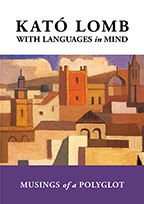
Meandering, repetitive grab bag on languages and language learningKató Lomb was one of the twentieth century’s most accomplished polyglots (a speaker of many languages). Learning languages was her great love, and she did it well enough to work as a professional interpreter in sixteen tongues. Lomb also wrote books on language learning and interpreting, three of which are available for free download as pdfs on the website of The Electronic Journal for English as a Second Language (TESL-EJ). One of those books, With Languages in Mind: Musings of a Polyglot, was originally published in Lomb’s native language of Hungarian in 1983. The contents are aptly described by the subtitle as “Musings.” The book is comprised of 35 chapters, each from one to a dozen pages in length, in which Lomb shares thoughts, anecdotes, and her expert wisdom on languages, their interesting peculiarities, and how to learn and teach them.
This book will appeal to both language educators and language enthusiasts. For members of the latter category (like myself), Lomb does not provide a “fluent in 30 days” wonder scheme for how to learn languages quickly, but she does describe her preferred methods and acquired habits for studying and practicing new languages. She also advises teachers on how her methods could be incorporated into language education to improve student enthusiasm and success. Interspersed throughout the book are humorous anecdotes and horror stories of Lomb’s work as a simultaneous interpreter at various academic and political conferences. There isn’t really much rhyme or reason to the organization of the book; it is just a haphazard pouring forth of linguistic minutiae as the expert pontificates on her love of languages in a lively and for the most part accessible manner. Some topics Lomb discusses include the importance of context in learning vocabulary, the growing tendency in many languages towards the use of more and smaller words, general differences in speech patterns between males and females, and the purported value of learning Latin. To illustrate the points made in each chapter, she often cites examples from the linguistic characteristics of English, German, Hungarian, French, Spanish, Russian, and Japanese.
Lomb wrote her books in Hungarian primarily for a Hungarian audience. Thus the text includes many references, puns, inside jokes, and historical anecdotes that can only be truly understood by a native Hungarian. The English translator Ádám Szegi and/or the editor Scott Alkire explain these Hungarian-specific comments with footnotes, but much of the humor and import of such comments is lost to the English reader. This is an issue common to all of Lomb’s writings, but With Languages in Mind is by far the most Hungarian-centric of the three Lomb books I’ve read (the other two being Polyglot: How I Learn Languages and Harmony of Babel: Profiles of Famous Polyglots of Europe). In regard to her native tongue, some topics Lomb covers include the qualities of Hungarian that make it a beautiful literary language, the effect of the World War II fascist regime on the language, and generational changes in Hungarian over time.
The editor points out that some of the content in With Languages in Mind has either been pulled verbatim or slightly altered from the earlier published Polyglot: How I Learn Languages. Having read Polyglot previously, much of the content of With Languages in Mind did feel like a rehash, though I still enjoyed Lomb’s enlightening linguistic musings the second time around. Of the three Lomb books mentioned above that are freely available in English, With Languages in Mind is the least essential read. The other two books, Polyglot and Harmony of Babel, are more interesting, better organized, and cover more compelling ground.
If you liked this review, please follow the link below to Amazon.com and give me a “helpful” vote. Thank you.
Not quite what the subtitle promises, but still educational
 During her lifetime, Kató Lomb (1909-2003) was one of the world’s most renowned polyglots (a master of multiple languages). Languages were not only her passion but also her vocation. After earning a PhD in chemistry, she discovered her love for languages and pursued a successful career as an interpreter and translator, including simultaneous interpreting at scientific and political conferences. She was also an advocate for language learning and wrote four books on the subject. Her last book, Harmony of Babel, was published in 1988. The subtitle Profiles of Famous Polyglots of Europe leads one to believe that the book will consist of biographical sketches of renowned multilinguists, but such profiles comprise less than half the book. The rest is a discussion of languages and language learning techniques similar to the material featured in Lomb’s first book, Polyglot: How I Learn Languages.
Early in the book, Lomb provides biographical sketches of six great polyglots of the past. The best-known is Cardinal Giuseppe Mezzofanti (1774-1849), a Vatican scholar who was famous for his facility with dozens of languages, even though he never left Italy. Mezzofanti gets the most coverage, at 26 pages, while the shortest profile is less than a single page in length. The depth seems to be determined by the amount of information available on each person, which in some cases is pretty scant. Lomb only cites one or two references for each biographical sketch.
The bulk of the book is taken up by Lomb’s “Imaginary Round Table of Polyglots.” She interviewed 21 living (in 1988) polyglots and combined their answers to her list of questions into a sort of mock symposium on linguistics and language learning. Some, like Lomb, work as interpreters and translators, but others include linguists and philologists, reporters, poets, an archbishop, and the grandson of Emperor Franz Joseph von Habsburg. All are European except for one American and one Japanese. Each of these polyglots gets their own introductory profile, and it is fascinating to read how they learned their languages and how they use them. In the mock discussion that Lomb has compiled, they all provide interesting perspectives and tips on language learning, but they agree on very little.
Though her works have been translated into multiple languages, Lomb is Hungarian and wrote the book for a Hungarian audience. Consequently, Harmony of Babel includes an essay entitled “Why Is Language Instruction Ailing in Hungary?” In her writing, Lomb often makes references to Hungarian authors, poets, painters, and politicians, which actually makes the book more interesting to an American reader with little knowledge of Hungary, its history, or its arts and letters. The editor of the English-language edition provides helpful explanatory footnotes when needed. The book ends with a transcript of an interview of Lomb by a Hungarian TV host in which they engage in an in-depth discussion on the profession of interpreting.
A pdf file of this book, and two other Lomb books, can be downloaded for free from the website of The Electronic Journal for English as a Second Language. The primary audience for this book is language educators, but self-educating language enthusiasts will also find much useful wisdom. Given the subtitle, I was disappointed Harmony of Babel didn’t have more biographical information on historic polyglots. It turned out to be more of a miscellaneous grab bag, but I still enjoyed the read and gained a lot of insight into language learning methods.
If you liked this review, please follow the link below to Amazon.com and give me a “helpful” vote. Thank you.
https://www.amazon.com/review/R7J5EMGN3QFEO/ref=cm_cr_srp_d_rdp_perm
Anecdotes and tips from a master multilinguist
 Hungarian author Kató Lomb (1909-2003) has been called “the world’s most multilingual woman” and “possibly the most accomplished polyglot in the world.” After earning a PhD in chemistry, Lomb taught herself 16 languages well enough to work as a professional translator and interpreter in all of them, including Russian, Chinese, and Japanese. Lomb was also one of the world’s first simultaneous translators (like the ones who talk in the United Nations headphones). After achieving renown as a polyglot (master of many languages), Lomb wrote four books about languages and language learning. Her first book, Polyglot: How I Learn Languages, was published in Hungarian in 1970. An English translation can be downloaded for free from the website of TESL-EJ: The Electronic Journal for English as a Second Language.
The intended audience for Polyglot includes those who teach themselves foreign languages, those who teach languages to others, and those thinking of becoming professional interpreters. I fit into the self-taught category, but nowhere near the level of Lomb’s achievements. This book can be read by language learners of any skill level, even beginners, but one must have an avid curiosity for languages to find it interesting and useful. This book is for people who want to do more than just learn travel phrases, but who actually wish to read texts, have meaningful conversations, and go beyond mere memorization to learn the actual mechanics of a foreign language.
Despite the subtitle, only a few of the chapters really function as a how-to manual for language learning. This book is really a combination of Lomb’s personal anecdotes, learning tips, and educated reflections on languages. Even so, there is still plenty of concrete practical advice for those wishing to learn foreign languages. In addition to her own expertise as a polyglot, Lomb draws upon the work of educators who have researched the most efficient and successful methods of language instruction. First and foremost, Lomb dispels the myth that language learning is easier for children and that adults are too psychologically immutable to learn foreign languages effectively. Not only is she herself living proof that this is incorrect, having acquired almost all of her languages as an adult, Lomb also cites research opposing this assumption. In discussing her personal methods of language learning, Lomb enumerates her “Ten Commandments of Language Learning,” as well as a list of ten “dont’s” of language study. In a brief nutshell, her methods promote the deciphering of books (fiction, for example) over textbook learning, thus emphasizing the acquiring of words and phrases in context rather than memorizing vocabulary lists. Obviously there’s more to it than that, but too much to summarize here. Lomb also offers advice to those thinking of pursuing a career as a translator or interpreter.
Not surprisingly, Lomb credits enthusiasm and time invested as the most important factors for success. She obviously made language learning the most important activity in her life, and one would have to do the same to achieve her level of success. Those wishing to learn one or two languages rather than 16, however, need not be intimidated by Lomb’s methods. There is no panacea for acquiring fluency in an unfamiliar tongue, but Lomb’s insights and practical knowledge will surely prove helpful to readers with more than a passing interest in foreign languages. The advice she offers here is more rational and realistic than so many of the “learn in 30 days” methods on the market. In addition to her linguistic erudition, Lomb writes with a charming personality and sense of humor that makes the book an enjoyable read. I look forward to reading more of her works.
If you liked this review, please follow the link below to Amazon and give me a “helpful” vote. Thank you.
https://www.amazon.com/review/R36S69SGP093J2/ref=cm_cr_srp_d_rdp_perm