A brilliant work of dark satireCzech author Karel Capek is most famous for coining the term “robot” in his 1920 play entitled R.U.R. (Rossum’s Universal Robots). There is much more to this author, however, than just the answer to that trivia question. The more I delve into Capek’s catalog of works, the more I come to admire him as one of the better modernist European writers of the early 20th century. Like his countryman Franz Kafka, Capek’s fiction is often innovative, quirky, and profound. While most of Capek’s published writings fall outside the realm of science fiction, he is best known for two works in that genre: R.U.R. and his 1936 novel War with the Newts.
Captain van Toch, a Czech seaman (apparently not an oxymoron, even for this landlocked nation) leads a pearl-hunting expedition to a South Pacific island. In a secluded cove, he discovers a race of intelligent, chimp-sized, bipedal salamanders living in an underwater community. What would mankind do if we discovered another intelligent species on our planet? Breed them for slave labor, of course! Van Toch soon has the Newts harvesting pearls for him. He transports them to other islands and coastlines all over the world to increase his pearl production. Soon, due to their prolific breeding, the Newts are no longer van Toch’s little secret. As their population grows millions upon millions, the Newts become common knowledge and are taken for granted as manual laborers in many diverse industries.
From his 1922 debut novel The Absolute at Large, Capek resurrects the character of G. H. Bondy, a Czech industrialist who invests in van Toch’s pearl scheme. War with the Newts starts out in very much the same lighthearted humorous tone as that earlier book. While The Absolute at Large, however, just read like one joke repeated over and over again, War with the Newts is delightfully wide-ranging in its satirical targets. Capek manages to lampoon imperialism, colonialism, capitalism, militarism, nationalism, the Nazis, American racism, slavery, British pompousness, the League of Nations, animal cruelty, environmental degradation, religion, and more. War with the Newts is truly an ingenious and innovative work of sci-fi satire.
If there is a flaw to this novel, it’s that Book One is so different in style and tone from Books Two and Three. Book One is written largely in the silly, almost slapstick style of The Absolute at Large. There are even a couple of unnecessary chapters that satirize movie stars and the film industry. Books Two and Three, however, present a dark dystopian future crafted with meticulous and insightful detail. The reader can’t help but admire the levels of depth that Capek builds into this world he has created. The “Newt problem” is explored through political, social, economic, religious, cultural, and evolutionary dimensions, among others. The centerpiece of the novel, Book Two, is a brilliant faux scientific report on the Newts, complete with footnotes, that is permeated by between-the-lines revelations of human cruelty. Even when he’s depicting atrocities, Capek slyly works wry and biting humor into the telling.
A major focus of mockery in the novel is the slave trade. The exploitation of the Newts very much reflects that of Africans in prior centuries. Why write a book satirizing slavery in the 1930s? Likely Capek could see what was coming with the rise of the Nazis, who would soon treat many segments of the European population in much the same inhuman fashion in which the Newts are treated here. A passage on the use of Newts for biological experimentation presages the horrors of Joseph Mengele’s sadistic “research.” World War I was an extravagant showcase of human cruelty, and by the 1930s Capek could look to multiple instances of genocide taking place throughout the world and see the writing on the wall for the next world war. While there may be a dark sense of humor to Capek’s social commentary, one can also learn much from this book. Even today, many of the points made and issues addressed are still sadly valid and relevant.
One-joke satire of religious fanaticismBy the time Czech author Karel Capek published his first novel, The Absolute at Large, he had already established himself as a playwright. His most famous work nowadays, the science fiction drama R.U.R. (Rossum’s Universal Robots), was first staged in 1920. Like that play, The Absolute at Large, published in 1922, is also a work of science fiction that takes place in the future. Capek is an exceptional writer who deserves to be better-known among English-language readers. His writing bears some resemblance to that of his countryman Franz Kafka in its dystopian visions, pessimistic tone, and deadpan sense of humor. The Absolute at Large, unfortunately, is not one of Capek’s better novels.
The story begins in 1943. G. H. Bondy is an industrialist who owns a factory in Prague. While perusing the newspaper, he comes across an ad placed by an inventor wishing to sell his latest invention. Bondy recognizes the name of the inventor as a former classmate of his and decides to call upon his old friend. The inventor, R. Marek, shows Bondy a dynamo he has created that runs on atomic power. He calls the device the Karburator. Unlike the inefficient burning of coal or wood, the Karburator can utilize the full atomic energy of its fuel, completely obliterating the raw material for a far more efficient and clean energy production. With such a wonderful and potentially lucrative invention, Bondy wonders why Marek is so eager to sell his creation.
It turns out that the Karburator produces an unusual side effect: an overwhelming feeling of religious fervor. According to philosopher Baruch Spinoza’s pantheistic doctrine of monism, God is inherently present in all matter, thus permeating the entire universe. When Marek’s Karburator annihilates matter, the portion of God, or the Absolute, contained in that matter is then released, affecting the minds and souls of those in proximity to the machine. While Marek finds this side effect troubling, Bondy has no such scruples. He purchases the Karburator and begins mass production. Soon the world is run by these atomic power plants, and outbreaks of piety and zealotry become more frequent. Various cults arise, and members of established religious denominations become increasingly fanatical, leading to killings and war. In addition, the Absolute not only affects human minds but also acts on its own behalf. By applying its creative powers to manufacturing, it destabilizes economies by glutting the market with overproduced goods.
The premise of The Absolute at Large is commendably ingenious. What follows, however, becomes tedious. Capek presents scene after scene of religious fanaticism, which to the reader is like hearing the same joke over and over again. I don’t have a problem with Capek’s religious irreverence, as we seem to share the same freethought views. He is not satirizing Spinoza so much but rather making a mockery of organized religion and each believers’ sense of denominational superiority. The conflicts between sects escalate into a dystopian, apocalyptic future, but one told with satirical silliness. Capek keeps introducing new characters every couple chapters, thus making it hard to become emotionally invested in any protagonist. Towards the end of the novel, Capek makes some valid points about religious tolerance, but by that time I was rather bored.
For his time period, Capek was a unique voice in science fiction, and his works are still surprisingly thought-provoking and impressively innovative a century later. In general, however, I think I prefer his more serious works (not all of them sci-fi), like his “Noetic Trilogy” comprised of the novels Hordubal, Meteor, and An Ordinary Life.
If you liked this review, please follow the link below to Amazon.com and give me a “helpful” vote. Thank you.
The Czech master’s Noetic TrilogyNovelist and playwright Karel Capek (1890-1938) is one of the most highly regarded authors in Czech literature. He is probably best known to English-language readers for his science fiction works R.U.R. (Rossum’s Universal Robots) and War of the Newts, but his literary work extended far beyond that genre to include political and philosophical novels, travel writing, and more. From 1933 to 1934 Capek published three novels—Hordubal, Meteor, and An Ordinary Life—that formed what he called his “Noetic Trilogy.” Shortly after their Czech publication, these three novels appeared in English translation. An English-language collection of the entire trilogy in one volume, entitled Three Novels, was first published in 1948.
The three novels in the Noetic Trilogy do not share any common characters or plot continuity. They are only related thematically by Capek’s literary and philosophical objectives. The word “noetic” is derived from “nous,” a philosophical term going back to ancient Greece that denotes the faculty of the human mind that allows for rational thought and understanding. It has also been used as a synonym for insight, intuition, or common sense. Capek’s concern with nous involves the understanding of a human life, either through the consciousness of self or the memory of others. Each book in the Noetic Trilogy shows how the experience or impact of a human life is viewed and constructed differently through differing perspectives. Through the fictional biography of each protagonist, Capek shows that the sum total of an individual’s life is more a kaleidoscope of possible interpretations than a linear narrative.
In Hordubal, a Czech farmer returns home to his wife and daughter after eight years working as a miner in American, only to find that a hired hand has usurped much of his authority as landowner, husband, and father. The narrative of Hordubal is related partly through third-person prose and partly through Hordubal’s first-person interior monologue, as well as a portion of the story being told through the dry prose of a police report or legal briefing. Each relativistic account sheds new light on events and calls into question the reliability of any firm interpretation.
Meteor is the story of a plane crash survivor who fell from the sky in a ball of fire. Badly burnt and unconscious, the patient bears no indications of his identity, leaving hospital staff and other patients to construct one for him out of limited evidence and much speculation. The third novel, An Ordinary Life, purports to be exactly what its title suggests. A dying man sets out to write the autobiography of his “ordinary” life. As the narrative progresses, however, different aspects of his personality are revealed through which conflicting internal accounts of his actions emerge.
Although Meteor is not quite as outstanding as the other two novels, all three books are well worth reading. Three Novels also includes a brief afterword by Capek explaining how each novel fits into the Noetic Trilogy, but it is very brief and still leaves much open to interpretation. An introduction by William Harkins also sheds some light on the epistemological foundations of the trilogy. Like fellow Czech Franz Kafka (who wrote in German), Capek produced intellectually challenging literature that deals with deep psychological and existential themes. Three Novels is a formidable literary hat trick that proves his work deserves to be better known among English-language readers.
Works in this collection
Hordubal
Meteor
An Ordinary Life
If you liked this review, please follow the link below to Amazon.com and give me a “helpful” vote. Thank you.
https://www.amazon.com/review/R5JM66IDFT3A5/ref=cm_cr_srp_d_rdp_perm
Coming to terms with the prosaic and the perverseAn Ordinary Life is the third book in what Czech author Karel Capek called his “Noetic Trilogy.” This novel was originally published in 1934, following Hordubal and Meteor, the first two books in the series. Though the stories and characters of the three novels are unrelated, they do share a common style and purpose. I won’t attempt to define “Noetic,” but I can say that the common theme or scheme that runs throughout the trilogy is that in each book the life of its protagonist is viewed and/or analyzed through multiple perspectives. The disagreements in the various viewpoints alternately obscure and enlarge the reader’s understanding of different aspects of the character and events of the story, thus calling into question how we myopically view our own lives and what narrative will be left behind after our own passing.
When an unnamed narrator is diagnosed with a terminal illness, he decides to write his autobiography. He doesn’t consider his life anything exceptional, but why shouldn’t an ordinary man leave behind an account of his ordinary life? So that’s what he sets out to do. He paints a prosaic and mundane picture of his life as a contented railroad employee. He diligently works his way from one incremental promotion to the next. Along the way he meets a young woman. They marry, but have not children. The first half of the novel leads the reader to expect exactly what the title promises, a life so unremarkable that the book begins to descend into boredom.
About the halfway point, however, the autobiography unexpectedly changes direction and turns into something different entirely. The narrator becomes more critical of his life and begins to reveal details that belie the serenity of the account he just related. What differentiates An Ordinary Life from its two predecessors is that in this case the multiple perspectives through which the man’s life are reflected are all within his own mind. This is not a case of literal schizophrenia or multiple personality disorder, but rather an example of one person’s ability to assess his own life through different aspects of his personality. The portrait of hard work and contentment is only one side of the story, much like the favorable life narratives we craft for public view on social media. As various sides of the subject’s psyche begin to argue with one another over what should be included or omitted from his autobiography, other aspects of his character are revealed, including an aggressive ambition, a hypochondria enabled by his coddling mother, and perverted desires spawned by forbidden sexual encounters in his past. Capek’s writing on these darker topics is surprisingly frank and disturbing. This was a challenging read for its time, not a pandering potboiler. Capek also delivers some insightful dissenting views on the institution of marriage, albeit the marriage dynamic of the 1930s, when women were forced into a more subservient role than today.
All three novels in the Noetic Trilogy are well worth reading. It is a toss-up between Hordubal and An Ordinary Life as to which is the best of the three books. Meteor is not quite as outstanding as the other two, but it is still a remarkable work. English-language readers primarily know Capek as a science fiction writer, from his futuristic play R.U.R. and his utopian novel War of the Newts. The books in the Noetic Trilogy, however, are not sci-fi at all but rather more along the lines of the existential fiction of Franz Kafka or Albert Camus. An Ordinary Life and the two books that preceded it reveal Capek to be an underrated author with a keen insight into human psychology and an exceptional talent for crafting innovative and thought-provoking literature.
If you liked this review, please follow the link below to Amazon.com and give me a “helpful” vote. Thank you.
https://www.amazon.com/review/R329KSCTD8V3DE/ref=cm_cr_srp_d_rdp_perm
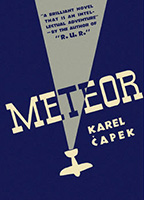
Clairvoyant character studyMeteor, a novel by Czech author Karel Capek, was originally published in 1934. The title of the work and Capek’s reputation as the author of the futuristic play R.U.R. (Rossum’s Universal Robots) might lead one to believe that this is a science fiction novel, but it is not. The “meteor” in question is metaphorical, not literal. This is the second novel of Capek’s Noetic Trilogy, in which Meteor follows Hordubal and precedes An Ordinary Life. I do not know enough about Capek’s work to explain what “noetic” means in this case or why these three novels with unrelated stories are considered a trilogy, but I have read Hordubal and enjoyed it so I expected good things from Meteor.
The plot of Meteor takes place largely within a hospital in an unspecified location in Europe. The “meteor” that the title refers to is a patient in this hospital, the victim of a plane crash, who fell out of the sky in a ball of fire. He is unconscious, burnt beyond recognition, and bears no identification, therefore nothing is known about the man. His past is a blank slate and thus fuel for speculation among those who come in contact with the patient, who is referred to as Case X. A doctor and a specialist make inferences about the man’s recent past based on his medical condition. A nun attending the patient has visions of him speaking to her in her dreams, revealing details of his life. Another patient in the hospital is a man known to have the gift of clairvoyance, who is able to “feel” aspects of the mystery man’s personality and past experiences. Lastly, the doctor has a friend who is a poet (though “poet” probably should have been translated as “author,” since we only find him writing prose fiction rather than poetry). Overcome with curiosity over this unusual case, the writer crafts his imagined life of Case X into a novella. Thus, the reader comes to know the protagonist through second-hand perspectives that are suspect for their subjective and speculative natures.
Meteor is quite captivating and intriguing as one begins to learn about Case X. The possibilities of this man’s past gradually expand as the nun and the clairvoyant elaborate upon his identity. The book takes a turn for the worse, however, when the poet chimes in, and unfortunately his narrative occupies at least half the book. This writer crafts a somewhat formulaic melodrama around Case X. Though skillfully done, it is not as interesting as the first half of Meteor, which promises a more unconventional novel. While the poet relates his fiction to the doctor, he also veers into reflective asides about the craft of writing, which feel like self-indulgent digressions only a writer could love. Capek himself is a far better writer than the fictional author he has created, who comes across a bit hacky. Though the latter half of Meteor doesn’t quite live up to its beginning, it does not descend into mediocrity. This novel is still a strong showing by Capek, but overall it is not as successful a work of literature as Hordubal nor as audacious as R.U.R.
In his homeland, Capek is regarded as the twentieth century master of Czech literature. Though English-language readers primarily know him as a science fiction writer because of a few prominent pioneering works in that genre (R.U.R., War of the Newts, Krakatit), Capek demonstrates in the first two books of his Noetic Trilogy that he is equally adept at portraying the drama of human lives in the real world. I look forward to seeing how he concludes the trilogy with An Ordinary Life.
If you liked this review, please follow the link below to Amazon.com and give me a “helpful” vote. Thank you.
https://www.amazon.com/review/R14PEVUZDKO9QV/ref=cm_cr_srp_d_rdp_perm
Compelling psychological drama of Czech rural lifeFor his spearheading of early 20th-century modernism, Karel Capek (1890-1938) is one of the most important figures in Czech literature. English-language readers will probably know him best as the writer who introduced the word “robot” to the world in his 1920 play R.U.R. (Rossum’s Universal Robots). Capek’s novel Hordubal was published in 1933. It is the first in a trilogy of thematically connected novels—followed by Meteor and An Ordinary Life—often referred to as the Noetic Trilogy. In English, this trilogy of novels is found together in one volume entitled Three Novels, translated by M. and R. Weatherall and first published in 1948.
As the novel opens, Juraj Hordubal is leaving America to return to his homeland, where he owns a farm in the Carpathians. He has spent the last eight years working as a coal miner and sending most of his earnings home to his wife and daughter. Having communicated with his wife only sparsely during his absence, Hordubal has given her no warning of his arrival, yet he nostalgically expects all at home to be just as he left it. His wife is understandably shocked when he shows up unannounced. Rather than pining away for her husband, Polana Hordubalova has been running the family farm successfully with the help of a hired man named Stepan Manya. Polana and Manya’s ideas on profitable agriculture clash with those of Hordubal, who is set in his ways with old-fashioned notions of bucolic life. As a result, in the management of his own property, Hordubal is made to feel like an ineffectual and unwanted interloper.
In personal matters, Polana treats Hordubal more like a stranger than a husband. Not surprisingly, it is hinted that Polana and Manya were lovers during her husband’s absence. Despite all the signs pointing in that direction, Hordubal either fails to ascertain the romantic relationship or deliberately denies it so as not to face up to the fact. Gossip among the neighbors eventually forces him to address the issue, causing conflict between the three parties concerned.
The narrative of Hordubal is related partly through third-person prose and partly through Hordubal’s first-person interior monologue, the two voices alternating seamlessly. As the reader gets to know the characters and become intimately involved in their lives, the story becomes more and more addictive. Despite the deceptively mundane milieu of rural life, each chapter manages to conclude with what feels like a psychological cliffhanger, leaving the reader anticipating what comes next. The suspense culminates in a shocking turn of events in the novel’s latter half. Capek’s storytelling has some of the deadpan objectivity of Franz Kafka’s The Trial or Albert Camus’s The Stranger, as if the characters are but guinea pigs in a philosophical experiment, their fates at the mercy of an indiscriminate universe. What makes this novel different, however, is the pathos and warmth one feels for Juraj Hordubal himself, who comes across as a much more likable and human character than Camus’s existential hero Mersault.
The “noetic” aspect of Capek’s Noetic Trilogy has to do with epistemology—the branch of philosophy that concerns how humans think and know. I won’t know what to say about that aspect of the novel until I’ve read the other two books in the series, which I fully intend to do. Regardless of Capek’s theories on epistemology, I just found Hordubal to be a very compelling story, one I was reluctant to put down until reaching the very end.
If you liked this review, please follow the link below to Amazon.com and give me a “helpful” vote. Thank you.
https://www.amazon.com/review/R32DVS9ZZ88LD/ref=cm_cr_srp_d_rdp_perm
Visionary science fiction meets Dadaist absurdism
 Karel Capek is frequently the answer to a historical trivia question: Who came up with the word “robot”? Capek it was, and this was the work in which he introduced it. R.U.R. (Rossum’s Universal Robots), published in 1920, is a four-act science fiction drama. It is the precursor to all the science fiction literature and movies about robots and/or computers becoming self-aware. The robots of R.U.R. can be seen as the great grandparents of Skynet from The Terminator, Hal from 2001, and Agent Smith from The Matrix. Though the concept may seem old hat to 21st-century audiences, this visionary play deserves more than a historical footnote. Almost a century after its debut, R.U.R. is still disturbingly thought-provoking and delightfully entertaining.
The play is set sometime in the late 20th century. Harry Domin is general manager of R.U.R., a robot manufacturer founded by Old Rossum in the 1930s. R.U.R. is the world’s foremost supplier of cheap, nonhuman labor. Helena Glory, the daughter of the President, arrives at Domin’s office unexpectedly. He is used to receiving curious visitors at the robot plant, and he gives her the VIP tour. Helena’s motives go beyond curiosity, however; she has come on behalf of a human rights organization called the League of Humanity, with the idealistic intention of liberating the robots. Her plot is thwarted, however, when Domin proposes marriage to her, an offer she somehow can’t resist. While Helena’s apparent change of heart cools her ardor for robot revolution, the robots, on the other hand, just might liberate themselves.
It goes without saying that this work was way ahead of its time. The robots of R.U.R. are not boxy, mechanical constructions, but rather androids built from man-made organic tissues, so as to physically resemble human beings. What differentiates a human from a robot? Just because we can create artificial beings, does that mean we have the right to use them as slaves? Do robots have rights? Do they have a soul? If these robot slaves we’ve created ever gain sentience, what does that mean for the future of the human race? By now we are all familiar with the ethical and philosophical debates regarding artificial intelligence, yet Capek’s take on the issues still feels fresh and provocative.
The wonderful thing about R.U.R. is that it doesn’t take itself too seriously. The play is quite lively and entertaining, and imbued with an absurdist sense of humor reminiscent of the Dada movement. The marriage proposal scene is outright slapstick. The dialogue is filled with wry little satirical witticisms. The human characters, with the possible exception of Helena, all have a trace of buffoonery about them, while the robots remain rational and dignified, almost noble. I would gladly sit in a theatre for two hours to watch this play. Reading it off the page, you can fancy yourself in a playhouse full of 1920s hipsters and imagine what the retro-futuristic sets and costumes might have looked like. Often a seminal work of classic literature, though groundbreaking, loses its appeal and relevance over time. Not so with R.U.R, which not only merits a spot in the science fiction canon but also deserves to be experienced and appreciated by a whole new generation of readers, performers, and spectators.
If you liked this review, please follow the link below to Amazon.com and give me a “helpful” vote. Thank you.
http://www.amazon.com/review/R3DJ5O0K9ZPPYL/ref=cm_cr_rdp_perm