Showing posts with label Miller Frank. Show all posts

Wednesday, September 13, 2023

Wolverine by Chris Claremont and Frank Miller


From X-Man to Samurai
Back in the 1980s when I used to pick out comic books at the drug store after school, Marvel invented the limited series. This was an opportunity to take supporting characters from superhero groups and highlight them in their own magazines, usually for a four-issue run (though some were two, six, or twelve issues). Thus, everyone from the Vision and the Scarlet Witch to Machine Man to Hercules to Iceman headlined their own miniseries. It was about this time that the character of Wolverine was really rising in popularity. What Eddie Murphy was to Saturday Night Live, Wolverine was to the X-Men. There was no doubt he was the star of that magazine, and sometimes it seemed like the rest of the team were just his back-up band. If any of Marvel’s characters seemed worthy of his own magazine it was Wolverine. While a lot of Marvel’s limited series of this era were not exactly high quality productions, Wolverine had the benefit of two of Marvel’s hottest creators, writer Chris Claremont and artist Frank Miller. The Wolverine limited series (now known as Wolverine Volume 1) was published in 1982.

The story takes place in Japan. Wolverine is in love with Mariko Yashida, a Japanese woman. Her father does not approve of the romance, however, and he happens to be one of Japan’s richest and most powerful crime bosses. After beating Wolverine up himself, Dad hires ninjas from The Hand to hunt Wolverine down and kill him. Wolverine, on the other hand, is concerned about Mariko’s safety and strives to free her from the clutches of her evil father. Marvel’s hardcover full-color reprint of this limited series, published in 2006, also includes two issues of the Uncanny X-Men (#172 and 173) in which this story is continued. While Miller draws the four issues of the Wolverine miniseries, Paul Smith pencils the pages of the Uncanny issues. All issues are written by Claremont.

Personally, I always found Wolverine’s Japanese storyline to be somewhat unnecessary. In a brief introduction, Claremont says he and Miller envisioned Wolverine as “a failed Samurai,” but didn’t Marvel try the same thing with Daredevil, Hawkeye, and who knows what other Marvel heroes? Wolverine already had plenty of back story with his Canadian history, his prior work as an intelligence agent and mercenary, his bloody rivalry with Sabretooth, and his connection with Alpha Flight. All of that could have been explored further before going down this Samurai road. Thankfully, this limited series was apparently successful enough to spawn an ongoing Wolverine series (now known as Wolverine Volume 2), which was one of Marvel’s best titles of the 1990s. Through that solo series, Marvel creators like Larry Hama were able to fully explore the possibilities of Wolverine’s past.

Frank Miller is one of the greatest superhero/action comics artists of all time, but this is not his best work. Chronologically, this Wolverine miniseries is sandwiched in between his run on Daredevil and his Batman: The Dark Knight Returns graphic novel. Miller’s art here isn’t as good as either of those works. Maybe it’s because he doesn’t have the benefit of Klaus Janson’s inking. One thing Miller does really well, however, is draw martial arts battles, and there are plenty of those in this Wolverine series. They just feel a bit like retreads of Daredevil’s battles with the Hand. In summation, this Wolverine limited series isn’t quite the masterpiece it’s often hailed as being, but it is a good solid piece of work from two of Marvel’s most talented creators and a whole lot better than a lot of the forgettable stuff Marvel cranked out in the ‘80s.
If you liked this review, please follow the link below to Amazon.com and give me a “helpful” vote. Thank you.

Monday, April 10, 2023

Hard Boiled by Frank Miller and Geof Darrow, et al.


Dystopian perversion and gore rendered in loving detail
Hard Boiled
, a graphic novel written by Frank Miller and drawn by Geof Darrow, was first published by Dark Horse Comics as a three-issue series in 1990. It was published as a trade paperback in 1993 and as a hardcover edition in 2017. It is this latter edition that I read. I have read that the 2017 release featured new coloring by comics colorist Dave Stewart. Some readers complained that the new colors altered the original work, but this is the only version I’ve read, so I can’t compare it to the original. The whole time that I was reading the book, however, I couldn’t help thinking how much Stewart’s striking coloring enhanced and intensified the artwork.

When Hard Boiled was first published, Miller was already famous for his gritty work on Marvel’s Daredevil and his Dark Knight graphic novels for DC. Dark Horse comics was a relatively young company at the time, but had already established a reputation for publishing daring work. As was characteristic of much of Miller’s work from this era, Hard Boiled is ultraviolent. In fact, it’s likely one of the most violent and gory comics ever published, and that’s saying a lot. The story takes place in a dystopian future reminiscent of Blade Runner. The main character is either a tax collector or insurance investigator (he’s not really sure himself), who will stop at nothing to hunt down and punish those he feels have broken the law, often putting himself in the way of bodily harm in the process. Hard Boiled is 128 pages long, and much of that is without dialogue. This is not really one of Miller’s more original or complex narratives. It bears some similarities to the film Robocop 2, which Miller wrote.

The real revelation here is Darrow’s art, which was like nothing else seen in American comics. With Stewart’s coloring, which calls to mind the colors of a Moebius comic, Hard Boiled resembles the European comics one finds in Heavy Metal magazine. Darrow’s distinct talent is to render every panel in hyper detail. When a car explodes, you see every nut and bolt that springs from the carnage, and the destruction of human bodies is rendered with the same exhaustive intricacy. This attention to minute detail extends to the backgrounds, in which Darrow renders the urban America of the future as a filthy landscape of wrecked cars, corporate logos, and perverse sex acts. Imagine if Where’s Waldo were porn, and you kind of get the idea.

One would have to be a little sick to draw these images, but I guess one would also have to be a little sick to enjoy them, which I did. Though the subject matter is dark and gruesome, Darrow sneaks a wry sense of humor into each disgusting panel. This really is a visual masterwork. Shortly after Hard Boiled’s original publication, Miller went in exactly the opposite direction with his Sin City series. Though the violent, film noir style of storytelling is similar, the art of Sin City, drawn by Miller himself, is stark black and white with an intentional lack of detail and brutal absence of nuance. In my opinion, Sin City was the greater contribution to comics. The stories are more complex and inventive than Hard Boiled, and the lengthier narratives allow for more character development of an interesting ensemble cast. Nevertheless, Hard Boiled is certainly a unique and intense experience. I’m not sure “enjoy” would be the right word for something this perverse, but this graphic novel will appeal to most Miller fans.
If you liked this review, please follow the link below to Amazon.com and give me a “helpful” vote. Thank you.

Monday, January 24, 2022

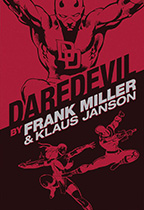
Daredevil, Volume 1 by Frank Miller and Klaus Janson


Promising start to an epic run
Back in the early 1980s when I used to stop by the drug store on my way home from school and pick up random comic books off the rotating rack, it was a special day if I walked out with a Frank Miller issue of Daredevil. At that time, Miller’s tenure on Daredevil was probably the most acclaimed title of Marvel Comics’ prolific output. Marvel’s series of trade paperbacks simply entitled Daredevil reprints this epic run. The volumes in this series are attributed to Frank Miller and Klaus Janson, the latter being the ace inker who finished Miller’s pencil sketches. For many years, the two artists comprised an almost symbiotic duo of comics creation. Volume 1 of this paperback series, published in 2008, reprints Daredevil issues 158 to 172, which were originally published from May 1979 to August 1981.


The book opens, however, with two 1979 issues of Peter Parker, the Spectacular Spider-Man in which Daredevil guest stars, drawn by Miller. Bill Mantlo wrote the story, and there is nothing special about it that merits these issues’ inclusion in this collection. Shortly thereafter, Miller took over the art duties on Daredevil with issue #158, while Roger McKenzie handled the writing. Prior to Miller signing on, Gene Colan was the artist for Daredevil. Colan, an old-school anatomist along the lines of Neal Adams, was one of Marvel’s best artists of the ‘70s. I happen to own Daredevil #157, Colan’s last issue before Miller took over, and issue #158 was definitely a step down in visual impact. Miller and Janson had yet to find their mature style, and the artwork is clumsily sketchy compared to Colan’s beautiful work, but still far better than the average Marvel art of the time. Over the course of this volume, however, one can see a definite positive development in Miller and Janson’s art, going from merely sketchy to deliberately stylized as Miller works his way towards the stark style of his later Sin City series. One area where Miller particularly excels in his Daredevil run is in the depiction of physical combat. More than just Jack Kirby-style splash-and-smash panels, Miller’s action scenes actually look like martial arts as practiced by someone of Daredevil’s superhuman abilities.

Miller didn’t take over the writing of Daredevil until issue #168. Prior to that, mostly in the hands of McKenzie, Daredevil faces off against a string of garden-variety tough guys like the Gladiator, the Mauler, and a rather dull outing against the Hulk. When Miller takes over, he gradually amps up the drama. The introduction of Elektra Natchios as Matt Murdock’s college girlfriend is a rather unimpressive debut, but then Miller introduces Daredevil to the Kingpin, which sets off a multi-issue arc that finally showcases Miller at his finest. The last few issues of Daredevil, Volume 1 are five-star comics that grant an enticing look at things to come when Elektra comes into her own, Stick becomes Daredevil’s mentor, and DD fights the ninjas of The Hand.


Marvel published four volumes in this Miller and Janson paperback series, then gathered them together in an “Omnibus” hardcover edition. The first half of Volume 1 holds it back from greatness, but the second half of the book is definitely a treat for classic Miller fans. Miller’s run on Daredevil is one of the shining moments in the history of Marvel, and this is where it all starts. Although there are no doubt better things to come in Volume 2, even Miller and Janson’s early issues are a substantial cut above typical Marvel fare of this time period.

If you liked this review, please follow the link below to Amazon.com and give me a “helpful” vote. Thank you.
Monday, September 8, 2014

Batman: The Dark Knight Returns by Frank Miller


The cinematic comic book that launched comic book cinema
Originally published in 1986 as a four-issue comic book miniseries, Batman: The Dark Knight Returns was written and drawn by Frank Miller, with inks by Klaus Janson and colors by Lynn Varley. Almost immediately, the four issues were collected into a trade paperback. Nearly 30 years later, it’s still one of the all-time greatest graphic novels in superhero comics. As the story opens, Batman has not been seen in Gotham for the past decade. Now 55, Bruce Wayne sees the rising tide of violent crime that’s sweeping his city’s streets as an invitation to come out of retirement. This ain’t your daddy’s Batman, however. Though this is a DC comic, Miller was primarily known for his work at Marvel Comics, and he definitely brought the Marvel sensibility to his Batman work for DC. Rather than a nimble detective matching wits with clue-dropping lunatics, Miller’s caped crusader is a hulking, brutal vigilante who fights violence with violence.

Judging by today’s comics and the movies that spring from them, it’s hard to imagine there was ever a time when superheroes weren’t trying to kill their adversaries. Back in the late ‘80s, however, Marvel and DC were just emerging from the confines of the Comics Code Authority and testing the waters of sex and violence. This graphic novel was like a big fat belly flop into the latter category. It’s much more than just a mindless slugfest, however. Watchmen is often hailed for its philosophical vision of superheroes in the real world, but Miller presents a more realistic and cynical view of how mankind might react if giants walked among us.

The art was also pretty ground breaking for its time, but in hindsight it’s not Miller’s best work. Most pages are cluttered with too many tiny panels. Batman is usually depicted as a blocky chunk of muscle while the bit players are often rendered with the wispy sketchiness of a Jules Feiffer caricature. Overall the art here is like a prepubescent stage in the development of the mature, in-your-face style of his Sin City books. One look at the neon-punk couture of the street gang known as The Mutants leaves little doubt that this book was a product of the 1980s. Regardless of the dated fashions, it’s a brilliant document of that decade’s Cold War paranoia. At times Miller gets a little heavy-handed, like depicting Reagan in a star-covered blazer, but he vividly calls to mind a time when a Russian-induced armageddon seemed an imminent possibility.

The Dark Knight Returns reads more like a movie storyboard than it does a typical comic book. With the finesse of a skilled film editor, Miller interweaves several competing narratives. A television is always on in the background, alternating between newscasters, talking heads, and pundits who provide political subtext and ethical discourse. More than any other American comics creator, Miller is responsible for the explosion of comic book action movies over the last quarter century. The comic books he created were so much like the movies we all wanted to see, the moviemakers were forced to follow his lead. 300 and Sin City are obvious examples, but rarely does a superhero film appear that doesn’t lift ideas from him in some way. Christopher Nolan’s Batman trilogy owes a great debt to Miller’s work. The Dark Knight Returns started it all. Though Miller has garnered his fair share of critical acclaim, he’s just as likely to be accused of being sadistic, misogynistic, or perpetually adolescent. Heck, if it’s Keats and Shelley you want, try Neil Gaiman. But if you like hard-boiled pulp fiction, visceral action, and epic thrills, Miller’s your man, and The Dark Knight Returns is the place to start.
If you liked this review, please follow the link below to Amazon.com and give me a “helpful” vote. Thank you.

Friday, April 19, 2013

Sin City by Frank Miller


Unleash your inner psychopath!
This is the first and best of Frank Miller’s Sin City graphic novels. Originally published in 1992, the first edition was simply entitled Sin City. It was later named The Hard Goodbye to distinguish it from the later stories in the series. Here we are introduced to the incomparable character of Marv—a big ugly psychotic lowlife with a heart of gold. Marv wakes up next to a dead hooker who just gave him the night of his life. In gratitude for his good fortune he vows to track down her murderer, even if he has to torture and kill everyone who stands in his way. Miller plucks the choicest cliches from every gritty noir thriller of the past three-quarters of a century, then exaggerates and magnifies them until they meld into something totally original and exhilarating. Miller simultaneously critiques and revels in America’s love affair with violence in pop culture. Through Marv’s interior monologue we are allowed entrance into the mind of this brutal antihero who possesses the mind of a child, the loyalty of a faithful dog, and the blood lust of a maniac. It is a testament both to Miller’s skill as a writer and to the depravity of our violence-jaded culture that we can root so enthusiastically for this demented sadist. The effect is truly liberating. Reading The Hard Goodbye is a ride like no other.

In the past two decades so many artists have copied Miller’s stark black and white art that it’s difficult to remember just how shockingly original this style was when these comics first came out. I remember seeing this book for the first time, as someone who had enjoyed superhero comics for most of my life, and thinking it was like nothing I had ever seen before. Miller’s work still stands as superior to all his imitators. The art of Sin City pays homage to the classic newspaper comics of masters like Milton Caniff and Will Eisner, yet Miller pares down the imagery to its sparsest elements, distilling each panel until it resembles something like a Japanese woodblock print. Though he takes plenty of liberties with human anatomy, Miller’s ingenious manipulation of positive and negative space would make this book an excellent supplemental text for an undergraduate drawing course. Of course, it wouldn’t be politically correct to use the book for such a purpose because the story is so delightfully perverse.

Judging from Miller’s art, I always thought Marv was a black man until Mickey Rourke was cast to play him in the movie. Rourke turned out to be an excellent choice, and the movie did justice to this great story. There’s still a few scenes here that never made it into the film, however, and Miller’s fabulous art alone makes it worthwhile to experience this story in its original form. For comics enthusiasts, this is one of those modern masterpieces you must own. Even if you don’t normally read comics, if you like hard-boiled crime stories of any media, you’ll love this book. Of all Frank Miller’s Sin City stories, this is the one essential must-have.

If you liked this review, please follow the link below to Amazon.com and give me a “helpful” vote. Thank you.
http://www.amazon.com/review/R9PF4WD9K4OUW/ref=cm_cr_rdp_perm