These “classics” are mediocre at bestI’ve always been a big fan of the Library of America. Mostly I’m familiar with their volumes of classic literature in the black and white dustjackets. When it comes to that sphere of publishing, they put together the best-edited and best-produced books in the business. When I saw that this volume on American Science Fiction was being offered as a Kindle Daily Deal, I snatched it up, expecting that it would reflect the smart editorial choices and general excellence I’ve come to expect from the Library of America. American Science Fiction: Four Classic Novels 1968–1969, however, proved to be a major disappointment. Although I enjoy reading vintage science fiction from this era, these selections did not impress me at all. Two of the books were terrible, and two were mediocre at best. The four authors featured are all well-respected in the genre, and these books have maybe won Nebula or Hugo Awards, but I don’t always agree with the arbiters of taste who hand out such accolades. If these four books are indeed regarded as “classics” of the genre, then they are vastly overrated.
Past Master is the debut novel by R. A. Lafferty. In the 26th century, an Earth colony on a far-off planet is facing unrest in their utopian community, so they reach back in time to abduct Sir Thomas More, author of the original Utopia, to rescue their government. The book is filled with bad ideas, nonsensical language, meaningless dialog, and silly attempts at humor that aren’t funny. Even worse is Picnic on Paradise by Joanna Russ. This novel is ostensibly a wilderness adventure, devoid of adventure, in which Alyx of Tyre (a recurring character for Russ) leads a band of frequently weeping idiots on a pointless trek through the mountainous terrain of a planet ironically named Paradise. Like Lafferty, Russ takes so many liberties with the English language that her prose reads like fruitless nonsense.
The other two selections in the volume fare better by at least being readable. Like the two aforementioned, both take place in a distant future after mankind has populated many worlds. Samuel R. Delany’s novel Nova has a decent story about interstellar voyagers aiming to fly through a star as it goes nova. It just gets too bogged down in an overly melodramatic space opera and a bunch of tangential digressions about Delany’s pet interests (tarot cards, for example) that in no way contribute to the main plot of the narrative. The best novel in the collection, and that’s not saying much, is Jack Vance’s Emphyrio. Man’s interstellar colonies are governed by a sort of medieval feudalism, which Vance uses to advance his libertarian theories of economics. Inspired by the legend of a Christ-like martyr named Emphyrio, a young hero decides to resist the ruling empire. Unlike the other showings in this collection, Vance is at least a good craftsman of the English language and a thoughtful storyteller who can write science fiction that doesn’t defy logic.
The Library of America has published at least three other volumes in this series of American Science Fiction collections, all edited by Gary K. Wolfe. I am familiar with a few of the novels included in those other volumes, such as the excellent Way Station by Clifford D. Simak in the 1960–1966 collection. After being disappointed by Wolfe’s selections in this 1968–1969 volume, however, I don’t have confidence that another volume of science fiction from the LOA would be worth my money or time.
Novels in this collection (all previously reviewed at Old Books by Dead Guys)

Past Master by R. A. Lafferty
Picnic on Paradise by Joanna Russ
Nova by Samuel R. Delany
Emphyrio by Jack Vance
If you liked this review, please follow the link below to Amazon.com and give me a “helpful” vote. Thank you.
https://www.amazon.com/review/R2FIGMG8OUZZ3/ref=cm_cr_srp_d_rdp_perm
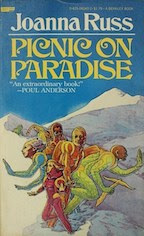
Pointless story about idiots on a camping tripPicnic on Paradise, a science fiction novel by American writer Joanna Russ, was published in 1968. It features a recurring character named Alyx who appears in a handful of Russ’s stories. Alyx is a thief and warrior woman of ancient Tyre (in present-day Lebanon) who was plucked from the past and brought forward by time machine to what would be our future. In this novel, Alyx is assigned by a lieutenant (a lieutenant of what is unclear) to guide several people on a backpacking exercise through the mountainous country of the planet Paradise. None of these people seem to be in the military (two are nuns, for example), so why are they taking orders from a lieutenant? Who knows? The planet Paradise is a nature preserve of sorts, but it is hardly paradisiacal. The mountains are snowy and cold, and the hikers have to face such hazards as freezing to death, falling in crevasses, and attacks by wildlife.
Alyx is the only member of the party who has any experience in this sort of wilderness adventure, and she’s the only one who acts remotely like an adult human being. The rest of the gang behave like children, speak in nonsensical non-sequiturs, and constantly break out crying for no apparent reason. Hardly a page goes by when one of these idiots isn’t weeping. It’s not just the characters that are dumb but the way they are written. Russ’s prose is merely a string of sentences that often make no sense and don’t really belong together in sequence. In the 1960s this might have been seen as creative, but to the intelligent reader of the 21st century it’s just annoying. It’s like listening to a bunch of children in a kindergarten shouting out whatever pops into their heads. The plot doesn’t really go anywhere, and the whole journey seems pointless. If there’s a larger philosophical meaning to this narrative, it escapes me. I question if this can even be considered science fiction because, with the exception of the occasional mention of a raygun or flying machine, it’s really just a camping story, and not a very good one.
I discovered this novel in the Library of America’s collection American Science Fiction: Four Classic Novels 1968–1969. This is the second novel I’ve read from that book, after R. A. Lafferty’s Past Master, and both were just terribly written and utterly pointless. Picnic on Paradise was nominated for a Nebula Award, which makes you wonder about the tastes of such award committees, science fiction critics, and the editors who put together “classic” anthologies. Were the sci-fi literati of that time so hard up for good books that anything remotely “different,” however foolish, is hailed as groundbreaking? I find that hard to believe. Alyx may be a feminist heroine, but doesn’t a feminist heroine deserve a better book than this? Russ may have some decent works in her oeuvre, but this isn’t one of them.
If you liked this review, please follow the link below to Amazon.com and give me a “helpful” vote. Thank you.