Showing posts with label Classics (ancient). Show all posts

Wednesday, March 9, 2022

Extinct Languages by Johannes Friedrich


A concise but not elementary overview of Old World epigraphy
Johannes Friedrich was a German linguist and hittitologist (an expert on the Hittites). His book Extinct Languages is a survey of ancient writing systems and the efforts made in deciphering them. (This is generally called epigraphy, but Friedrich’s translator never uses that word.) Originally published in 1954 as Entzifferung verschollener Schriften und Sprachen, the book was published in English translation in 1957. Friedrich begins his book by looking at “The Three Great Decipherments in the Study of the Ancient Orient”: Egyptian hieroglyphics, cuneiform writing, and Hittite hieroglyphics. This occupies the first half of the book, while the latter half is devoted to brief looks at about a dozen other ancient languages in various stages of decipherment. The book is illustrated with drawings or photographs of each script, and Friedrich explains the techniques employed, successfully or unsuccessfully, in deciphering them.

With the exception of the brief mention of an Indus Valley script and its similarity to writing found on Easter Island, the scope of the book is strictly confined to Southern Europe, North Africa, and the Middle East, ranging from Italy (the Etruscans) to Iran (Persian cuneiform). Friedrich never mentions Native American writing such as that of the Aztecs or Maya. The problems encountered and the techniques used in deciphering the Egyptian or Hittite hieroglyphics, however, are similar to those employed in the reading of the Maya glyphs (see Michael Coe’s book Breaking the Maya Code). Friedrich’s book offers an interesting glimpse into what epigraphers do and how they solve these fascinating centuries-old linguistic puzzles.

Given the broad and brisk coverage of each language, I’m guessing that Friedrich intended Extinct Languages to serve as an introductory text for undergraduate students and general readers. It is definitely accessible to amateur linguists and armchair archaeologists, but it’s not an easy read. In the 1950s, educated people were expected to have some knowledge of Greek and Latin, and Friedrich assumes his readers have that linguistic foundation, making some passages difficult for the average English-language reader of today. One thing I found frustrating is that Friedrich doesn’t provide any key to the Latinization scheme he’s using to transliterate these different writing systems into our alphabet. Perhaps he used a method that was the disciplinary standard for his time, but one unfamiliar with that scheme can only take a guess at the pronunciation of these transliterated words.

Obviously there’s been some progress made in the field since Extinct Languages was published. At the time of writing, the Linear B script from the Minoan civilization of Crete had not yet been deciphered. As the book went to press, however, Friedrich added an appendix describing the promising progress made by Michael Ventris towards reading that ancient language. (For more on that, see John Chadwick’s 1959 account The Decipherment of Linear B.) I’m sure advances have since been made in all of the languages discussed in this book, so Friedrich’s 60-year-old survey of the discipline cannot be considered up-to-date. The advantage to this book, however, is the broad range of languages that it covers. In all cases, if you want to learn how a specific script was deciphered, you’d be better off consulting a text that’s solely devoted to that one language. Friedrich’s overview gives enough of an introduction to each language to allow the reader to decide which topics merit following up with further research. For anyone interested in languages, it will definitely pique your interest enough to want to learn more.
If you liked this review, please follow the link below to Amazon.com and give me a “helpful” vote. Thank you.
https://www.amazon.com/review/RVMXCWFC1V2YI/ref=cm_cr_srp_d_rdp_perm

Wednesday, January 12, 2022

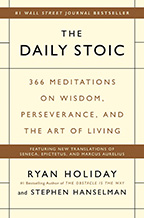
The Daily Stoic: 366 Meditations on Wisdom, Perseverance, and the Art of Living by Ryan Holiday and Stephen Hanselman


Insightful reflections on the ancient philosophy of life
The philosophical school of Stoicism may have been born in the 3rd century BC, but it has enjoyed a resurgence in recent years. In modern times, Stoicism served as the basis for cognitive behavioral therapy, a psychotherapeutic technique used to treat depression, substance abuse, eating disorders, and other mental maladies. Many contemporary would-be Stoics, however, prefer to bypass CBT entirely and go straight to the source for their life-coaching by using the writings of the Stoic philosophers of ancient Greece and Rome as the basis for a guide to living. With all the Stoic self-help books published in recent years, it was only a matter of time before one utilized the “daily affirmations” format. Such is the strategy of The Daily Stoic, published in 2016. The book was written by Ryan Holiday, a former PR man and marketing director, and Stephen Hanselman, a publisher and literary agent with a master’s degree in philosophy.

As the title of the book indicates, The Daily Stoic delivers 366 mini-lessons in Stoicism, dated January 1st through December 31st. These daily entries are divided into months, each revolving around a different theme, such as “Passions and Emotions,” “Duty,” “Fortitude and Resilience,” and “Virtue and Kindness.” Each daily lesson begins with a quotation from an ancient Stoic—most commonly Epictetus, Seneca, or Marcus Aurelius, but the authors also include selections from less familiar Stoics like Musonius Rufus, Cleanthes, and Zeno (the latter quoted from Diogenes Laertius’s Lives and Opinions of Eminent Philosophers). Holiday and Hanselman then provide a page or two of elaboration on the quote and how it applies to the problems of modern life.

Overall these daily Stoic meditations are really quite well-written. The authors are adept at taking ancient Stoic concepts and translating them into plain English without dumbing-down the philosophical content. Holiday and Hanselman certainly know their stuff and write about Stoicism knowledgably and intelligently. They often use examples from history or current events to illustrate the points made in the ancient quotes, which keeps the text interesting and relevant to 21st century readers. If you have already looked into Stoicism, chances are you’ve probably already read the Meditations of Marcus Aurelius or the Discourses of Epictetus, but this book will help you see those texts in a new way. Occasionally, the lectures sometimes veer into what one might call “self-help shaming,” implying that if you’re not living your life to the fullest, then your life is a waste. Such instances read more like a 21st-century conceit than what the Stoics had in mind when they promised a life of tranquility. Overall, however, I found the book quite insightful and useful.

Though I believe in Stoicism and its benefits for mental and emotional health, I did not diligently stick to the lesson-a-day schedule the book prescribes. Sometimes I got bored with The Daily Stoic and let several days go by without picking it up; sometimes I would enthusiastically devour half a month’s worth of entries in one sitting. This is not the best book I’ve read on Stoicism (William B. Irvine’s A Guide to the Good Life is hard to beat), but it is better than most. If you are serious about Stoicism, these daily contemplations on Stoic thought can be a useful tool to augment your studies. Having just finished the book with the end of the calendar year, I’ll probably just go back to the beginning and read it all over again.
If you liked this review, please follow the link below to Amazon.com and give me a “helpful” vote. Thank you.
https://www.amazon.com/review/R2I505MTLBP5V0/ref=cm_cr_srp_d_rdp_perm

Wednesday, November 24, 2021

The Home Life of the Ancient Greeks by Hugo Blümner


From cradle to grave in Athens and Sparta
Hugo Blümner was a German archaeologist who wrote several books on ancient Greece and Rome. His book The Home Life of the Ancient Greeks was published in English in 1895. It was first published in German in 1887 as Leben und Sitten der Griechen. The book is a synthesis of what was known in the late nineteenth century about the daily lives of ancient Greeks, not just the kings and warriors of renown but also the common folk and even slaves. Much of the book’s conclusions are drawn from extant texts and works of art left behind by the Greeks rather than from archaeological digs in which remains and artifacts are found in situ. For example, Blümner frequently refers to Homer’s descriptions of the archaic Greek world, as well as vase paintings and statues pictured in over 200 illustrations

The book opens with a very extensive chapter on clothing that really challenges the reader’s attention span with its charting of every fold, stitch, and pleat in the ancient Greek wardrobe. Next is a discussion of childbirth and childhood that covers not only how children were cared for but also how they amused themselves. After describing the kind of education Greek children of different classes would have received, Blümner then delves into marriage customs. This is followed by a dawn-to-bedtime study of daily life in a Greek household, paying close attention to the different activities practiced by men and women. A chapter on sickness and death explains the birth of the medical profession in Greece as well as burial customs. Succeeding chapters deliver copious details of the athletic, musical, and religious activities of the Greeks. A section on public festivals provides a vivid look at the Olympics and the Festival of Dionysus, among other events. Blümner’s very interesting chapter on Greek theatre does not go into the literary history of drama but rather describes how the plays were performed and the experience of the theatergoers. The book then delves into the lives of soldiers, farmers, and artisans before closing with a chapter on slaves, who greatly outnumbered the free population of ancient Greece.


Blümner admits that most of his book applies specifically to Athens and its vicinity, for that was the area of Greece on which most archaeological knowledge had been accumulated. On many subjects, however, he also provides specific information on Spartan life and customs, and on rarer occasions he discusses some of the outlying regions of Greece. Blümner also makes a distinction between the “heroic age” (the time of Homer’s works) and the “classic” period of Greek history, from about the sixth to the third century BC. He often discusses both eras, pointing out differences between the two.


A lot of archaeological digs have taken place over the past century, which no doubt have expanded upon our knowledge of ancient Greece, so there are bound to be some errors in accuracy and omissions of detail in Blümner’s work. For the non-archaeologist like myself, however, Blümner draws a sufficiently clear picture of the ancient Greek world to satisfy the curious general reader. Blümner’s writing, and its translation, were aimed at a nineteenth-century audience, so his prose often comes across as stilted and dry by today’s standards. For a more up-to-date, detailed, and user-friendly synthesis on the subject, I would recommend the Handbook to Life in Ancient Greece by Lesley and Roy Adkins, from Oxford University Press’s exceptional Handbook to Life series. Though it wasn’t always the most engaging text, I did learn much from The Home Life of the Ancient Greeks and found it a rewarding read.

If you liked this review, please follow the link below to Amazon.com and give me a “helpful” vote. Thank you.
https://www.amazon.com/review/R1QE3ISICETTV7/ref=cm_cr_srp_d_rdp_perm

Friday, June 18, 2021

The Decipherment of Linear B by John Chadwick


Cracking the ancient Mycenaean code
In the late nineteenth and early twentieth centuries, archaeologists working in Greece discovered a number of clay tablets inscribed with a previously undiscovered system of writing. Caches of these tablets were found primarily at two sites: the Minoan palace of Knossos on the island of Crete, and the Mycenaean city of Pylos on the Greek mainland. Eventually linguists and archaeologists established that the writing dates to around 1450 BC. The script was dubbed Linear B (as opposed to Linear A, an even earlier script). From the 1930s to the 1950s, many philologists tried unsuccessfully to decipher this writing, until British architect Michael Ventris discovered the key to cracking the code. Tragically, Ventris died soon after, in his mid-thirties. In his book The Decipherment of Linear B, first published in 1958, classical linguist John Chadwick, who collaborated with Ventris on the decipherment, tells the story of how this ancient writing system was discovered and decrypted. I am reviewing the Second Edition published in 1967.


When first encountered, any unknown script presents two main problems: First, is it a pictographic, alphabetic, or syllabic script, or a combination of the above? Second, all scripts are meant to represent a spoken language, but to which particular language does this script correspond? In the case of Linear B, it might very well be a language that no longer exists. Egyptian hieroglyphics were deciphered with the help of a bilingual text, the Rosetta Stone, but for Linear B there exists no such bilingual text, so the investigators basically had to start with nothing. Ventris and others began this daunting task by looking for familiar syntactical patterns in the texts and comparing them to languages from roughly the same time period, such as Etruscan, Cypriot, and Hittite. Ventris finally cracked the code when he proved that the characters corresponded to an early form of Greek.

Though Chadwick, along with Ventris, published several articles and books intended for specialists in the field, he states in the introduction to The Decipherment of Linear B that this book is intended for a general reading audience. While this is certainly an authoritatively informative book on its subject, Chadwick is not entirely successful at making this topic accessible to the lay reader. To tackle this book, one not only needs to have an avid interest in the ancient Greek world but also a fairly firm knowledge of linguistics. In explaining the decryption process, Chadwick goes into a level of detail that often surpasses the layman’s comprehension. One editorial choice that really makes this book user-unfriendly is that, due to difficulties in typesetting, the bulk of the text does not reproduce the Mycenaean words in the Linear B script in which they were actually written. Instead, Chadwick uses a system of numerals assigned to each character. Thus, the notation 08-60-02-15-04-13-06 may signify the word for “chariots.” Page after page of these numbers is enough to drive the reader nuts. The volume does, however, include 17 figures that illustrate the actual Linear B characters, including a comprehensive numbered syllabic chart (see below).

The tablets found at Knossos and Pylos were not literature, but rather lists of commodities. Still, as Chadwick interprets them, these tablets reveal a surprising amount of information on ancient Mycenaean life, including governmental administration, taxation and tribute, religious practices, the organization of military units, and ancient armaments. This window into the past is the most fascinating aspect of Chadwick’s book. The process of decipherment itself does not make as captivating a story as the decipherment of the Mayan language, as related by Michael Coe in Breaking the Maya Code, but anyone interested in ancient languages, particularly of Greece, will certainly find much intellectual stimulation in Chadwick’s insider account.

If you liked this review, please follow the link below to Amazon.com and give me a “helpful” vote. Thank you.


Friday, April 9, 2021

Handbook to Life in Ancient Greece by Lesley Adkins and Roy A. Adkins


Encyclopedic book of lists
The Handbook to Life series is a set of comprehensive books on ancient civilizations (and has recently expanded into medieval and Renaissance times as well). The Handbooks seem intended as undergraduate textbooks but are suitable and satisfying reading for any armchair archaeologist interested in the ancient world. I believe the Handbook to Life in Ancient Greece, compiled by British archaeological power couple Lesley Adkins and Roy A. Adkins, was the first volume published in the series, and it set a high standard of quality for the books that followed. It was originally published in 1997 by the publisher Facts on File, but the series has since been acquired by Oxford University Press, who have published the series in paperback editions.

I have read three other volumes in the Handbook to Life series, those on Prehistoric Europe, the Ancient Maya World, and the Aztec World. The Aztec and Maya volumes are excellent at examining all aspects of a civilization and providing a vivid look at what life was like in those periods, not just for royalty but for the common people as well. The Handbook to Life in Ancient Greece is less successful on the latter score. Like all of the Handbooks, the text is arranged in thematic chapters highlighting various aspects of the culture in question. In this Greek volume, only one brief chapter covers common aspects of everyday life such as food, clothing, and funerals, though an extensive chapter on economy and trade also helps to illuminate the lives of common working stiffs. The authors devote their heaviest coverage to religion, warfare, and historical events.

The problem, of course, is that so much is known about ancient Greece, what do you cram in between the covers of a one-volume synthesis? The Adkins’s strategy for solving the problem is to devote the bulk of the volume to a series of comprehensive lists, with each alphabetical entry elaborated by a paragraph or two of text. Thus, in addition to an extensive historical chronology (12 pages), the reader is treated to a smorgasbord of historical personages (42 pages), regions and alliances (24 pages), place names (11 pages), authors (17 pages), gods and mythological beings (49 pages), artists and architects (5 pages), and philosophers and scientists (9 pages). This makes the Handbook to Life in Ancient Greece a very good reference for looking up individual facts, but for those readers seeking a general overview of Greek civilization, this is not the most satisfying text for linear reading. Amid the morass of detail, it is often hard to see the forest for the trees.

Like other books in the series, this volume is heavily illustrated. Most of the illustrations are photographs of architectural ruins or artifacts such as sculptures, pottery, and coins. There are also some helpful labeled diagrams, though one wishes there would have been more of those, particularly in the architecture and art sections. The maps of Greek regions and city-states are very detailed. They are not the easiest to read but are more than informative enough for all but professional archaeologists.

New discoveries are constantly being made, so the information in this book can’t help but become dated with time. I’m sure professional archaeologists could find details to quibble about, but the layman or student will find this an abundant source of knowledge on the complex history and culture of the ancient Greek civilization. The Adkinses also wrote Handbook to Life in Ancient Rome, which I look forward to reading next.
If you liked this review, please follow the link below to Amazon.com and give me a “helpful” vote. Thank you.
https://www.amazon.com/review/R36BWSTKJZJWLJ/ref=cm_cr_srp_d_rdp_perm

Tuesday, September 22, 2020

The Speeches and Sayings of Marcus Aurelius


Bits and pieces beyond the Meditations
Marcus Aurelius
Emperor Marcus Aurelius ruled the Roman Empire from 161 to 180 AD and is remembered as one of Rome’s wisest and most benevolent rulers. He also left behind a wonderful book of philosophical thought, the Meditations, which is considered one of the fundamental texts of ancient Stoicism. The Meditations, however, is not Marcus’s only extant written work. A number of brief and fragmentary writings and quotations have survived from antiquity. These are generally grouped under the categories of Speeches and Sayings. Both are included in The Complete Works of Marcus Aurelius, an ebook published by the Delphi Classics, which is the edition that I am reviewing.


The Speeches of Marcus Aurelius consist of three brief orations. Two of them concern a rebellion led by Avidius Cassius in 175 AD. The third speech purports to be “The Last Words of Marcus,” spoken on his deathbed. One of the Cassius speeches was written down by Marcus and sent as a letter to the Senate, which speaks in favor of its veracity. The other two speeches are related second-hand, perhaps by first-hand observers or perhaps by writers long after the fact. The deathbed speech certainly reads as if it were embellished with the perfect eloquence possessed by dying characters in tragedian dramas. None of the speeches contain any overtly Stoic content, but they do illustrate Marcus’s good qualities as a leader, such as the two addresses regarding the revolt of Cassius, in which Marcus strongly emphasizes forgiveness and leniency over vindictiveness and harsh punishment.


The Sayings of Marcus Aurelius consist of 22 numbered paragraphs. These are written in an anecdotal third-person style similar to the Analects of Confucius. Each paragraph relates that on such-and-such an occasion, when addressing so-and-so, Marcus said . . . and then follows a quotation or aphorism from the master. It is unclear whether these sayings were gathered by an ancient author, or whether they are second-hand quotations selected from a number of ancient texts. The anecdotes collected represent a series of historical scenes in the life of Marcus, and the words he delivers often relate directly to that context. A few of the sayings can be taken to have broader philosophical meaning, touching upon Stoicism, as Marcus reveals his humble nature, his desire to be a good leader, and his brave attitude toward facing death. Also lumped in with the Sayings is a letter Marcus wrote to the Common Assembly of Asia, in which he censures the violent persecution of Christians and urges leniency instead.


There is nothing in the Speeches or Sayings that in any way competes with the insight or profundity of the Meditations. These writings are interesting in their own way, however, more for historical and biographical content than for philosophy. The Speeches and Sayings are unnecessary to an understanding of Marcus as a Stoic, so if Stoicism is you’re primary interest in the man then you’d be better off rereading the Meditations. On the other hand, for those completists who wish to cover the complete works of Marcus Aurelius, reading these brief works will likely take up less than an hour of your time.


Thursday, August 6, 2020

The Map of Knowledge: A Thousand-Year History of How Classical Ideas Were Lost and Found by Violet Moller


Whirlwind tour through a millennium of scholarship
The intellectual foundations of Western civilization were laid by the philosophers and scholars of ancient Greece. The original scrolls that documented their words of wisdom have long since disintegrated, so the earliest surviving manuscripts of Greek texts are copies of copies. The fact that any of these writings have survived to the present day is rather amazing, and the story of how they survived is fascinating. In her 2019 book The Map of Knowledge, historian Violet Moller gives credit where it’s due to the scribes, translators, scholars, and collectors who kept this knowledge alive through the Dark Ages. Moller covers roughly a thousand years of history, circa 500 to 1500, from the decline of the Western Roman Empire to the birth of the printing press and rise of the Renaissance. In telling this epic story, Moller organizes her narrative around seven cities—Alexandria, Baghdad, Córdoba, Toledo, Salerno, Palermo, and Venice—each of which successively supplanted its predecessor as the Western world’s leading center of books and learning.

To narrow down what would otherwise be a huge and ungainly study, Moller focuses on the works of three scholars who were at the apex of their respective fields: Euclid (mathematics), Ptolemy (astronomy), and Galen (medicine). The prolific Galen alone is responsible for roughly half of the extant writings from ancient Greece. Moller not only charts the history of ideas but also the world events and political figures that helped foster those ideas. The book highlights emperors and kings who patronized scholars and established legendary centers of learning, such as the Great Library of Alexandria, the House of Wisdom in Baghdad, and the Schola Medica in Salerno. The chapters on Baghdad and Córdoba are of particular interest because they highlight the contributions of Arab and Muslim scholars and scientists whose invaluable contributions to Western civilization are little known to most American readers.

With so much geographical ground and temporal scope to cover, Moller can only provide a whirlwind tour of these thousand years. Some key characters are granted extensive biographical sketches, but often an important figure will only be mentioned in a sentence or two before the narrative must rush on to the next succeeding stage of scientific enlightenment. Nevertheless, the reader is introduced to many fascinating lesser-known figures, such as al-Khwarizmi, the brilliant Persian mathematician who invented algebra; Gerard of Cremona, the hardest working translator in medieval Toledo; Roger II, the Sicilian king who transformed Palermo into an intellectual mecca; and Erhard Ratdolt, the pioneering book printer whose work rivaled that of the more famous Aldus Manutius.

Intended for general readers, this book is very clearly written without any challenging academic jargon, and explanatory footnotes spell out some very elementary concepts for those unfamiliar with ancient or medieval history. Even so, the very nature of the subject and Moller’s vast breadth of scope demands a confusing tangle of detail that may very well prove exhausting to the general history buff. One really has to be an enthusiast of rare books and their history to appreciate The Map of Knowledge. Such bibliophiles, however may be unsatisfied by the briskness with which Moller rushes through these thousand years. While novice readers might find it hard to see the forest for the trees, more knowledgeable readers will wish the tour bus would slow down a bit so they could enjoy the scenery.

If you liked this review, please follow the link below to Amazon.com and give me a “helpful” vote. Thank you.
https://www.amazon.com/review/R3NJAW7VBVAZGQ/ref=cm_cr_srp_d_rdp_perm

Wednesday, June 10, 2020

Libraries in the Ancient World by Lionel Casson


Literacy, publishing, and book collecting in early Western civilization
Libraries in the Ancient World, published in 2001, provides a concise but comprehensive summary of the history of libraries, both private collections and public institutions, from the birth of writing to the dawn of the Middle Ages. Author Lionel Casson was a professor of classical studies at New York University and a winner of the American Institute of Archaeology’s Gold Medal for Distinguished Achievement. As one would expect from a classicist, the “ancient world” referred to in the title lies strictly within the cradle of Western civilization—Greece, the Roman Empire, Egypt, and Mesopotamia—only venturing as far east as Iraq.

Concrete archaeological evidence of ancient libraries is unfortunately very scanty. Thanks to the volcanic eruption of Vesuvius in 79 AD, The Villa of the Papyri at Herculaneum is the one notable exception of an ancient Roman library found preserved intact and in situ, scrolls and all. Portions of ancient library buildings have survived, but their shelves of wood and books of papyrus and parchment have long since disappeared or rotted away. Casson uses these architectural remnants to reconstruct the layouts of ancient public libraries, giving the reader a vivid glimpse into the environments where scholars of ancient Greece and Rome consulted and copied handwritten scrolls. Most of the information we have on ancient libraries, however, comes from references in ancient texts. Though only a fraction of the ancient world’s books have survived, Casson, with an encyclopedic knowledge of extant classical manuscripts, is able to draw a wealth of fascinating detail from the writings of ancient authors.


Casson begins with the origin of libraries in the ancient Near East, when Sumerian cuneiform writing was incised into clay tablets, and then proceeds to Greece and Rome. He covers all the famous libraries one would expect to find in a book on this subject, such as the library of Ashurbanipal in Nineveh and the great Greek library of Alexandria, but he also discusses lesser-known libraries and privately held collections. The reader gets a thorough education in how libraries were formed, funded, and managed, how they acquired their collections, and how librarians catalogued those collections. Casson expands the scope of the book beyond libraries, however, to cover broader issues of book culture in the ancient literary world. The reader learns about all aspects of the classical book trade, including the materials and methods of book construction, how books were copied and disseminated (since “publishing” as we know it did not really exist), and the rise and role of the bookselling profession. Using statistical and ancient anecdotal evidence, Casson charts the development of writing from a utilitarian to a literary form of expression, the spread of literacy throughout the Greco-Roman world, and the gradual change in format from the scroll to the codex (the book with pages, as we know it today). He even outlines a sort of ancient bestseller list of those books likely to have been the most popular and widely stocked.


Libraries in the Ancient World is very accessible to general readers. It could easily be used as a supplemental text in any undergraduate course, not just in classics or archaeology but also in library science or literature. So as not to intimidate a general audience, the publisher has omitted in-text citation numbers and relegates Casson’s notes and sources to the back of the book, where they are recorded in a supposedly user-friendly nonacademic format that higher-level readers will likely find inhospitable. Nevertheless, anyone interested in rare books or the literary origins of Western civilization will enjoy Casson’s fascinating revelations on ancient bibliographic history.

If you liked this review, please follow the link below to Amazon and give me a “helpful” vote. Thank you.
https://www.amazon.com/review/R1X7T855YQ3YFW/ref=cm_cr_srp_d_rdp_perm

Monday, March 2, 2020

The First Six Books of The Elements with Coloured Diagrams and Symbols by Oliver Byrne


Ancient math meets modern graphic design
Home page of the Byrne’s Euclid website
Written around 300 BC by the Greek mathematician Euclid, The Elements has remained the primary textbook for the teaching of geometry for over 2000 years. Nevertheless, the Irish mathematician Oliver Byrne felt that this landmark work could be improved to make it more user-friendly. In 1847, Byrne published his own edition of The Elements, replacing the black-and-white figures that usually accompanied Euclid’s text with color diagrams illustrating each mathematical proposition or theorem. The resulting volume, entitled The First Six Books of the Elements of Euclid, in Which Coloured Diagrams and Symbols are Used Instead of Letters for the Greater Ease of Learners, marks a milestone in the history of book design and infographics. You can view Byrne’s Elements for free at the Internet Archive, but there is now an even better way to experience this clever merging of ancient learning and modern graphic design. American web designer Nicholas Rougeux has recreated Byrne’s Euclid as a website, free for all to read, that adds a dimension of interactivity to the learning process.

Euclid’s original The Elements consisted of thirteen books, but Byrne chose to include only the first six of those books in his 1847 edition. Perhaps he planned to continue in a further volume, or perhaps he felt the first six books would benefit the most form his color treatment. Five of these first six books deal with plane geometry—angles, circles, and polygons. Book V, which deals with proportions, is the anomaly in this set and perhaps gives some indication of things to come in Euclid’s Books VII through X, which are concerned with such topics as number theory, geometric sequences of integers, and prime numbers. Books XI, XII, and XIII deal with the geometry of three-dimensional solids and would have no doubt yielded some impressive illustrations had Byrne chosen to tackle them.


The Elements may be one of the foundational books in the history of mathematics, but as a tool for education it is a bit too cumbersome and perplexing. Thankfully, over the past century Euclid’s knowledge has been distilled into more accessible geometry textbooks. I pity our college-bound great-grandparents who no doubt had to learn directly from Euclid’s cryptic text and perhaps even memorize his axioms and theorems. Book V, on ratios and proportions, is particularly difficult to understand. Euclid’s text is almost unintelligible, and Byrne’s illustrations do little to clarify. The other five books on plane geometry, however, are more interesting, and if nothing else Byrne’s illustrations, like mini works of modern art, are certainly attractive. (In fact, you can purchase Rougeux’s versions in the form of a poster.) Whether Byrne’s colored diagrams significantly enhance the teachability of Euclid is arguable, but they sure are a pleasure to behold.


The Elements is valuable not only for its treatise on geometry but also for its unique structure. In this work Euclid establishes the fundamental framework of logical argument. The method by which he builds upon basic definitions and undeniable axioms to progressively develop and prove more complicated propositions is seen as the gold standard in applied logic and has been used by other scientists and philosophers to construct logical arguments in their own fields, most notably by Baruch Spinoza in his Ethics. This broadens the influence of The Elements far beyond mathematics, making it one of the most important books in Western thought. Even if geometry is not your cup of tea, some exploration of Rougeux’s ingenious website will give you a deep appreciation for Euclid’s impressive achievement, as well Byrne’s ambitious take on it.


A page from Oliver Byrne’s 1847 edition of Euclid’s The Elements

Monday, August 19, 2019

Epic Films: Casts, Credits and Commentary on More Than 350 Historical Spectacle Movies, Second Edition by Gary Allen Smith


An entertaining and informative guide for the sword-and-sandal fan
If you like movies about gladiators, centurions, argonauts, and apostles, then Gary Allen Smith has compiled the book for you. I am an enthusiast of ancient-world movies myself, and Epic Films is the best viewer’s guide that I have found on the genre. In the second edition, Smith catalogs 353 historical epics, providing cast and credits for each, as well as descriptive copy including plot outlines (with spoilers, unfortunately) and interesting behind-the-scenes anecdotes on the making of many of these films. Smith’s personal critiques are insightful and articulate, though the book really should have had a better proofreading because it does contain a lot of typos.

The second edition of Epic Films was published in 2004. Ridley Scott’s Gladiator is the most recent major film to be profiled, while Wolfgang Petersen’s Troy is mentioned as being in production at the time of publication. Smith mostly skips over the silent era, with a few exceptions. He does include D. W. Griffith’s Intolerance, for example, but not the 1914 Italian epic Cabiria. Beyond the dawn of the talkies, the book covers all periods of cinematic history amply, from the Golden Age of Hollywood to the Italian peplum films of the 1960s to the modern era of digital special effects, including many made-for-TV movies and miniseries that have long been forgotten. Smith does not confine himself to ancient Greece and Rome, biblical epics, and caveman films. He explains in his introduction that his definition of epic covers history up to around the year 1200. This allows for the inclusion of more medieval fare, such as stories of King Arthur and the Knights of the Round Table. The lion’s share of the entries, however, focus on ancient times, and when adventures from the Middle Ages are included, such as El Cid or Braveheart, they definitely qualify as epics. Noticeably absent are the Arabian Nights genre, such as The Thief of Baghdad or The Seventh Voyage of Sinbad. Asian history is represented solely by Genghis Khan, the Mongols, and the Tartars, and, through Hollywood’s fault rather than Smith’s, Kings of the Sun is the only film about the ancient Americas. Mostly Smith focuses on American, British, French, and Italian productions, with an occasional outlier like the Polish film Pharaoh.

Most of the books published on this genre of film have been scholarly monographs by film studies or cultural studies professors, such as The Ancient World in Cinema by Jon Solomon. The only other film-by-film guide I’ve seen is a book called The Encyclopedia of Epic Films, which, although it may have Ben-Hur on its cover, considers everything from Spider-Man to Star Wars as epics. Smith’s Epic Films, on the other hand, is aimed at the general reader who just enjoys grandiose cinematic depictions of prehistoric, ancient, and medieval times. Smith proves himself a very knowledgeable guide and offers much to learn for even the most avid fans of sword-and-sandal cinema. I have only watched about a third of the movies covered in this book, and it has yielded quite a few fortuitous discoveries of interesting films yet to be seen.

Though one might quibble here and there about a film that was or was not included, Smith deserves to be commended for putting together what is likely the most authoritative and user-friendly guide to the genre. Film fans who just can’t get enough of Hercules, Maciste, Samson, Goliath, Ursus, Odysseus, Spartacus, Cleopatra, Jesus, or the various Caesars are sure to enjoy this book. It is high time for a third edition.
If you liked this review, please follow the link below to Amazon.com and give me a “helpful” vote. Thank you.
https://www.amazon.com/review/R2U9ISZA7UL962/ref=cm_cr_srp_d_rdp_perm

Wednesday, September 12, 2018

A Short History of Greek Philosophy by John Marshall


A good concise overview from Thales to Chrysippus
A Short History of Greek Philosophy was written by John Marshall, a classicist and educator who translated classic Greek texts and also worked as rector of the Royal High School in Edinburgh, Scotland. Though published in 1891, the text is still very accessible to 21st-century readers. Marshall provides a very good concise overview of Greek philosophy from Thales—the first philosopher of the Western world—through the various pre-Socratics schools, the triumvirate of Socrates, Plato, and Aristotle, and the Epicureans and Stoics who followed them.

Throughout the book, Marshall discusses the thought of these ancient philosophers in clear and intelligent prose. The amount of detail he provides is enough for the reader to get a general understanding of each philosopher’s major tenets without getting bogged down in every twist and turn of their philosophical arguments. The text is not in any way dumbed-down, though it is much easier to get through than more extensive studies of Greek philosophy, such as a book like Frederick Copleston’s History of Philosophy, Volume 1, which probably delivers more information than the average non-philosophy major needs to know. In his Short History, Marshall really does a fine job of showing the continuous threads of thought weaving from one philosopher to the next through the course of history as each influenced his successors. Marshall also pauses periodically throughout the text to compare and contrast the important concepts of different philosophers.

Marshall gives ample coverage to the pre-Socratic schools, including the Pythagoreans, the Eleatics, and the Atomists, and satisfactorily distinguishes the differences and similarities between each thinker’s underlying conception of the cosmos. The bulk of the book, not surprisingly, is devoted to the teachings of Socrates, Plato, and Aristotle. Marshall gives the best simplified explanation of Plato’s ideas that I’ve ever read, and he provides a brief summary guide to Plato’s dialogues so that the reader can intelligently choose which texts to pursue for further reading. Plato is clearly Marshall’s favorite in the Greek philosophical pantheon, though he covers Aristotle with almost the same level of detail and regard. Marshall makes no secret of the fact that he feels the glory days of Greek philosophy ended with Aristotle. He gives the Sceptics and Epicureans cursory treatment and even expresses some disdain towards them. He ends the book with the Stoics, for whom he likewise gives short shrift. To be fair, however, all the best Stoics—Epictetus, Marcus Aurelius, Seneca—were Romans, not Greeks, so Marshall only mentions them briefly if at all.

One point that repeatedly shines forth in Marshall’s book is how so much of the philosophical output of these ancient Greek thinkers ended up being subsumed into Christian dogma. Marshall overtly makes that connection in a few brief passages, acknowledging the intellectual debt that Christianity owes to these early philosophers. It is easy for us today to dismiss the ancient Greeks as being too remote in antiquity to affect our daily lives, but in reality their influence is all around us. By reinforcing that relevance, A Short History of Greek Philosophy makes for a far more interesting read than I expected from a 19th-century philosophical history. Anyone looking for an introduction or a refresher course to the main ideas of ancient Greek thought will be well served by this commendable book.
If you liked this review, please follow the link below to Amazon.com and give me a “helpful” vote. Thank you.
https://www.amazon.com/review/R3BQL85HVUTQIG/ref=cm_cr_srp_d_rdp_perm

Friday, August 10, 2018

Historical Novels of the Ancient World

“Epic” doesn’t always mean good
Historical novels are a favorite genre here at Old Books by Dead Guys, and ancient civilizations are also a preferred area of interest, but it is rare that the two come together to make a great book. Below is a recap of some novels of the ancient world that have been reviewed here at this blog, including books set in ancient Greece, Rome, Egypt, and Carthage. Click on the titles below to read the full-length reviews. While there are a couple masterpieces included in this list, sometimes even great authors set out to craft an ancient epic and end up delivering a dud.  

Acté by Alexandre Dumas (1838) - 2.5 stars
This was the first historical novel by Dumas, who would go on to write dozens of them, if not hundreds. The story takes place around AD 54. Acté was a Corinthian woman who became the favored lover of Roman Emperor Nero. The romantic storyline, however, gets lost in a morass of non-fictional detail that chronicles Nero’s career and climaxes with his downfall. From the author of such classics as The Count of Monte Cristo and The Three Musketeers, this is a surprisingly dull affair, though it does feature a riveting chapter about a gladiatorial exhibition. Acté served as the inspiration for Quo Vadis (see below), a much better book.

Salammbô by Gustave Flaubert (1856) - 4 stars
After achieving fame and success with Madame Bovary, Flaubert did a literary 180 with this romantic epic set in ancient Carthage (in present-day Tunisia). During the First Punic War of the third century BC, Carthage hired many mercenaries to help them fight the Romans. Failing to pay those mercenaries, however, Carthage then suffered the revolt of its hired warriors. Salammb̂ô, the daughter of one of Carthage’s chief military commanders, becomes the object of desire for the leader of these mercenaries. The story takes a backseat to its opulent window dressing, as Flaubert loving describes the clothing, furniture, and decor of each scene as if he were writing a Carthaginian Sears catalog. To its benefit, the novel is also loaded with gore galore. Salammbô is a flawed novel, but a good read nonetheless.

Ben-Hur: A Tale of the Christ by Lew Wallace (1880) - 3 stars
According to some sources, this is the best-selling novel of the 19th century, but today’s readers will likely find this book inferior to its film adaptation of 1959. Judah Ben-Hur is the son of a wealthy aristocratic Jewish family in Jerusalem who, through misfortune and foul play, is condemned to a life of slavery. The lethargic pacing of the plot is far slower than the Charlton Heston movie, and the action scenes are comparatively anticlimactic. The story is a discordant mix of minute archaeological detail and supernatural mumbo jumbo, and author Wallace, a former Civil War general, too often settles for merely paraphrasing the New Testament. After much heavy-handed preaching, the book ultimately leaves the reader with mixed moral messages.

Quo Vadis by Henryk Sienkiewicz (1895) - 4.5 stars
Inspired by Alexandre Dumas’s Act́é (see above), Quo Vadis (the title is Latin for “Whither goest thou?”) also depicts the reign of Emperor Nero, a ruler known for his insanity and brutality. Marcus Vinicius, a Roman patrician and military tribune in Nero’s court, falls in love with Lygia, the beautiful daughter of a foreign king. In the process of pursuing her, Vinicius discovers that she is a member of a new and mysterious religious sect, the Christians. Nobel laureate Sienkiewicz exquisitely captures the minute details of Roman life, whether he’s depicting an orgy, a gladiatorial battle, a crucifixion, or Nero’s burning of Rome. Though Sienkiewicz, a devout Catholic, implanted the novel with a strong religious message, the book is great reading for theist or atheist alike. As far as ancient epics published in the 19th century go, Quo Vadis may be the gold standard.

The Pharaoh and the Priest by Boleslaw Prus (1895) - 2.5 stars
Another ancient epic from Poland, published in the same year as Quo Vadis, but Prus has a much more realistic style than the hyper-romantic Sienkiewicz. The Pharaoh and the Priest is set in ancient Egypt in the year 1087 BC. Young Ramses XIII, heir to the throne of Egypt, has just reached the age to begin learning the intricacies of his nation’s administration. His father, Pharaoh Ramses XII, sends him on a mission to investigate the cause of Egypt’s declining revenue, diminishing population, and loss of arable land. Young Ramses learns that the priestly bureaucracy is undermining the Pharaoh’s authority for its own financial and political gain. What follows is a lesson in ancient Egyptian government that suffers from slow pacing and tedious detail. Prus wrote better novels set in his native Poland, including The Returning Wave (1880).

Creation by Gore Vidal (1981) - 5 stars
This is one of my all-time favorite novels. Set in the 5th century BC, Creation chronicles the adventures of Cyrus Spitama, a Persian ambassador who travels the known world rubbing elbows and matching wits with historical figures like Socrates, Lao Tzu, the Buddha, Confucius, Themistocles, Pericles, and several rulers of ancient kingdoms in present-day India and China. All the while Cyrus engages in his own personal philosophical quest for the meaning of life. Rarely will you find a work that’s both as entertaining and as intellectually stimulating as Creation. Vidal also wrote a very good novel set in ancient Rome, Julian (1964), about the emperor of the same name, but I haven’t read it in many years and have not reviewed it.

The Song of Achilles by Madeline Miller (2011) - 3.5 stars
This isn’t so much a historical as a mythological novel. One of the characters, for example, is a centaur, and it occasionally goes into full-on Clash of the Titans mode. Mostly the story focuses on a homosexual relationship between Achilles and Patroclus, his dear friend from the Iliad. The latter serves as the novel’s narrator. Miller freshens the ancient Greek tales for a modern audience by making the mythical heroes less idealized, adding psychological depth to the characters, and staging scenes that vividly recreate life in the ancient world. I found the supernatural content rather annoying and wasn’t crazy about the way the story of the Trojan War is overpowered by the romance, but the book improves greatly in its second half when the Greeks finally sail for Troy. While this novel is no substitute for the Iliad, it is an admirable supplement to it.

What about the Aztecs, Inca, and Maya?
I wish I could include some great novels about the ancient Americas, but unfortunately I haven’t found one. I gave a mediocre review to Leonide Martin’s book The Visionary Maya Queen: Yohl Ik’nal of Palenque (2013) and a bad review to Graham Hancock’s novel of the ancient Mexica (a.k.a. the Aztecs), War God: Nights of the Witch (2013). Both are the first books in series I chose not to follow. The history of these great empires isn’t interesting enough, apparently, because the authors felt the need to resort to supernatural embellishment. Eduardo Galleano’s Genesis (1982) is a much better book, but it only touches on ancient myths before focusing on the Western colonization of the Americas. I’m still looking for a good epic of ancient Mexico or Mesoamerica that takes place before the arrival of the Europeans.

Wednesday, January 31, 2018

Greek Mythology: Greek Gods, Goddesses, Heroes, Heroines, Monsters, and Classic Greek Myths of All Time by Lance Hightower


An adequate overview, but poorly written
When I saw Lance Hightower’s 2015 book Greek Mythology: Greek Gods, Goddesses, Heroes, Heroines, Monsters, and Classic Greek Myths of All Time offered as an inexpensive Kindle Daily Deal, I figured I could use a refresher course on the subject. A cursory glance at the contents satisfied me that it would be worth the low price at which it was being offered. Once I actually started reading the book, however, I found it disappointing for the most part. It adequately covers the topics it promises, but it fails to inspire much enthusiasm in its subject matter.

Hightower seems knowledgeable on the subject of Greek Mythology, but the way in which that knowledge is delivered to the reader is frustratingly amateurish. It is obvious this book was neither edited nor proofread, because the text is littered with typographical and grammatical errors that are not only annoying but at times also hinder the reader’s understanding of what’s being said. One god is described as having three parents, until you figure out that one of the “and”s is supposed to be an “an”. A distraught mother “began to cream with grief.” A heroic prince returns to his homeland to reclaim his “thrown.” Alexander the Great (around 300 BC) was apparently at the Trojan War (about 1200 BC). Hightower also doesn’t seem to know the difference between who and whom. It seems as if every screen of this ebook contains two or three such errors. Much of the text is printed between quotation marks, in a stilted syntax that indicates Hightower is translating from some ancient text. Rarely, however, does Hightower actually tell you what work he’s quoting from, so the book is full of these free-floating unattributed quotations. Even when Hightower is writing in his own voice, the prose is clunky and difficult to follow. In an effort to be brief, he often dispatches the myths hastily, resulting in paragraphs loaded with proper nouns that may or may not have been discussed previously in the text, under the assumption that the reader will just figure it out.


The book is at its best when Hightower is simply relating the information in list form, classifying the gods into various categories and ascribing to each his or her defining characteristics and spheres of influence. What Hightower really does well is establish a genealogy of the gods, beginning with the elemental beings present at the creation of the universe and tracing their lineage through the titans and gods down to mortal man. One concept I had never encountered before is the stratification of the mythological characters into “Classes of Immortals,” forming seven or eight different levels like steps of a pyramid. I’m not sure if this is an established convention in classical studies, or if this is Hightower’s own creation, but it is a helpful way to think about the hierarchy of beings in Greek mythology. The book is structured quite well overall; it is a shame that the storytelling used to flesh out that structure is less than successful. Given Hightower’s writing style, if the book had been arranged as a series of charts it probably would have been more effective.


For those seeking an overview of Greek mythology, I would suggest looking into the writings of Bernard Evslin. I remember his book Gods, Demigods, and Demons as being a really helpful reference on the subject. Though it is arranged alphabetically like an encyclopedia, the tales and descriptions in each entry are more complete, vivid, and clear than what Hightower delivers here.

If you liked this review, please follow the link below to Amazon.com and give me a “helpful” vote. Thank you.
https://www.amazon.com/review/R6R9SMT0TZBES/ref=cm_cr_srp_d_rdp_perm

Monday, November 20, 2017

The Analects by Confucius


Prior historical knowledge required
The Analects is a collection of aphorisms, anecdotes, and other snippets of instruction compiled by followers of Confucius around 2,000 years ago. There are no doubt many different versions and editions of The Analects in English translation. The one I am reviewing is the ebook edition from Open Road Media, which is likely based on the public domain file of the James Legge translation from Project Gutenberg. There is no denying the importance of Confucius in Chinese history and Eastern philosophy, but how does The Analects hold up as a reading experience for the 21st century reader? To a Westerner, like myself, even if you habitually read philosophy, it is difficult to just pick up a copy of The Analects and extract the wisdom contained within it.

In form and structure, the Western text that most closely resembles The Analects would likely be the Meditations of Marcus Aurelius. The Analects is divided into 20 books, which are then divided into numerous chapters, most of which are only a sentence or a paragraph long. Some chapters consist of a few brief numbered passages. Like the Meditations, there is no discernible order to these chapters; for the most part they just fall where they may. While each individual chapter can be studied for its own merits, you’d really have to develop an intimate knowledge of the book as a whole in order to understand all the connections between the various chapters and form a complete picture of Confucian thought.


Though the teachings of Confucius form the basis for the Chinese religion of Confucianism, the philosophy of Confucius is really a secular philosophy that concentrates on ethics and politics rather than any metaphysical worldview. Confucius’s teachings were intended as training for scholars wishing to enter public service and work their way up the bureaucratic ladder of government. He also, however, looks into broader issues of ethics, interpersonal relations, right living, and personal happiness that may be relevant to anyone’s daily life. Some of the advice on governing may be applicable to the political and business worlds of today, but Confucius’s emphasis on knowing one’s place in the social strata is unlikely to be embraced by ambitious Western individualists. There are some similarities between The Analects and the stoicism of Marcus Aurelius in their advocation of resigning one’s self to the reality of one’s place in life. While the Stoic attitude might be simplistically summed up as, “You may be born a slave, but no one can enslave your mind,” the Confucian view in a nutshell might be something more like, “If you’re born a servant, be the best servant you can be.”


Just as the first book of the Meditations refers to a number of ancient Roman personages that the average modern reader is unlikely to be familiar with, The Analects is peppered with references to historical figures of China’s ancient past. Such references are pervasive throughout The Analects, to the point where you’d really need a master’s degree in Chinese history to figure out much of what’s being alluded to. There are plenty of passages that clearly state a code of conduct for right living, or list the admirable qualities of a superior man, but these are interspersed between anecdotes of dukes, government functionaries, and students of the Master, some of which seem to require prior knowledge of the characters mentioned. What’s a Westerner to make of such passages without detailed explanatory annotations? There is relevant wisdom in The Analects if you’re willing to dig for it, but rather than reading the original text most readers would probably be better off consulting a textbook that explains the teachings of Confucius in an orderly and accessible manner.

If you liked this review, please follow the link below to Amazon.com and give me a “helpful” vote. Thank you.
https://www.amazon.com/review/RKUW81TYITRIY/ref=cm_cr_srp_d_rdp_perm