A jack of all trades, master of someIn America at least (I think the case might be different in Britain), H. G. Wells is known for a very specific range of dark, pessimistic science fiction novels: The War of the Worlds, The Time Machine, The Island of Dr. Moreau, The Invisible Man. Wells was a very prolific author, however, who wrote in a wide variety of genres, including crime stories, romance, humor, history, politics, and philosophy. Looking over his body of work, it seems that Wells never wanted to be ghettoized as a science fiction writer and therefore liked to stretch himself by venturing into other genres and forms, even those which are rather mundane compared to the fantastical visions he’s known for. Wells published over 80 short stories, which were gathered into six collections published during his lifetime. With perhaps one exception, these collections tend to be miscellaneous grab bags of all the genres Wells dabbled in, successfully or not. Such is the case with Twelve Stories and a Dream, published in 1903.
Though there are no tales of outer space or time travel in this volume, it does include other varieties of science fiction—natural science, chemistry, medical science—and these tend to be the collection’s most successful selections. “The Truth about Pyecraft” and “The New Accelerator” both involve medicinal potions that perform wonders but also result in the unexpected side effects of science gone wrong. “The Valley of Spiders” is like a good old-fashioned killer-animal monster movie. On the downside, “Filmer,” the story of an aviation pioneer, manages to take the wonder of flight and the excitement of mechanical invention and render them lethargic and boring. Too many stories in this volume venture into spiritualism and the supernatural—magic, ghosts, astral projection, fairies—where the atheistic Wells feels less than comfortable. Add to that a couple of crime stories, “Mr. Ledbetter’s Vacation” and “Mr. Brisher’s Treasure,” both comical in nature and moderately enjoyable in quality.
I tend to think that Wells is always at his best when he goes dark, bordering on horror, but maybe here he’s proved me wrong. One of the more satisfying entries in this book is “Miss Winchelsea’s Heart,” a silly comic romance that lampoons its own heroine with somewhat mean-spirited sarcasm. On the other hand, a story like “A Dream of Armageddon” should be right up Wells’s dystopian alley, but it ends up being one of the book’s weakest selections. The narrator meets a man on a train who tells him about a vividly realistic recurring dream he has had. The dream takes place in the future and involves a world war. Wells has little interesting to say about the future or the war, however, opting instead to dwell on a maudlin love story that’s familiar, boring, and pointless. And is the dream structure even necessary? Why not just tell a story set in the future? This a problem common to a lot of Wells’s stories: unnecessarily long setups before the tale even begins to be told.
Of Wells’s short story collections that I’ve read so far, I have liked Tales of Space and Time the best. The Stolen Bacillus and Other Incidents is another mixed bag of genres, but overall it’s slightly better than Twelve Stories and a Dream. In general, however, if I’m going to read a collection of short stories where science fiction is mixed in with a lot of other genres, I would opt for a volume by Arthur Conan Doyle, who exercises his versatility more successfully than Wells.
Stories in this collection

Filmer
The Magic Shop
The Valley of Spiders
The Truth About Pyecraft
Mr. Skelmersdale in Fairyland
The Inexperienced Ghost
Jimmy Goggles the God
The New Accelerator
Mr. Ledbetter’s Vacation
The Stolen Body
Mr. Brisher’s Treasure
Miss Winchelsea’s Heart
A Dream of Armageddon
If you liked this review, please follow the link below to Amazon.com and give me a “helpful” vote. Thank you.
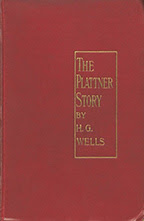
Good science fiction mixed with mediocre romanceNowadays we know H. G. Wells as an early master of science fiction, but during his lifetime he was known for fiction and nonfiction in many different genres and subject areas. Looking through Wells’s bibliography, one gets the idea that he never wanted to be confined to the sci-fi ghetto and likely craved recognition as a “mainstream” writer. To today’s reader, however, his science fiction seems remarkably creative and advanced for its age, while his non-sci-fi works often come across as unremarkable run-of-the-mill British fiction of its era, stuffy and rather predictable. This presents a problem when reading a collection of short fiction by Wells, as his anthologies tend to be a grab bag of various genres. The Plattner Story and Others, published in 1897, is a collection of 17 short stories, most of which originally ran in British periodicals from 1894 to 1896. This volume starts out with six or seven science fiction stories, followed by one ghost story and a trio of Edgar Allan Poe-style murder tales. The book then closes with half a dozen mundane tales of Victorian life focusing on romance and inheritances. As one reads through the volume, the sci-fi works are initially quite promising, but it’s all downhill from there.
Although Wells doesn’t hit it out of the park with every sci-fi and fantasy yarn, the first half of this book is impressive for its wide range of subjects and styles, worthy of a season of The Twilight Zone: alternate dimensions (“The Plattner Story”), futuristic air travel (“The Argonauts of the Air”), minds switching bodies (“The Story of the Late Mr. Elvesham”), undersea exploration (“In the Abyss”), a glimpse into the afterlife (“Under the Knife”), a haunted house horror story (“The Red Room”), and a good old-fashioned cryptozoologic monster attack (“The Sea-Raiders”). As the stories get less science-based and move more into the realm of Poe, however, one can feel Wells’s talent begin to wane as he ventures out of his element.
All of that seems like genius, however, compared to the book’s latter half, which consists of dull stories with insipid endings. In most of these, Wells also attempts a more lighthearted style, and humor isn’t exactly his strong suit. Or at least, his humor hasn’t held up well over the intervening century and a quarter. “The Sad Story of a Dramatic Critic,” for example, is a bad joke only a pretentious Victorian gentleman could love. “A Catastrophe” starts out as a realistic look at middle class life, but ends with a lazy deus ex machina. The one standout among the last half dozen entries is “In the Modern Vein,” a story about a married man who falls in love with another woman. The only remarkable thing about this is that the other woman is Indian. Given that it was written in the Victorian Era, when divorce, infidelity, and interracial romance were not considered proper in literature, the story can only end one way, and it does, as expected.
As a short story writer, Wells’s efforts are hit and miss. His success rate in that department is nowhere near as good as Poe, Arthur Conan Doyle, or Jack London. In The Plattner Story and Others, the cons outweigh the pros. The farther Wells’s stories are removed from reality, into science fiction and fantasy territory, the more successful they are. Like Conan Doyle, however, his sci-fi sometimes suffers from venturing too far into spiritualism. For an atheist, Wells seems overly preoccupied with spirits and the afterlife (though not nearly as much as Conan Doyle). Those who are only interested in Wells as a science fiction writer would be better off reading his 1899 collection Tales of Space and Time, which is more specifically devoted to that genre.
Stories in this collection
The Plattner Story
The Argonauts of the Air
The Story of the Late Mr. Elvesham
In the Abyss
The Apple
Under the Knife
The Sea-Raiders
Pollock and the Porroh Man
The Red Room
The Cone
The Purple Pileus
The Jilting of Jane
In the Modern Vein
A Catastrophe
The Lost Inheritance
The Sad Story of a Dramatic Critic
A Slip Under the Microscope
If you liked this review, please follow the link below to Amazon.com and give me a “helpful” vote. Thank you.
https://www.amazon.com/review/R3IG2NI46O0PCE/ref=cm_cr_srp_d_rdp_perm
Innovative ideas in underdeveloped storiesThe Stolen Bacillus and Other Incidents, a collection of 15 short stories by H. G. Wells, was published in 1895, the same year as his first novel The Time Machine. The stories in the book originally ran in London newspapers over the preceding two years; most of them appeared in the Pall Mall Budget or the Pall Mall Gazette. These are all science fiction or adventure stories, but you won’t find any mention of outer space or time travel, such as one finds in his 1899 collection Tales of Space and Time. Rather, the science in these science fiction stories is mostly within the realms of zoology, botany, or chemistry. The collection also includes a few crime stories concerning thefts or murders of an unusual nature.
The title selection, “The Stolen Bacillus,” is about a terrorist who steals a test tube full of cholera. While that may sound like a terrifying premise, Wells takes a rather comical approach to the idea, turning it into something like a Keystone Cops chase scene. That lighthearted treatment is typical of the stories included here. The books for which Wells is famous—The Time Machine, War of the Worlds, The Island of Dr. Moreau, The Invisible Man—all have a darker dimension to them that borders on the horror genre, but that harsher edge is missing from almost all of the tales included here.
Most of the selections in this volume are quite short, less than ten pages, which also makes it difficult to get excited about them. Though some of the ideas that Wells comes up with are admirably ingenious, the stories in general feel underdeveloped. Wells spends half the narrative introducing you to his humorous protagonist, then by the time he gets to the science fiction concept it’s already time to wrap up the plot with a hasty ending. As a writer of short stories, Wells is not as adept at developing characters and plot as someone like Arthur Conan Doyle, who also wrote sci-fi and fantasy stories, but Wells has the greater breadth of vision and depth of imagination when it comes to the scientific and fantastical aspects of his fiction. The longest stories in this collection are the most successful, like “Aepyornis Island” and “The Hammerpond Park Burglary,” which are each twice as long as the average entry. The former is about an adventurer hunting for remains of an extinct bird, while the latter is a comical caper in the crime genre. In both cases the longer word count gives Wells the opportunity to satisfyingly engage the reader with interesting characters and a lively plot.
Another problem with this book is the racism. In these stories, Wells brands anyone darker than the White Cliffs of Dover with the n-word, regardless of their land of origin. Wells has a tendency to draw his characters of color as idiots or psychotics, even more so than other writers of his time. This is evident in four or five of the stories included here, which is enough to leave a bad taste in the mouth.
Overall, this collection is fine by the standards of late 19th-century pulp fiction, but it doesn’t really live up to Wells’s esteemed reputation as a science fiction writer or storyteller. These are some of his earliest published writings, so maybe he was still learning to spread his wings and hone his craft. Though there are some creative ideas in these tales, most of the stories suffer from a brevity that ultimately undermines their worth.
Stories in this collection
The Stolen Bacillus
The Flowering of the Strange Orchid
In the Avu Observatory
The Triumphs of a Taxidermist
A Deal in Ostriches
Through a Window
The Temptation of Harringay
The Flying Man
The Diamond Maker
Aepyornis Island
The Remarkable Case of Davidson’s Eyes
The Lord of the Dynamos
The Hammerpond Park Burglary
A Moth—Genus Novo
The Treasure in the Forest
If you liked this review, please follow the link below to Amazon.com and give me a “helpful” vote. Thank you.
https://www.amazon.com/review/R35T8NSR5T6CBE/ref=cm_cr_srp_d_rdp_perm