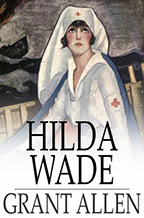
A mansplainer’s half-baked idea of “women’s intuition”Hilda Wade was published in 1900, shortly after the death of its author, Canadian-British writer Grant Allen. On his deathbed, Allen received some assistance in the completion of the novel from his friend and neighbor Arthur Conan Doyle. The two seem like an odd couple of pals since Allen was an atheist and skeptic, while Conan Doyle was so heavily into spiritualism. Nevertheless, they must have had a strong friendship. Any finishing touches Conan Doyle may have made to the manuscript are undetectable; the book reads like it’s all Allen. By the standards of his time, Allen was a liberal thinker, and he often wrote fiction that promoted radical ideas like atheism, socialism, and feminism. He was still firmly ensconced in the literary world of Victorian England, however, so any forays he made in those directions were baby steps at best.
Hilda Wade is a single woman who works as a nurse at a London hospital. She deliberately chose her place of employment because she wanted to work with a certain medical genius, Dr. Sebastian. In the first couple chapters, Hilda proves herself an able aid in Sebastian’s medical research. At first the expert physician doesn’t always greet Hilda’s suggestions with approval, but eventually he comes to learn that Hilda Wade is always right. The novel is narrated by Dr. Hubert Cumberledge, who also works with Sebastian, forms a friendship with Hilda, and not surprisingly develops a crush on her.
Similar to earlier works like The Woman Who Did and Miss Cayley’s Adventures, Hilda Wade is a novel with a strong, independent female protagonist who stretches the traditional gender role of the Victorian heroine. Any feminism that Allen intended with the novel is somewhat misguided, however. Like Miss Cayley, Hilda Wade is only allowed her independence until she fulfills her foregone destiny of marriage. Allen also places inordinate emphasis on Hilda’s superhuman power of “feminine intuition,” which sometimes allows her to magically predict the future. How does she use this wonderful power? Well, in one cringeworthy episode early in the book, Hilda asserts that lippy wives are destined to be murdered. Then she doesn’t do anything to save the woman in question from that horrible fate, but rather waits until after the killing to say I told you so.
The first four chapters of the book are really pretty bad. Fortunately, the plot then takes an unexpected twist and the novel evolves into a mystery. It is not, however, a Conan Doyle-style mystery in which clues lead to a revelation. Instead, the villain is revealed early, and from that point on the plot is really more of a cat-and-mouse chase that leads to far-off lands like Rhodesia and India. Allen never really takes full advantage of such exotic locales, however. Overall, Hilda Wade is a rather boring novel in which the possibilities for suspense are squandered and the characters are difficult to care about. In his desire to hold Hilda up as some kind of poster girl for new womanhood, Allen ends up creating a character with about as much depth as a cardboard cutout. In general I prefer Allen’s nonfiction writings to his novels, but even in the latter category, Miss Cayley’s Adventures and An African Millionaire are better than this. In the mystery and suspense department, Allen isn’t in the same league with his buddy Conan Doyle.
If you liked this review, please follow the link below to Amazon and leave me a “helpful” vote. Thank you.
https://www.amazon.com/review/R1WNGQF7ESIYKV/ref=cm_cr_srp_d_rdp_perm
Not strange enough, or strange for the wrong reasonsStrange Stories, published in 1884, is a collection of short fiction by Grant Allen (1848-1899), a Canadian-British author known for both science writing and fiction. The title would lead one to believe that this is a collection of science fiction or horror tales, but of the 16 selections in the volume only a few dabble in those genres.
To the collection’s detriment, it serves up two reprehensible offerings early on. The first and third selections in the book, “The Reverend John Creedy” and “Mr. Chung,” are both marred by racism. I think Allen was trying to demonstrate that he could be sympathetic to people of color, but in both cases he serves up racist depictions of his title characters. The moral of “The Reverend John Creedy” could best be summed up as “You can take the ‘savage’ out of Africa, but you can’t take the Africa out of the ‘savage’.” “Mr. Chung,” a story about an Oxford-educated Chinese man in England, spends most of its length asserting how barbaric and uncivilized China is compared to enlightened England. The former story is a cautionary tale of interracial marriage, while the latter continually scoffs at the idea of its characters even considering such a blasphemous absurdity. Later in the book, however, another story of interracial courtship is handled much better. Set in Jamaica, “Carvalho” is a romance between a British woman and a Jewish man who is 1/16th Black. Here Allen manages to address the topic of racism without it backfiring on him.
Luckily, from its inauspicious beginnings, there’s nowhere for the book to go but up. Several of the stories are rather mundane Victorian romances or faltering attempts at comedy. The volume’s best selections are those that fall within the genres one might expect from a book entitled Strange Stories. “The Curate of Churnside” is a very good crime story, reminiscent of Edgar Allan Poe, in which Allen takes a unique look at the psychology of a murderer. “Pausodyne” is a sci-fi tale of the mad scientist variety with a clever touch of Rip Van Winkle-style time travel. “The Child of the Phalanstery” is a more serious science fiction story set in a dystopian future that presages later novels like Yevgeny Zamyatin’s We and Aldous Huxley’s Brave New World. “The Empress of Andorra” is a fun political satire in which a government functionary of the tiny nation indulges his delusions of grandeur by attempting world domination. Allen also delivers wry twists on the conventions of the horror genre with “My New Year’s Eve among the Mummies” and “Our Scientific Observations of a Ghost.”
For a collection of short stories by one author, 16 is a lot, and none of these are very short. In fact, most of them are quite longer than they need to be. The first edition of the book was 356 pages, which doesn’t sound like a lot, but it sure feels lengthy when you’re wading through these overly protracted narratives. I considered myself a moderate admirer of Allen’s work before I started this book, but by the time I finished I had had more than I wanted of him. I have to say I prefer his nonfiction writings, as evidenced by books such as The Evolutionist at Large and Biographies of Working Men. The qualities that I admire in Allen—his liberalism, his atheism, his rationalism—are more overtly pronounced and eloquently expressed in his essays than in his short stories. In his fiction, Allen tends to get mired in the worn-out conventions of Victorian literature, even when he attempts to satirize conservative England. You can tell he’s trying to push the envelope, but often that push feels more like a minor nudge. For all his egalitarian rhetoric, he really seems to idolize the British aristocracy to a point where he can’t adequately criticize or lampoon them. I admire Allen as an advocate of science and reason, but my opinion of him as a writer has diminished a bit after reading Strange Stories.
Stories in this collection
The Reverend John Creedy
Dr. Greatrex’s Engagment
Mr. Chung
The Curate of Churnside
An Episode in High Life
My New Year’s Eve among the Mummies
The Foundering of the “Fortuna”
The Backslider
The Mysterious Occurrence in Piccadilly
Carvalho
Pausodyne
The Empress of Andorra
The Senior Proctor’s Wooing
The Child of the Phalanstery
Our Scientific Observations on a Ghost
Ram Das of Cawnpore
If you liked this review, please follow the link below to Amazon.com and give me a “helpful” vote. Thank you.
https://www.amazon.com/review/R9XJ7WJ9MKE75/ref=cm_cr_srp_d_rdp_perm
Scam after scam from an expert flimflam manGrant Allen (1848-1899) was a prolific Canadian-born British writer of both science books and fiction. His book An African Millionaire: Episodes in the Life of the Illustrious Colonel Clay was published in 1897. The table of contents would lead one to believe this is a collection of short stories, since all the chapter titles begin with “The Episode of the . . .”, but really this is a novel. The chapters don’t really make much sense unless read together in sequence, and they all add up to one unified narrative. The story is narrated by Seymour Wilbraham Wentworth, who works as secretary to his wife’s brother Sir Charles Vandrift, the “African Millionaire,” an Englishman who has struck it rich in South African diamond mines. Vandrift has an estate in Scotland but spends most of his time in London. He and Wentworth’s adventures take place primarily in Europe, not in Africa, with a sojourn in America.
The first chapter gives the impression that the reader is in for yet another Sherlock Holmes pastiche, with Wentworth playing the part of Vandrift’s Dr. Watson. It soon becomes apparent, however, that the plot is not so much a mystery as it is a series of what might be called capers. The “illustrious” Colonel Clay is a con artist who sets his sights on Vandrift. In each chapter he comes up with a new ingenious scheme to bilk the millionaire out of thousands of pounds sterling. Colonel Clay (not his real name) is a master of disguise and various accents, as is his attractive female accomplice. The larcenous pair repeatedly fool Vandrift and Wentworth with their assumed personalities and ever-changing appearances. Thus, An African Millionaire does not emulate the Sherlock Holmes stories but rather presages the adventures of the gentleman thief Arsène Lupin created by French writer Maurice Leblanc in 1905.
The premise soon becomes formulaic, as the reader always recognizes that every new character the millionaire and his secretary encounter in each chapter will likely turn out to be Clay or his woman friend in disguise. This is very similar to the structure of another book by Allen, Miss Cayley’s Adventures, in which the heroine travels around Europe repeatedly encountering a rogue who serves as her nemesis. Vandrift and Wentworth get a little wiser in each chapter, employing various methods in an attempt to thwart the master con man, but Clay remains one step ahead of them. Allen’s clever and witty writing keeps all this from becoming monotonous, and the way he wraps things up in the final two chapters is delightfully smart.
Also adding to the fun is that the right-and-wrong, good-vs.-evil setup of the crime story plot becomes less cut-and-dried as the story moves along. Allen was a writer known for advocating radical ideas like evolution, socialism, atheism, and feminism. At first his leftist agenda is not readily apparent in An African Millionaire. The novel reads as if Allen aimed for an audience of the smart set, who would identify with Vandrift’s lavish lifestyle and expensive vacation destinations. After Clay’s first few scams, however, Allen starts working in digs at the British class system. The con man is fashioned into a quasi-socialist Robin Hood while Vandrift is painted as a greedy capitalist. Though Vandrift and Wentworth are supposedly the heroes of the book, Allen takes pleasure in satirizing the upper classes by frequently depicting the pair as buffoons.
An African Millionaire is a bit too familiar, predictable, and repetitive to get excited about, but it is a moderately entertaining read. I think I prefer Allen’s nonfiction writings, but his fiction is dependably good for those who appreciate Victorian pulp fiction along the lines of Sir Arthur Conan Doyle.
If you liked this review, please follow the link below to Amazon.com and give me a “helpful” vote. Thank you.
https://www.amazon.com/review/RM4PAKWRW3M1J/ref=cm_cr_srp_d_rdp_perm
Insightful observations of Darwinism at workScience writer and novelist Grant Allen was born in Canada but emigrated to England as a teenager, where he remained the rest of his life. As a science writer, Allen was kind of like the Carl Sagan of the late 19th century, but instead of educating the public on astronomy, physics, and Einstein’s relativity, Allen concentrated on biology, evolution, and Darwinism. At that time, the theory of evolution was still relatively new and needed secular evangelists like Allen to make it accessible and palatable to the masses. His book The Evolutionist at Large, published in 1881, proves that Allen still has a thing or two to teach the science-savvy reading public of today.
The Evolutionist at Large consists of 22 short essays that originally appeared as newspaper columns in the St. James’s Gazette. Each brief chapter is written in the first person, and usually starts with Allen and his dog strolling through the English countryside, where they chance upon an interesting specimen of flower, snail, butterfly, or other class of wildlife. From there, Allen elaborates on the specific characteristics of the creature in question and how it illustrates the process of evolution at work. Some of the topics include the differing developmental strategies of fruits and nuts, the scent-based intellect of ants, and the influence of butterfly psychology on the color of flowers. Although I am a firm believer in evolution and consider myself pretty well versed in biological science, Allen’s 140-year-old essays consistently made me view the workings of nature in surprising new ways. His writing calls to mind the work of Sir David Attenborough in his television nature documentaries or his books like The Life of Birds.
Even if you already know everything Allen has to say about evolution, the book is still a beautiful piece of nature writing. Because Allen’s audience is the general reading public, the writing is very clear and accessible. He uses hardly any scientific jargon, except for the occasional Latin species name. He doesn’t dumb down the vocabulary at all, however, so his prose displays the verbal erudition typical of nineteenth-century texts. Allen was one of the Victorian Era’s most outspoken freethinkers and challenged religion and superstition in all of his works, including his fiction. Here he not only trumpets Darwin’s system of evolution but also blatantly illustrates how evolutionary evidence refutes the idea of intelligent design. Allen is very forthright about his atheism, which makes one wonder how he managed to slip these articles into a London newspaper of the 1870s.
The Evolutionist at Large proved a very pleasant surprise. Nineteenth century writing on nature often tends to be very poetic and romantic in nature, emphasizing man’s contemplation of the wild as a sort of spiritual experience. Allen’s take on nature, however, is firmly grounded in science and empirical observation, like a simplified version of the scientific travelogues of Darwin or Alexander von Humboldt. On the other hand, like Henry David Thoreau’s Walden, Allen still manages to convey the wonder and inspiration of the natural environment all around us. Nature lovers and freethinkers alike will enjoy this insightful book.
If you liked this review, please follow the link below to Amazon.com and give me a “helpful” vote. Thank you.
Independent woman travels the world
 Canadian-born British author Grant Allen spent his career pushing the boundaries of Victorian England’s conservative mores. As both an essayist and a novelist, Allen often wrote works advocating for such liberal and radical ideas as atheism, socialism, feminism, free love, and the theory of evolution. His 1899 novel Miss Cayley’s Adventures is a protofeminist story of female independence. The title character is an unmarried woman who, after her stepfather’s death, finds herself with nothing to her name but the twopence in her pocket. Rather than find a husband, take a job as a teacher, or confine herself to a convent, Lois Cayley embraces the freedom of having nothing to lose and decides she wants to travel around the world. She then fortuitously stumbles into a series of odd jobs that finance her travels to exotic locations around the globe.
Like a collection of Sherlock Holmes stories, the chapter titles all begin with “The Adventure of the . . .” (Cantankerous Old Lady, Magnificent Maharajah, Unprofessional Detective, and so on). Although each chapter focuses on a particular escapade, this is indeed a novel. All the adventures must be read sequentially as one complete narrative, as they culminate in Miss Cayley’s ultimate fate. Some sources (Wikipedia included) state that this book is a detective novel, but that is not accurate. Miss Cayley is not a detective, and her adventures run the gamut from thwarting a crime, fending off a suitor, establishing her own business, or competing in a bicycle race.
In 1899, there were likely hundreds of novels published that featured a penniless young man striking off to make his fortune in the world. The idea of an unmarried woman traveling alone, however, would have been a shock to British readers, and probably to many Americans as well. In the story, Miss Cayley is frequently presumed to be an “adventuress,” that is to say, a woman of easy virtue looking to snag a wealthy husband. Allen, who enjoys satirizing priggish attitudes toward sex and class, endows Miss Cayley with an admirable I-don’t-give-a-damn attitude. She is clearly an intelligent and capable young woman, and one who values personal freedom and happiness over money. Sometimes her confidence comes across as a little too egotistical when she expresses thoughts of self-praise that are meant to come across as spunky or plucky but would seem off-puttingly arrogant if uttered by a male character. The story is light-hearted good fun, more romantic than realistic, and well-told for the most part by Allen. The situations he puts Miss Cayley in are sufficiently lively and complex to maintain the reader’s interest, but comfortably predictable in their good-triumphs-over-evil outcomes. The last few chapters, however, feature a tedious courtroom battle that ends the book on a weak note.
Though Allen was quite liberal for his era, he’s not entirely free from Victorian prejudices, or at least here he compromisingly panders to a more conservative audience in matters of race, sex, and class. Though he wishes to make Cayley the very embodiment of an independent woman, the novel never leaves any doubt that her final destination will be marriage. On a trip to India, Cayley is the only Brit who refuses to refer to the natives by the n-word, yet she blushes at the idea of marrying outside her race. Allen frequently scoffs at class distinctions, yet the events and characters of the narrative continually imply that the upper classes are a cut above the laboring masses, Miss Cayley excepted. Nevertheless, Allen’s novel does make baby steps in the right direction, and it is certainly a refreshing improvement over the racist, sexist, and classist sentiments found in much of English genre fiction at the time. Without succumbing to heavy preachiness, Allen manages to get his views across in a fun story that makes for an entertaining read.
If you liked this review, please follow the link below to Amazon.com and give me a “helpful” vote. Thank you.
https://www.amazon.com/review/R2Z7U8H9FDD4SP/ref=cm_cr_srp_d_rdp_perm
A great time capsule of this important period in sci-fi history
 Though examples of science fiction can be found as far back as ancient times, it was during the late 19th and early 20th centuries when this genre became popular and plentiful. Before the term “science fiction” gained widespread use in the 1920s, literary critics commonly referred to speculative fiction based on scientific concepts as “scientific romance.” In the book Scientific Romance: An International Anthology of Pioneering Science Fiction, published in 2017, editor Brian Stableford presents 27 short stories that exemplify the era of scientific romance. For the most part, the quality of the volume’s selections is very good. Reading this book is like opening an entertaining and educational time capsule of this pioneering period in science fiction.
In his introduction to the book, Stableford gives an overview of the origins of the scientific romance genre and its heyday from the 1830s up until World War I. It must be noted that in this case “International” only includes writings from the United States, the United Kingdom, and France. Stableford obviously reads French and is quite knowledgeable in the history of French literature. I don’t think he translated the French works for this volume, but he does supply helpful footnotes that provide historical context and explain difficulties of translation.
Due to their influential talents and prolific output, the undisputed giants of this era were Jules Verne and H. G. Wells. This volume does not contain an entry by Verne, likely because he didn’t write any stories short enough to fit. Wells is represented by his excellent apocalyptic vision “The Star” from 1897. Edgar Allan Poe and Arthur Conan Doyle were also prominent authors in this genre, and Stableford includes their stories “The Conversation of Eiros and Charmion” and “The Horror of the Heights,” respectively. Readers of classic literature will also recognize familiar names such as Nathaniel Hawthorne (“The Artist of the Beautiful”), Ambrose Bierce (“For the Akhoond”), and Jack London (“The Shadow and the Flash”), as well as several regular contributors to the American and British pulp magazines. One of the best things about this volume, however, is that it draws attention to French writers with whom English-language readers are likely to be unfamiliar, such as S. Henry Berthoud, Charles Epheyre, Émile Goudeau, and Camille Debans. Stableford provides brief but valuable biographical introductions to each story, often referencing a few other works by each author for further reading.
The diverse range of topics these authors cover represents the scientific concerns of their times. The ideas around which these stories revolve include future utopias, the end of the world, artificial intelligence, automatons, alien life forms, evolution, eugenics, microbial disease, climate change, and human immortality. The protagonists of these tales invent flying machines, weather control devices, invisibility potions, and a method for creating artificial memories. Many of the authors take a humorous or satirical approach to their sci-fi visions, with some hilarious results.
This collection is published by Dover Books, a company known for its inexpensive, no-frills volumes of public domain material. It is therefore a pleasant surprise that Scientific Romance is such a well-edited collection. Stableford has done a great job of not only selecting the stories but also of educating the reader on the history of this literature. One could find these stories online for free, but Stableford’s knowledge adds value to the reading experience. Not every story in this collection is a masterpiece, but overall the outstanding entries far outweigh the mediocre.
Stories in this collection
The Conversation of Eiros and Charmion by Edgar Allan Poe
A Heavenward Voyage by S. Henry Berthoud
The Artist of the Beautiful by Nathaniel Hawthorne
What Was It? by Fitz-James O’Brien
The End of the World by Eugène Mouton
A Paradoxical Ode (After Shelley) by James Clerk Maxwell
The Ablest Man in the World by Edward Page Mitchell
Josuah Electricmann by Ernest d’Hervilly
The Child of the Phalanstery by Grant Allen
The Salvation of Nature by John Davidson
Tornadres by J.-H. Rosny
Professor Bakermann’s Microbe by Charles Epheyre
In the Year Ten Thousand by Edgar Fawcett
The Revolt of the Machines by Émile Goudeau
For the Akhoond by Ambrose Bierce
The Philosophy of Relative Existences by Frank R. Stockton
June 1993 by Julian Hawthorne
The Dancing Partner by Jerome K. Jerome
The Conqueror of Death by Camille Debans
The Star by H. G. Wells
A Corner in Lighting by Gorge Griffith
The Memory Cell by Walter Besant
The Shadow and the Flash by Jack London
The Gorilloid by Edmond Haraucourt
The Voice in the Night by William Hope Hodgson
The Singular Fate of Bouvancourt by Maurice Renard
The Horror of the Heights by Sir Arthur Conan Doyle
If you liked this review, please follow the link below to Amazon.com and give me a “helpful” vote. Thank you.
https://www.amazon.com/review/R2CJ6MG0ELD1VA/ref=cm_cr_srp_d_rdp_perm