Showing posts with label Dutch. Show all posts

Friday, October 24, 2025

Dr. Adriaan by Louis Couperus


Full house in Holland
Dr. Adriaan
, published in 1903, is the fourth and final novel in the Books of the Small Souls series by Dutch author Louis Couperus, having been preceded by 1) Small Souls, 2) The Later Life, and 3) The Twilight of the Souls. This fourth installment takes place ten years after The Twilight of the Souls. Adriaan (Addie) van der Welcke, now 26, has realized his dream of becoming a physician. He is a general practitioner, which at the time included the treatment of various nervous disorders which are now under the domain of psychiatrists. In such cases, Addie has become known for his adept use of hypnotism as a treatment technique. He now has a wife, Mathilde, and two toddler children.


Addie and his family reside with his parents, Baron Henri van der Welcke and Constance (née van Lowe), who have inherited the Van der Welcke estate in Driebergen, a country town outside of the Hague. In the previous novel, Constance’s brother Gerrit van Lowe died, leaving behind a wife and nine children. Addie, who has always been mature beyond his years, has assumed the guardianship of this family, even though he is only six years older than the eldest of Gerrit’s children. They all live in the Driebergen mansion, as do elderly Mama van Lowe and a few cousins with various ailments whom Addie is treating for free. At one point in the book, I counted 19 residents in the Driebergen house, not counting servants, plus a few other relatives living nearby who show up for dinner almost every night. Addie’s wife Mathilde does not fit in with the Van Lowe family and resents the fact that she has to share her husband with his numerous aunts, uncles, and cousins. This causes problems in their marriage. Addie is happy living in Driebergen, generously offering his medical skills to the country poor, but Mathilde would prefer they move back to the Hague, where Addie can become a fashionable big-city doctor and grow a prosperous practice serving the urban wealthy.

The closest literary analogy I can make to Couperus’s Small Souls series is the Jalna novels by Canadian author Mazo de la Roche. Both feature a large family of distinct personalities whose lives revolve almost entirely around each other and their family dinners at Grandma’s house. The Jalna novels are a little prone to soap-opera melodrama, however, while the Small Souls books read more like real life. Dr. Adriaan doesn’t have many of the momentous or scandalous events one can frequently count on in family sagas: love affairs, deaths, crimes, divorces, etc. Instead, these small souls tend to live small quiet lives like most of us do. Couples question their relationships. Siblings quarrel. Young people try to find their direction in life. Aging people come to terms with old regrets and resign themselves to contentment. Some deal with pesky, non-fatal illnesses, both physical and mental. If this were the first novel in the series, such prosaic happenings might be too boring to be justified. Couperus, however, has developed these characters over the course of four volumes, so that the reader has come to know them, identify with them, feel for them, and become invested in their lives and struggles. Anyone who’s read the first three Small Souls novels will be thoroughly engaged from the first page of Dr. Adriaan.

Although Couperus could have kept this series going for at least another novel or two, he does conclude Dr. Adriaan with a touch of finality, and he never returned to the Van Lowe family. A naturalist in a similar mode as Emile Zola or Theodore Dreiser, Couperus enjoyed some popularity in English translation in the early 20th century, but I think it’s fair to say he has since largely been forgotten by American readers. That’s a shame, because he really is a very talented and accomplished novelist who deserves worldwide recognition, as evidenced by his compelling Books of the Small Souls.

Thursday, October 2, 2025

The Twilight of the Souls by Louis Couperus


Neuroses of the Dutch
Louis Couperus (1863–1923) is one of the most prominent authors in modern Dutch literature, and many of his works have been published in English translation. His novel The Twilight of the Souls, published in 1902, is the third book in a series of four novels known as The Books of Small Souls, the first two volumes being Small Souls and The Later Life. These novels chronicle the lives of the fictional Van Lowe family. The eight Van Lowe siblings grew up on the East Indian island of Java, where their father was Dutch governor general. When the first novel begins, the father is deceased, the siblings are now in their thirties, forties, and fifties and residing in The Hague, most with children of their own. Collectively, the prestige and fortunes of the Van Lowes have taken a gradual downward turn since Papa’s glory days in the diplomatic service.


The first two novels concentrated primarily on Constance van der Welcke (née van Lowe) and her immediate family. The Twilight of the Souls broadens its focus to other members of the Van Lowe clan, allowing the reader to learn more about siblings who were barely mentioned in the two previous volumes. The family gathers weekly at elderly Mama van Lowe’s house for Sunday dinner and card games. Her children do their best to keep Mama unaware of the family’s problems, but some scandals and tragedies are too big to sweep under the rug. In the opening chapter of The Twilight of the Souls, we find that Ernst van Lowe is going mad. A bachelor who leads a largely solitary life, Ernst is hearing voices and experiencing hallucinations. He envisions scores of “souls” chained to him, wailing in pain, whom he must guard and protect. The rest of the family comes to Ernst’s aid in finding him psychiatric help. He is not the only Van Lowe, however, experiencing mental problems in this novel.

At times in this novel, Couperus gives a somewhat romanticized depiction of mental illness, in that the hallucinations described are almost operatically dramatic. There’s nothing here beyond the realm of realism, however; Couperus almost invariably draws his characters with an authentic psychological verisimilitude. The reader has no trouble believing or relating to the psychological maladies of the characters—Gerrit’s depression, Paul’s OCD and germaphobia, Mama’s forebodings of death. In the Van Lowe family, Couperus has created an ensemble cast with whom the reader can identify and become emotionally invested. While The Twilight of the Souls is a very fine novel in its own right, its merits are compounded by the foundation that Couperus built in the first two novels, upon which this third installment productively builds.

The whole idea behind the concept of “small souls” is that these characters are shaped and controlled by rather petty concerns—social climbing, family squabbles, keeping up appearances, and so on. This never feels shallow or inconsequential, however, because it is a reflection of real life, or most of our real lives, anyway. In each novel, certain characters strive to rise above the “smallness” of their lives to find a deeper meaning and a more fulfilling existence. Most readers can identify with such endeavors, especially when revealed with the sensitivity and insight that Couperus brings to these books. In the saga of the Van Lowes, one is sure to find some engaging parallels to their own personal and family dramas.

Another plot thread taken up in this book is that Adriaan van der Welcke, now 16 or 17 years of age, has decided that he does not wish to pursue a career in the diplomatic service and instead wants to become a physician. This leads us to volume four in the series, entitled Dr. Adriaan.

Thursday, September 4, 2025

The Later Life by Louis Couperus


Midlife crises in The Hague
The Later Life
is a novel by Dutch author Louis Couperus (1863–1923). It is the second book in a four-novel quartet called Small Souls or The Books of Small Souls. (The first novel in the series is also titled Small Souls). The Later Life was originally published in the Netherlands in 1902, which is the time period in which the novel is set. It was first published in English in 1915.


Small Souls introduced us to the extensive Van Lowe family of The Hague, and the family drama continues in The Later Life. This second novel begins about two months after the end of Small Souls. In that previous book, Constance van der Welcke (née van Lowe) had a confrontation and a falling out with the rest of the Van Lowe family. After fleeing to Paris to be alone for several weeks, she returns to her husband and son in The Hague. Soon, the Van der Welckes patch up relations with Constance’s relatives and resume attendance at the family dinner parties.


The Later Life seems quite a bit shorter than Small Souls, and there is less going on in this second outing. Instead of bouncing around the entire Van Lowe family, here the focus remains primarily on the Van der Welckes: Constance, her husband Henri, and son Adriaan. Shortly after returning from Paris, Constance comes to the realization that her husband and her niece Marianne are in love with each other, though so far the interaction between the two has remained innocent. Meanwhile, an old school chum of Henri’s named Brauws returns to The Hague and becomes the frequent dinner guest of the Van der Welckes. Despite his history with Henri, Brauws forms a closer bond with Constance, and she falls in love with him. Much like her husband’s budding romance, there has been no physical affirmation of the relationship, just conversation. Will either of these harmless infatuations develop into full-fledged infidelity?


The title “The Later Life” may seem to imply that the novel is about senior citizens, but the three main players in this love quadrangle only range in age from their late thirties to their early forties (Marianne is about 19 or 20). Constance, Henri, and Brauws, however, all go through some sort of midlife crisis in this book and find themselves contemplating their lost youth. They are all dissatisfied and depressed by their present state of living. They’re lonely, trapped in loveless relationships, and/or depressed by the lack of meaning in their lives. Each wonders if he or she can finally find true happiness in later life, or is it too late to make a fresh start?


The phrase “small souls” is brought up more than a few times in the first two novels of this series. Couperus uses these words to signify the restrictive societal conventions under which these characters have developed and continue to live their lives. While somewhere in the world surely people are truly living lives that matter, the Van Lowes’ lives revolve around petty aristocratic concerns over what is proper or what people might think. “The world is full of mighty problems; and we . . . we are pigmies . . . in the tiny world of our own selves. . . .” says Brauws. Whatever was the equivalent of the Victorian era in the Netherlands, Couperus’s novels don’t so much rebel against it as rather critically acknowledge it as a pervading fact of life. Constance is the only one in her family who even questions the established order of things—whether these dinner parties or social engagements even matter. At 43, she realizes that she’s never really been in love, that she’s never even really lived. In the Small Souls series, which has proven a great read so far, Couperus reveals the existential angst beneath the veneer of upper-class respectability.

Monday, August 18, 2025

Small Souls by Louis Couperus


Compelling start to a Dutch family saga
Name a Dutch author. I dare you. If you’re an American, chances are it’ll be Anne Frank or maybe Spinoza. Not much Dutch literature has been available to English-language readers, although there has been an increase in the last few decades. One notable Dutch author, however, did enjoy worldwide success in the early 20th century: Louis Couperus. His novel Small Souls was first published in 1901, then came out in English in 1914. It is the first of four books in a series also called Small Souls.


The Van Lowe family lives in The Hague. The family patriarch, “Papa” van Lowe, is deceased when the novel opens. He is survived by his widow, eight children, and numerous grandchildren. The elder Van Lowe was formerly the Dutch governor general of the colony of Java, a very prestigious position through which he might occasionally rub elbows with the King and Queen. None of Papa’s children, however, have quite lived up to his level of distinction. The eight Van Lowe siblings now find themselves in varying levels of social status and class, which sometimes inspires envy and resentment among them. Because they’re well-to-do, they spend most of their time visiting one another, throwing parties, criticizing and gossiping about each other. (Some of the men have careers, but we don’t really see them at work.) Twenty years ago, one daughter, Constance, married a diplomat forty years her senior. She cheated on her husband with one of his subordinates, causing a divorce and a scandal that forced her and her lover to flee to Brussels. Now, after 15 years in exile, she has returned to The Hague to reconnect with her family and her homeland, but not everyone is willing to overlook her shameful past.

Small Souls reminds me of British author John Galsworthy’s Forsyte Saga (I have only read the first book in that series). In both cases, the reader is introduced to a large, rather wealthy family. An extramarital scandal threatens the family’s respectability, and the various siblings all have deep-seated beefs against one another. Often these squabbles feel like much ado over rich people problems.

What makes Small Souls interesting, however, is its quintessential Dutchness. There are thousands of novels set in London, but The Hague? In English, hardly any. Couperus’s novels provide a welcome look into Dutch life, one unique aspect of which is the Netherlands’ relationship to its colonies in Indonesia. The East Indies played an important role in the Dutch economy. The Van Lowe children grew up in Java, and the family still has agricultural interests on the island. In this novel, the adjective “Indian” is used to describe anyone or anything from Java. Couperus’s writing also exhibits a sensibility that’s more Northern than Western European. There’s an understated yet authentic psychological sensitivity here that reads more like the writings of Scandinavian authors such as Knut Hamsun, Jens Peter Jacobsen, and Henrik Ibsen than that of English or French novelists.

Much like Galsworthy’s Forsytes, the difficult aspect of reading Small Souls is just getting a grasp on the huge roster of Van Lowes. One really needs to chart out a family tree to keep them all straight. Since I couldn’t find hardly any information on this novel online, I’ve done that for you (image attached below). As a member of a large family myself, I found Couperus’s depiction of brother-sister, parent-child, and husband-wife relationships quite authentic and insightful. As the first novel in a tetralogy, much of Small Souls is spent introducing us to this clan, thus setting the stage for further developments in the subsequent novels. I found myself thoroughly engaged in the Van Lowe family dynamics, enough to make we want to follow their fortunes through the next three books: The Later Life, Twilight of the Souls, and Dr. Adriaan.


Van Lowe family tree (click to enlarge)

Wednesday, March 5, 2025

Footsteps of Fate by Louis Couperus


Dutch treat
Louis Couperus (1863-1923) was a Dutch novelist and poet who enjoyed some international success in the late 19th and early 20th centuries. His novel Footsteps of Fate (Dutch title: Noodlot) was published in 1890. According to literary critic Edmund Gosse, who wrote the introduction to the first English translation of the novel, Couperus was a member of the Dutch Sensitivists school (a term I’ve never seen anywhere else, so maybe Gosse invented it). As far as I can tell from Gosse, this sounds like a literary school that was inspired by French Naturalism but didn’t want to admit that it was inspired by French Naturalism. Judging by Footsteps of Fate, Couperus writes in accord with the same philosophy of fatalism and heredity as the Naturalists, as exemplified by the novels of Emile Zola, but he stops short of the more blatantly coarse, vulgar, and offensive scenes and subject matter in the writings of Zola or even Balzac. The Sensitivists were also admirers of Joris-Karl Huysmans, a Zola protégé of Dutch ancestry.

Frank Westhove is a Dutch expatriate living in London. There are a few brief mentions of his background as an engineer, but at the time the story opens he seems to be living the life of an independently wealthy English gentleman, i.e. not working at all. One cold winter night he is approached by a shabby vagrant who turns out to be an old chum of his, Bertie van Maeren. Bertie had been to America, experienced some career failures and hard times, and was now homeless and almost penniless. He asks Frank for some assistance, and with a generous what-are-friends-for attitude, Frank invites Bertie into his home and promises to support him financially until he can get back on his feet. This turns into an extended roommate situation in which Frank and Bertie live the lives of well-to-do gentleman, financed entirely by Frank, who doesn’t seem to mind one bit. While the two are off on a trip to Norway, they meet some fellow Londoners, Sir Archibald Rhodes and his daughter Eva. The travelers get to know one another, and Frank, not surprisingly, falls in love with Eva. Rather than being happy for his friend, this relationship brings out the worst in Bertie, who fears that a union between Frank and Eva will rob him of his meal ticket and put him back out on the streets. 

One doesn’t learn much about Dutch life or literature from Footsteps of Fate. It reads very much like an English novel of the Victorian Era. It has a gentility about it that one doesn’t often find in the works of Naturalist literature, but nevertheless the fundamental elements of Naturalism are present: the faithfulness to realism and the assertion that much of mankind’s behavior is molded by social and hereditary forces and therefore out of one’s control. Some aspects of the story come across as unrealistic—most notably Frank’s limitless generosity and Eva’s exaggerated frailties—but one must keep in mind that what seems realistic in the 21st century differs from what would have seemed realistic to the Victorian readers of 1890. Bertie, however, rings true as a timeless archetypal example of the mooching houseguest. Footsteps of Fate starts out in a deceptively decorous and sober manner, but to Couperus’s credit, the book snowballs surprisingly into full-on unsparing Naturalism. Couperus fools you into a false sense of comfort and complacency before hitting you with the hard stuff towards the end.

I’m a fan of Naturalist literature in the vein of Zola or Frank Norris. This was my first experience with Couperus, and I enjoyed this book quite a bit. The characters are memorable, the situations believable, and the plot served up its fair share of surprises. I will definitely seek out more of Couperus’s novels in the future.

Monday, June 12, 2023

Babel: Around the World in Twenty Languages by Gaston Dorren


Another fascinating tour through the peculiarities and politics of language
If you are fascinated by foreign languages, Gaston Dorren’s books are a must-read. Babel, published in 2018, is the follow-up to Dorren’s excellent 2014 book Lingo: Around Europe in Sixty Languages. In both books, Dorren looks at many different languages, examining their histories, their structural oddities, and their political and cultural controversies. While Lingo focused entirely on European languages, in Babel, Dorren examines the twenty most widely spoken languages in the world today. Chapters devoted to each language are arranged like a top 20 countdown from least popular to most popular (though even number 20 has 85 million speakers, so they’re all winners here).


Though it delves into some complicated linguistic concepts, Babel is not written for linguists. Rather, if you’ve ever tried to learn a foreign language—successfully or not—and enjoyed it, chances are you have a linguistic curiosity that will find satisfaction in Dorren’s exploration of these top twenty tongues. Dorren expounds upon each language differently. Sometimes he will delve into the unusual mechanics of a language, such as his discussion of the grammatical peculiarities of German that make it one of the most difficult languages to learn, or his examination of the differences between male and female speech in Japan. He recounts his own attempts at learning Vietnamese, with limited success, and attempts to demystify Arabic by pointing out the numerous Arabic words that over the centuries have made their circuitous way into English. In many chapters Dorren explains the history of a language and its effect on the politics and culture of its speakers, such as Turkey’s ambitious program of language reform in the early 20th century, or how Persian and Malay became the dominant languages in their respective regions. Unfortunately, some of these histories involve genocide along linguistic lines, as has occurred for example in India, Pakistan, and Sri Lanka. Dorren does not limit himself to spoken languages but discusses scripts as well, providing brief explanations of the Chinese and Japanese systems of writing, for example, or the differences between the different scripts used in India. In all cases, Dorren is really a wizard at concisely explaining the complex intricacies of language in terms that a general reader (not a professor of linguistics) can easily understand, and he manages to keep the discourse entertaining without dumbing down the subject matter in the least.

Although Dorren resides in the Netherlands, and Dutch is his first language, he wrote both Lingo and Babel in English. He then wrote the Dutch editions, which were published later. The English editions are clearly written specifically for an English-language reading audience because they include numerous examples comparing the grammar and vocabulary of different world languages to British and American English. In addition, Dorren is able to provide an educated outsider’s perspective on the English language, and he offers a balanced critique on its difficulties and oddities in a way that a native speaker who takes such oddities for granted could not.

Of Dorren’s two books, I would have to say I slightly prefer Lingo over Babel, probably because the broader scope of 60 languages allows for more intriguing anomalies among lesser-known languages. Nevertheless, Babel is really a fascinating and enlightening read. I look forward to reading whatever Dorren publishes next. I’d love to see him do a book where he can examine some of the more obscure languages of Africa, Asia, and the Americas.
If you liked this review, please follow the link below to Amazon.com and give me a “helpful” vote. Thank you.

Monday, January 9, 2023

The Bookshop of the World: Making and Trading Books in the Dutch Golden Age by Andrew Pettegree and Arthur der Weduwen


Oh, to be a printer in 17th century Holland!
In the 17th century, the Netherlands was one of the most literate countries in the world and published more books per capita than any other nation. In fact, as authors Andrew Pettegree and Arthur der Weduwen convincingly argue in their 2019 book The Bookshop of the World, books should be the export for which Holland is renowned, rather than its tulips and cheese. During the 1600s, not only were wealthy collectors, intellectual professors, and studious clergymen amassing impressive personal libraries, but even common Dutch working stiffs also managed to prioritize much of their meager disposable income towards the purchase of books. In this copiously researched and detail-rich study, Pettegree and der Weduwen take the reader on a comprehensive tour of the publishing, printing, and bookselling industries in the 17th-century Netherlands. Along the way, they impart a wealth of information on the region’s political, religious, and economic history, perhaps more than most book lovers would ever want to know.

In the 1600s, the Netherlands included what is now Belgium and Luxembourg, or at least parts of them. The authors’ particular focus of concern here, however, is specifically Holland, the Protestant stronghold of the Dutch Republic of the North, as opposed to the predominantly Catholic Spanish Netherlands of the South. Holland included the two major centers of publishing, Amsterdam and Leiden, the latter home to the nation’s flagship university and therefore a center of scholarly publishing. Pettegree and der Weduwen also cover the rest of the Netherlands to a lesser extent. The Dutch were not only master publishers but also master marketers, allowing them to dominate the book trade in other European countries and languages, often drawing the ire of those nations whose own publishing industries suffered from the competition.

The text is divided into thematic chapters examining various aspects of the printing and publishing industries, such as political pamphlets, newspapers, religious treatises (of both Protestant and Catholic persuasion), exploration narratives, university dissertations, medical texts, and schoolbooks, prayer books, and almanacs aimed at the working and middle classes. Despite such categorical divisions, readers never lose sight of the overarching chronological history of the Netherlands, which the authors skillfully maintain throughout. At times they assume a pre-existing knowledge of Dutch history on the part of the reader, but for the most part a reasonably historically informed reader can follow along without getting lost.

The thoroughness of Pettegree and der Weduwen’s research is staggering. They seem to have read, catalogued, and statistically analyzed just about everything published in the Netherlands during this period. They combine all this data into an incredibly informative and well-written historical study. The problem is the question of who would want to read it. This is really a very specialized scholarly monograph on 17th-century Dutch history. The primary audience is the authors’ academic peers in the field. The authors, however, obviously consider this subject eminently fascinating and write the book as if everyone should be equally fascinated by it. They almost pull it off by doing a very good job of making the subject accessible to general readers. Even so, only the most avid enthusiasts of book history—rare book librarians and collectors, for example—will be willing to wade through so much arcane knowledge of early Dutch printing. I work in scholarly publishing, so I found the information on the origins of the university press and the Elzevier publishing empire quite interesting. As someone with Dutch heritage, I also enjoyed the vivid historical glimpse into the politics and religion of the literate and intellectual culture in which my ancestors lived. This book may not be for casual readers, but it provides an eye-opening education for those open to learning a lot about this subject.
If you liked this review, please follow the link below to Amazon.com and give me a “helpful” vote. Thank you.

Friday, January 14, 2022

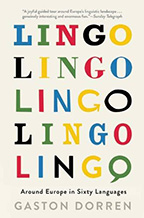
Lingo: Around Europe in Sixty Languages by Gaston Dorren


Entertaining kaleidoscope of linguistic history and diversity
Gaston Dorren is a Dutch author who has written and published works both in his native language and in English. Fluent in several languages and able to read several others, Dorren certainly demonstrates an encyclopedic knowledge of many languages in his book Lingo: Around Europe in Sixty Languages. Published in America in 2015, Lingo is based on a book Dorren previously published in Dutch entitled Taaltoerisme. The American edition, however, reads as if it were expressly written for an English-language audience, not just because of Dorren’s English fluency but also because he constantly makes comparisons between the vocabulary, grammar, and syntax of English and that of other European languages. Though he is an accomplished polyglot, it is unclear to me whether Dorren has had any formal education in linguistics. If not, that may be a good thing, because were he an academic he might not write such entertaining prose for the general reader.


As the subtitle indicates, Lingo is comprised of sixty chapters, each of which typically examines a different language. That structure is not strictly adhered to, however, because often several languages will be discussed in a single chapter. Dorren goes well beyond the familiar national languages to cover some of the lesser-known regional tongues of Europe such as Breton, Sami, Manx, Gagauz, and Faroese. The chapters are divided among nine thematic sections that focus on, for example, languages with interesting historical pedigrees, languages with unusual grammar, alphabets, or spelling conventions, or languages that are endangered. Dorren reveals much fascinating detail on the history of languages, how they developed from their prehistoric progenitors, and how they have been influenced by politics in ancient and modern times. The book also delves into the mechanics of languages, pointing out similarities and highlighting structural anomalies, such as the convoluted spellings of Welsh, the confusing cases of Romani, the uncommon ergativity of Basque, the baffling genders of Dutch, and the cumbersome peculiarities of English.

Reading Lingo will not help you become fluent in a foreign language, but it will certainly kindle your enthusiasm for linguistic study. If you are already interested in learning foreign languages, then you will definitely enjoy all the arcane trivia that Dorren presents on the languages of Europe. It is really quite amazing how he can take such technical subject matter and generate prose that is not only intelligent and articulate but also lively and fun. If you happen to be studying any European languages, you might pick up a useful skill or an aid to understanding along the way. I know nothing about Russian, for example, but Dorren’s brief primer on the reading of Cyrillic was an enlightening introduction that renders the exotic alphabet less intimidating. This book’s brief linguistic vignettes explain the quirky learning hurdles in many languages while simultaneously demystifying them.

As an avid self-educated language dilettante, I wish there were more books like this—comparative linguistics for the culturally curious general reader and traveler. Dorren followed up Lingo with Babel, published in 2019. This latter book examines the world’s twenty most popular languages, including Asian and African languages. No doubt it will showcase more of Dorren’s comprehensive insight into the idiosyncrasies of planet Earth’s many tongues. After thoroughly enjoying Lingo, I look forward to reading it.
If you liked this review, please follow the link below to Amazon.com and give me a “helpful” vote. Thank you.
https://www.amazon.com/review/R1BXZRUV1JOFKT/ref=cm_cr_srp_d_rdp_perm

Wednesday, September 6, 2017

Ethics by Baruch Spinoza


The toughest book you’ll ever love
Ethics by Baruch Spinoza (a.k.a. Benedict de Spinoza) was originally published in 1677 under the Latin title of Ethica, ordine geometrico demonstrata. Though the title highlights Spinoza’s ethical philosophy, the scope of the book is much broader. Before he ever gets around to discussing how people should conduct themselves, he first examines in great detail the nature of God, the substance of matter, and the processes of human thought and emotion. One thing that separates Ethics from just about any other philosophical text you’re likely to come across is that Spinoza makes his argument in the form of a mathematical proof, similar to the style of Euclid’s The Elements. He begins each of the book’s five parts by defining terms. He then postulates several fundamental axioms. From these axioms, he proceeds to make a series of propositions, each of which builds upon the material that came before. He supports each proposition with explanatory commentary, corollaries, and notes.

The result of this approach is a very comprehensive and coherent one-volume philosophical system of how the universe works. By coherent I mean that its pieces cohere firmly and logically together; I definitely don’t mean easy to read. Never has a book been so orderly structured yet so confusing. Each sentence Spinoza writes is crafted in a circuitous syntax that is quite frustrating to decipher. He pens each statement with such precision that at times its like reading computer code. Yet when kernels of wisdom do emerge from this fog of verbiage the reader reaps the rewards of pure genius. It’s not always a fun read, but it is a work that deserves deep concentration and contemplation. Though the Euclidean structure of the book makes for labor intensive reading, you’ll end up wishing more philosophers would have adopted this logical structure and stated their ideas so systematically.

Spinoza begins by discussing the substance of which the universe is comprised. While dualists like Plato and Descartes posited that the universe consists of two substances, matter and spirit, Spinoza proposes a monism by which matter and mind are one and the same substance. Since only one substance exists, God is also comprised of it, and since God is infinite, the universe (or Nature) is God. Thus, from the philosophy of monism springs the religion of pantheism. In Spinoza’s view, everything is divine. His deity is not an anthropomorphic god, nor does he believe in ideal definitions of good and evil. Spinoza maintains a strictly deterministic view of the universe in which every action leads back to the ultimate cause, the eternal God. Fate is predetermined and free will is an illusion. Spinoza goes to great lengths to explain how human thoughts and emotions are the result of natural processes, even so far as to define a tedious laundry list of human emotions and their causes. His ethics are very similar to those of the ancient Stoics. Man has no control over what befalls him, but he can manage his emotions with rational thought and cultivate happiness by contemplating God and resigning himself to his natural destiny. Despite his continual use of the G-word, Spinoza’s pantheism is about as near as you can get to atheism without calling it as such. The Ethics may be the closest thing to a bible for freethinkers that has ever been produced. Thanks to its Euclidean structure, you can even quote it chapter and verse.

The Wordsworth Classics series has a beautifully typeset paperback edition of the Ethics, with a revised version of the 1883 translation by W. H. White. However, the translation by R. H. M. Elwes (also 1883), found in the free ebook edition from Project Gutenberg, is a little easier to understand. For difficult passages, I found myself going back and forth between the two.
If you like this review, please follow the link below to Amazon.com and give me a “helpful” vote. Thank you.
https://www.amazon.com/review/R1CO8EFGXFKWIU/ref=cm_cr_srp_d_rdp_perm