Showing posts with label Foreign language. Show all posts

Monday, March 17, 2025

Empires of the Word: A Language History of the World by Nicholas Ostler


Bites off more than most general readers can chew
Nicholas Ostler is a British scholar with degrees in linguistics, Greek, Latin, and Sanskrit, among others. He is currently the chairman of the Foundation for Ancient Languages. The publisher HarperCollins says Ostler has “a working knowledge of twenty-six languages.” His book Empires of the Word was published in 2005.

In this book, Ostler writes about what he calls “language dynamics,” that is, how languages are born, proliferate, migrate, and die. Why does one language succeed in dominating large portions of the world, through millions of native and secondary speakers, while many others languish and disappear over time? Ostler explains how these rises and falls have played out numerous times over the course of world history due to causes such as military conquest, imperialism, trade relations, economic influence, religious conversion, government bureaucracy, mass media, and perceived status and prestige. Ostler doesn’t provide a unifying thesis as to how languages survive and thrive. Rather, he examines the spread and decline of languages over the course of history and examines each pivotal turning point on a case-by-case basis, often drawing parallels between the trajectories of ancient and modern languages. He focuses much attention on the languages that are most prominent in the world today, and how they got that way.


As for the intended audience, I’m guessing this is a history book written for linguists. Ostler certainly assumes a lot of prior knowledge of history and languages on the part of the reader. I was hoping for something a little more accessible to general readers, like Gaston Dorren’s books Lingo and Babel, which cover many of the same topics as this book but in a much more user-friendly manner. Empires of the Word is such a relentless barrage of detail it is difficult to see the forest for the trees. Ostler’s prose often reads like a text composed entirely of footnotes. Foreign words discussed in the text are often accompanied by a phonetic approximation of pronunciation, yet there is no key provided as to the system of phonetic notation used, so the reader is simply expected to know that. Even if the notation is a standard with which linguists would be familiar, the reliability of the phonetic transcriptions is called into question by typographical issues with font glyphs and diacritics (in the ebook, as discussed below). The only thing that might make me think this book is meant for general readers is Ostler’s repetitive summarizing of his points and conclusions. By the time you get to the end, it feels like you’ve read the same book three times.

Ostler likes to quote from historical texts. He presents these quotes in their original language (often non-Latin alphabets) and then in English translation. It is often interesting to see the comparison between the two writing systems. Early in the book, however, Ostler uses the French phrase “coup de grâce.” In the ebook edition, the “a” accented with a circumflex is replaced by an “s” with an hacek. This is a font error that likely does not occur in the print edition, but this caused me to question the accuracy of the spelling and diacritics of all the foreign words, of which there are many, throughout the ebook. How do I know if what I’m seeing is correct? The “s” with an hacek appears quite frequently, and some words have dollar signs in them. Of course, a font problem is no fault of the author’s, but rather a production issue that is the publisher’s responsibility, so Ostler is not to blame. Near the end of the book, there’s a chapter about the top twenty languages in the world today, in terms of number of speakers. Throughout the chapter, Ostler repeatedly refers to “the list,” yet the list itself is not provided to the reader. My guess is that the list was formatted as a table, and that table was excluded from the ebook. Perhaps that’s also what happened to the pronunciation key. HarperCollins really did not do a very good job of putting this ebook together, resulting in a rather annoying experience for the reader.

Friday, December 1, 2023

Writing (Ancient Peoples and Places series) by David Diringer


Broad, shallow overview of ancient scripts
In 1957, the London publisher Thames & Hudson began publishing a series of books on archaeology entitled Ancient Peoples and Places, which eventually grew to 113 volumes. In most cases, each book synthesizes the current research on a particular region or ancient civilization. The 25th book in the series, however, was the first volume to break that rule by focusing instead on the worldwide ancient history of a particular cultural phenomenon: Writing. That book entitled Writing, written by David Diringer, was first published in 1962.

Diringer starts by explaining the distinctions between pictographic, ideographic, transitional, phonetic or syllabic, and alphabetic forms of writing. He then goes on to examine individual scripts of different regions of the world and their chronological development. He starts by discussing the first pictographic symbols of prehistoric peoples. He then examines ancient writing styles of the Near East, including cuneiform, Egyptian hieroglyphics, Hittite hieroglyphics, and the Minoan or Cretan scripts Linear A and B. This is followed by a chapter on East Asian scripts, which only covers Chinese and Japanese, with a brief addendum on Easter Island writing. Then follows a chapter on the pre-Colombian writing of the Maya and Aztecs. Not surprisingly, the most coverage is reserved for the ancient languages that were precursors to our own alphabet, which arose out of Semitic scripts that precursed the Phoenician, Greek, and finally Latin alphabets. Multiple side trips are taken into other written languages, such as Aramaic, Arabic, and Indian scripts. The book is illustrated with many transcriptions of ancient writing, photographs of inscribed artifacts, and phonetic and alphabetic tables of the languages covered.

The books in the Ancient People and Places series are meant to be concise introductory texts for students and general readers. They typically run about 200 pages, with many illustrations and charts, plus another 60 pages of photographs. In a book of that size, Diringer can’t provide a comprehensive history of every ancient script, so he had to make choices about what to feature and what to omit. Nevertheless, he covers a surprisingly large number and broad variety of languages here. What you get in this book is a little bit of knowledge about a lot of different scripts and their cultures. Diringer provides enough information to pique one’s interest, so the reader can seek out further information on specific languages in more specialized texts.

I read the first edition of this book from 1962. At that time, the Minoan script Linear B had just been deciphered, and the Mayan glyphs had not been completely deciphered. Soviet scholar Yuri Knozorov would put the finishing touches on cracking that code a few years later. I’m sure a lot of other discoveries have been made regarding ancient scripts in the past 60 years. Nevertheless, as emphasized before, this is a basic introduction to the field, and much of the fundamentals have survived the test of time. There’s not enough space here for Diringer to teach you how to read any of these scripts anyway, so if you require that level of detail and accuracy, look for a more advanced text. As a general overview, I enjoyed this book. It provides a clear outline of the development of alphabets over millennia, and it brought to my attention a few ancient civilizations and their scripts with which I was unfamiliar. I have been pleased with the volumes of the Ancient Peoples and Places Series that I have seen thus far, and I look forward to reading more of them.
If you liked this review, please follow the link below to Amazon.com and give me a “helpful” vote. Thank you.

Friday, November 10, 2023

The Code Book: The Science of Secrecy from Ancient Egypt to Quantum Cryptography by Simon Singh


An intelligent mix of history and how-to
In The Code Book, British author and physicist Simon Singh provides a history of cryptography from ancient times to the present. This is a popular science book aimed at general readers, so the text is accessible and isn’t bogged down with incomprehensible mathematical jargon. It’s still an intellectually challenging read, however, and those who are interested in the arcane details of this subject will find it quite entertaining. Singh explains that The Code Book is really more about ciphers than about codes, but The Cipher Book just wouldn’t sound as cool.


Every time someone writes a book about cryptography for the general reader, some fundamentals must be covered. First of all, the author must explain how a simple alphabetic substitution cipher works (each letter in the alphabet is substituted for another). Then, the writer must explain how to solve such a cipher using frequency analysis (the most commonly used letter in the ciphertext, for example, is likely to represent E, the most common letter in the English alphabet, and so on). Anyone with an interest in cryptography already knows about these elementary matters, but they must be included in order to lay the foundation for the discussion and to educate newcomers to the subject. It’s no small feat that Singh manages to explain these basics in an articulate way that novices can understand but won’t bore the pants off those who already know what he’s talking about.

The Code Book is a fascinating mix of cryptographic history and practical knowledge on how ciphers are created and cracked. Singh doesn’t just talk about how ciphers were used in the past and show you some examples. He really gives you an understanding of how each cipher works and the motivation behind its development. There’s an entire chapter, for example, on the Nazis’ World War II code machine named Enigma. The reader comes away with a pretty thorough understanding of that mechanism’s cryptographic process. This is followed by another chapter about how the Allies cracked the Enigma cipher. From there, Singh goes into digital cryptography. To some extent, computer-generated ciphers are too complex for the unaided human mind to unravel, but Singh still does a great job of explaining the methods and mathematics behind today’s digital encryption. Finally, Singh moves into quantum cryptography and quantum computing. In order to discuss these topics, he has to give the reader a nutshell overview of quantum mechanics, which he manages to do quite eloquently.

Singh goes off on some digressions that feel unnecessary. In the first chapter, I don’t think I needed a complete biography of Mary Queen of Scots to figure out how her cipher worked, and the discussion of cryptography really got lost amid all the historical context. Singh also spends half a chapter on the decipherment of ancient languages, such as Egyptian hieroglyphics and Linear B. While I’m interested in that subject, it feels out of place here because it ventures more into linguistics than cryptography.

The Code Book was published in 1999, so it only covers the history of cryptography up to that point. A lot has happened since then. Singh writes about identity theft and personal data leaks as if they were events bound to happen in the future, not the common occurrences of today. Although he covers the initial scientific investigations into quantum computing, further developments have occurred in the past two decades. This is a history book, after all, and the present never stays the present forever. As a historical summary of cryptography up to the year 2000, it’s hard to imagine a better one-volume treatment than this.  
If you liked this review, please follow the link below to Amazon.com and give me a “helpful” vote. Thank you.
https://www.amazon.com/review/R2RA3N728FZS19/ref=cm_cr_srp_d_rdp_perm

Monday, June 12, 2023

Babel: Around the World in Twenty Languages by Gaston Dorren


Another fascinating tour through the peculiarities and politics of language
If you are fascinated by foreign languages, Gaston Dorren’s books are a must-read. Babel, published in 2018, is the follow-up to Dorren’s excellent 2014 book Lingo: Around Europe in Sixty Languages. In both books, Dorren looks at many different languages, examining their histories, their structural oddities, and their political and cultural controversies. While Lingo focused entirely on European languages, in Babel, Dorren examines the twenty most widely spoken languages in the world today. Chapters devoted to each language are arranged like a top 20 countdown from least popular to most popular (though even number 20 has 85 million speakers, so they’re all winners here).


Though it delves into some complicated linguistic concepts, Babel is not written for linguists. Rather, if you’ve ever tried to learn a foreign language—successfully or not—and enjoyed it, chances are you have a linguistic curiosity that will find satisfaction in Dorren’s exploration of these top twenty tongues. Dorren expounds upon each language differently. Sometimes he will delve into the unusual mechanics of a language, such as his discussion of the grammatical peculiarities of German that make it one of the most difficult languages to learn, or his examination of the differences between male and female speech in Japan. He recounts his own attempts at learning Vietnamese, with limited success, and attempts to demystify Arabic by pointing out the numerous Arabic words that over the centuries have made their circuitous way into English. In many chapters Dorren explains the history of a language and its effect on the politics and culture of its speakers, such as Turkey’s ambitious program of language reform in the early 20th century, or how Persian and Malay became the dominant languages in their respective regions. Unfortunately, some of these histories involve genocide along linguistic lines, as has occurred for example in India, Pakistan, and Sri Lanka. Dorren does not limit himself to spoken languages but discusses scripts as well, providing brief explanations of the Chinese and Japanese systems of writing, for example, or the differences between the different scripts used in India. In all cases, Dorren is really a wizard at concisely explaining the complex intricacies of language in terms that a general reader (not a professor of linguistics) can easily understand, and he manages to keep the discourse entertaining without dumbing down the subject matter in the least.

Although Dorren resides in the Netherlands, and Dutch is his first language, he wrote both Lingo and Babel in English. He then wrote the Dutch editions, which were published later. The English editions are clearly written specifically for an English-language reading audience because they include numerous examples comparing the grammar and vocabulary of different world languages to British and American English. In addition, Dorren is able to provide an educated outsider’s perspective on the English language, and he offers a balanced critique on its difficulties and oddities in a way that a native speaker who takes such oddities for granted could not.

Of Dorren’s two books, I would have to say I slightly prefer Lingo over Babel, probably because the broader scope of 60 languages allows for more intriguing anomalies among lesser-known languages. Nevertheless, Babel is really a fascinating and enlightening read. I look forward to reading whatever Dorren publishes next. I’d love to see him do a book where he can examine some of the more obscure languages of Africa, Asia, and the Americas.
If you liked this review, please follow the link below to Amazon.com and give me a “helpful” vote. Thank you.

Monday, November 14, 2022

Life and Works of Alexander Csoma de Körös by Theodore Duka


Inadequate biography of a fascinating life 
Alexander Csoma de Körös
Alexander Csoma de Körös (1784-1842) is the founder of Tibetology. A Hungarian philologist, he was one of the first Western scholars to venture into Tibet, learn their language, and read their texts. His journey East and his cultural and linguistic studies are really quite fascinating. Unfortunately his biography, Life and Works of Alexander Csoma de Körös by Theodore Duka, doesn’t really do justice to its subject. Due to a lack of concrete information on Csoma, this account of his life is rather boring and repetitive, but it is likely the best source we have for shedding light on the journeys, discoveries, and eccentric personality of this intrepid linguistic explorer.

Born in the town of Körös in Transylvania, Csoma was of Székely origin, a Hungarian ethnic group in Romania. As a young scholar, he decided to research the origins of the Hungarian people. He believed they were descended from the Huns, who came from Asia to make frequent raids into Eastern Europe. This naturally directed his studies Eastward. Today we know that most European languages evolved from a prototypical Indo-European tongue. In his peregrinations Eastward, Csoma was essentially tracing this linguistic family tree backwards to India, where he marked similarities between the Hungarian language and Sanskrit. Eventually he became fascinated with Tibet and Buddhism, and the Tibetan language became the primary focus of his studies and the field in which he made important contributions. Csoma was a gifted polyglot with a facility in many languages, among them Hungarian, Romanian, Greek, Latin, Hebrew, French, German, English, Slavonic, Turkish, Arabic, Persian, Sanskrit, Bengali, Pashto, Hindustani, Marathi, Tibetan, and Russian.


Despite his formidable achievements, Csoma was a very modest man, and didn’t write much about himself or his travels. The result of this is a paucity of information on the man. Duka based this biography mostly on a series of letters, many reproduced verbatim, between Csoma and officials of the English government in India who financed his travels. In these letters, Csoma summarized his studies, much like a professor today might write a grant report to a funding agency. Much of the correspondence discusses the stipend granted to Csoma by the English, some of which he refused to accept. In India and Tibet, Csoma lived a very ascetic existence similar to the Buddhist monks with whom he studied. He resided in small cells, sleeping on the floor, surviving on tea and rice, and devoting all his time to his studies. He seemed to be addicted to self-denial, eschewing not only luxuries but also what most would consider bare necessities, perhaps viewing himself as a martyr to knowledge. Out of gratitude to his English benefactors, Csoma published his research in English, including the first Tibetan-English dictionary.


While the biography feels sparse, one thing Duka does very thoroughly is summarize Csoma’s writings, perhaps too thoroughly for all but Csoma’s peer Tibetologists. About the last quarter of the book is devoted to this extensive annotated bibliography of Csoma’s published research.


I enjoy reading biographies of scientists, explorers, and ethnographers because they allow one to live vicariously through the subject’s travels and discoveries. That’s difficult to do with Life and Works of Alexander Csoma de Körös, because the person in question never shared his experiences of world travel, only his scholarly research. Even so, I’m glad I read this to learn more about this interesting historical figure. Thankfully, I also have a healthy interest in foreign languages, because this book will probably only appeal to those who do.

Wednesday, March 23, 2022

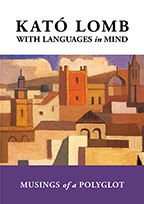
With Languages in Mind: Musings of a Polyglot by Kató Lomb


Meandering, repetitive grab bag on languages and language learning
Kató Lomb was one of the twentieth century’s most accomplished polyglots (a speaker of many languages). Learning languages was her great love, and she did it well enough to work as a professional interpreter in sixteen tongues. Lomb also wrote books on language learning and interpreting, three of which are available for free download as pdfs on the website of The Electronic Journal for English as a Second Language (TESL-EJ). One of those books, With Languages in Mind: Musings of a Polyglot, was originally published in Lomb’s native language of Hungarian in 1983. The contents are aptly described by the subtitle as “Musings.” The book is comprised of 35 chapters, each from one to a dozen pages in length, in which Lomb shares thoughts, anecdotes, and her expert wisdom on languages, their interesting peculiarities, and how to learn and teach them.

This book will appeal to both language educators and language enthusiasts. For members of the latter category (like myself), Lomb does not provide a “fluent in 30 days” wonder scheme for how to learn languages quickly, but she does describe her preferred methods and acquired habits for studying and practicing new languages. She also advises teachers on how her methods could be incorporated into language education to improve student enthusiasm and success. Interspersed throughout the book are humorous anecdotes and horror stories of Lomb’s work as a simultaneous interpreter at various academic and political conferences. There isn’t really much rhyme or reason to the organization of the book; it is just a haphazard pouring forth of linguistic minutiae as the expert pontificates on her love of languages in a lively and for the most part accessible manner. Some topics Lomb discusses include the importance of context in learning vocabulary, the growing tendency in many languages towards the use of more and smaller words, general differences in speech patterns between males and females, and the purported value of learning Latin. To illustrate the points made in each chapter, she often cites examples from the linguistic characteristics of English, German, Hungarian, French, Spanish, Russian, and Japanese.


Lomb wrote her books in Hungarian primarily for a Hungarian audience. Thus the text includes many references, puns, inside jokes, and historical anecdotes that can only be truly understood by a native Hungarian. The English translator Ádám Szegi and/or the editor Scott Alkire explain these Hungarian-specific comments with footnotes, but much of the humor and import of such comments is lost to the English reader. This is an issue common to all of Lomb’s writings, but With Languages in Mind is by far the most Hungarian-centric of the three Lomb books I’ve read (the other two being Polyglot: How I Learn Languages and Harmony of Babel: Profiles of Famous Polyglots of Europe). In regard to her native tongue, some topics Lomb covers include the qualities of Hungarian that make it a beautiful literary language, the effect of the World War II fascist regime on the language, and generational changes in Hungarian over time.


The editor points out that some of the content in With Languages in Mind has either been pulled verbatim or slightly altered from the earlier published Polyglot: How I Learn Languages. Having read Polyglot previously, much of the content of With Languages in Mind did feel like a rehash, though I still enjoyed Lomb’s enlightening linguistic musings the second time around. Of the three Lomb books mentioned above that are freely available in English, With Languages in Mind is the least essential read. The other two books, Polyglot and Harmony of Babel, are more interesting, better organized, and cover more compelling ground.

If you liked this review, please follow the link below to Amazon.com and give me a “helpful” vote. Thank you.

Wednesday, March 9, 2022

Extinct Languages by Johannes Friedrich


A concise but not elementary overview of Old World epigraphy
Johannes Friedrich was a German linguist and hittitologist (an expert on the Hittites). His book Extinct Languages is a survey of ancient writing systems and the efforts made in deciphering them. (This is generally called epigraphy, but Friedrich’s translator never uses that word.) Originally published in 1954 as Entzifferung verschollener Schriften und Sprachen, the book was published in English translation in 1957. Friedrich begins his book by looking at “The Three Great Decipherments in the Study of the Ancient Orient”: Egyptian hieroglyphics, cuneiform writing, and Hittite hieroglyphics. This occupies the first half of the book, while the latter half is devoted to brief looks at about a dozen other ancient languages in various stages of decipherment. The book is illustrated with drawings or photographs of each script, and Friedrich explains the techniques employed, successfully or unsuccessfully, in deciphering them.

With the exception of the brief mention of an Indus Valley script and its similarity to writing found on Easter Island, the scope of the book is strictly confined to Southern Europe, North Africa, and the Middle East, ranging from Italy (the Etruscans) to Iran (Persian cuneiform). Friedrich never mentions Native American writing such as that of the Aztecs or Maya. The problems encountered and the techniques used in deciphering the Egyptian or Hittite hieroglyphics, however, are similar to those employed in the reading of the Maya glyphs (see Michael Coe’s book Breaking the Maya Code). Friedrich’s book offers an interesting glimpse into what epigraphers do and how they solve these fascinating centuries-old linguistic puzzles.

Given the broad and brisk coverage of each language, I’m guessing that Friedrich intended Extinct Languages to serve as an introductory text for undergraduate students and general readers. It is definitely accessible to amateur linguists and armchair archaeologists, but it’s not an easy read. In the 1950s, educated people were expected to have some knowledge of Greek and Latin, and Friedrich assumes his readers have that linguistic foundation, making some passages difficult for the average English-language reader of today. One thing I found frustrating is that Friedrich doesn’t provide any key to the Latinization scheme he’s using to transliterate these different writing systems into our alphabet. Perhaps he used a method that was the disciplinary standard for his time, but one unfamiliar with that scheme can only take a guess at the pronunciation of these transliterated words.

Obviously there’s been some progress made in the field since Extinct Languages was published. At the time of writing, the Linear B script from the Minoan civilization of Crete had not yet been deciphered. As the book went to press, however, Friedrich added an appendix describing the promising progress made by Michael Ventris towards reading that ancient language. (For more on that, see John Chadwick’s 1959 account The Decipherment of Linear B.) I’m sure advances have since been made in all of the languages discussed in this book, so Friedrich’s 60-year-old survey of the discipline cannot be considered up-to-date. The advantage to this book, however, is the broad range of languages that it covers. In all cases, if you want to learn how a specific script was deciphered, you’d be better off consulting a text that’s solely devoted to that one language. Friedrich’s overview gives enough of an introduction to each language to allow the reader to decide which topics merit following up with further research. For anyone interested in languages, it will definitely pique your interest enough to want to learn more.
If you liked this review, please follow the link below to Amazon.com and give me a “helpful” vote. Thank you.
https://www.amazon.com/review/RVMXCWFC1V2YI/ref=cm_cr_srp_d_rdp_perm

Friday, January 14, 2022

Lingo: Around Europe in Sixty Languages by Gaston Dorren


Entertaining kaleidoscope of linguistic history and diversity
Gaston Dorren is a Dutch author who has written and published works both in his native language and in English. Fluent in several languages and able to read several others, Dorren certainly demonstrates an encyclopedic knowledge of many languages in his book Lingo: Around Europe in Sixty Languages. Published in America in 2015, Lingo is based on a book Dorren previously published in Dutch entitled Taaltoerisme. The American edition, however, reads as if it were expressly written for an English-language audience, not just because of Dorren’s English fluency but also because he constantly makes comparisons between the vocabulary, grammar, and syntax of English and that of other European languages. Though he is an accomplished polyglot, it is unclear to me whether Dorren has had any formal education in linguistics. If not, that may be a good thing, because were he an academic he might not write such entertaining prose for the general reader.


As the subtitle indicates, Lingo is comprised of sixty chapters, each of which typically examines a different language. That structure is not strictly adhered to, however, because often several languages will be discussed in a single chapter. Dorren goes well beyond the familiar national languages to cover some of the lesser-known regional tongues of Europe such as Breton, Sami, Manx, Gagauz, and Faroese. The chapters are divided among nine thematic sections that focus on, for example, languages with interesting historical pedigrees, languages with unusual grammar, alphabets, or spelling conventions, or languages that are endangered. Dorren reveals much fascinating detail on the history of languages, how they developed from their prehistoric progenitors, and how they have been influenced by politics in ancient and modern times. The book also delves into the mechanics of languages, pointing out similarities and highlighting structural anomalies, such as the convoluted spellings of Welsh, the confusing cases of Romani, the uncommon ergativity of Basque, the baffling genders of Dutch, and the cumbersome peculiarities of English.

Reading Lingo will not help you become fluent in a foreign language, but it will certainly kindle your enthusiasm for linguistic study. If you are already interested in learning foreign languages, then you will definitely enjoy all the arcane trivia that Dorren presents on the languages of Europe. It is really quite amazing how he can take such technical subject matter and generate prose that is not only intelligent and articulate but also lively and fun. If you happen to be studying any European languages, you might pick up a useful skill or an aid to understanding along the way. I know nothing about Russian, for example, but Dorren’s brief primer on the reading of Cyrillic was an enlightening introduction that renders the exotic alphabet less intimidating. This book’s brief linguistic vignettes explain the quirky learning hurdles in many languages while simultaneously demystifying them.

As an avid self-educated language dilettante, I wish there were more books like this—comparative linguistics for the culturally curious general reader and traveler. Dorren followed up Lingo with Babel, published in 2019. This latter book examines the world’s twenty most popular languages, including Asian and African languages. No doubt it will showcase more of Dorren’s comprehensive insight into the idiosyncrasies of planet Earth’s many tongues. After thoroughly enjoying Lingo, I look forward to reading it.
If you liked this review, please follow the link below to Amazon.com and give me a “helpful” vote. Thank you.
https://www.amazon.com/review/R1BXZRUV1JOFKT/ref=cm_cr_srp_d_rdp_perm

Friday, June 18, 2021

The Decipherment of Linear B by John Chadwick


Cracking the ancient Mycenaean code
In the late nineteenth and early twentieth centuries, archaeologists working in Greece discovered a number of clay tablets inscribed with a previously undiscovered system of writing. Caches of these tablets were found primarily at two sites: the Minoan palace of Knossos on the island of Crete, and the Mycenaean city of Pylos on the Greek mainland. Eventually linguists and archaeologists established that the writing dates to around 1450 BC. The script was dubbed Linear B (as opposed to Linear A, an even earlier script). From the 1930s to the 1950s, many philologists tried unsuccessfully to decipher this writing, until British architect Michael Ventris discovered the key to cracking the code. Tragically, Ventris died soon after, in his mid-thirties. In his book The Decipherment of Linear B, first published in 1958, classical linguist John Chadwick, who collaborated with Ventris on the decipherment, tells the story of how this ancient writing system was discovered and decrypted. I am reviewing the Second Edition published in 1967.


When first encountered, any unknown script presents two main problems: First, is it a pictographic, alphabetic, or syllabic script, or a combination of the above? Second, all scripts are meant to represent a spoken language, but to which particular language does this script correspond? In the case of Linear B, it might very well be a language that no longer exists. Egyptian hieroglyphics were deciphered with the help of a bilingual text, the Rosetta Stone, but for Linear B there exists no such bilingual text, so the investigators basically had to start with nothing. Ventris and others began this daunting task by looking for familiar syntactical patterns in the texts and comparing them to languages from roughly the same time period, such as Etruscan, Cypriot, and Hittite. Ventris finally cracked the code when he proved that the characters corresponded to an early form of Greek.

Though Chadwick, along with Ventris, published several articles and books intended for specialists in the field, he states in the introduction to The Decipherment of Linear B that this book is intended for a general reading audience. While this is certainly an authoritatively informative book on its subject, Chadwick is not entirely successful at making this topic accessible to the lay reader. To tackle this book, one not only needs to have an avid interest in the ancient Greek world but also a fairly firm knowledge of linguistics. In explaining the decryption process, Chadwick goes into a level of detail that often surpasses the layman’s comprehension. One editorial choice that really makes this book user-unfriendly is that, due to difficulties in typesetting, the bulk of the text does not reproduce the Mycenaean words in the Linear B script in which they were actually written. Instead, Chadwick uses a system of numerals assigned to each character. Thus, the notation 08-60-02-15-04-13-06 may signify the word for “chariots.” Page after page of these numbers is enough to drive the reader nuts. The volume does, however, include 17 figures that illustrate the actual Linear B characters, including a comprehensive numbered syllabic chart (see below).

The tablets found at Knossos and Pylos were not literature, but rather lists of commodities. Still, as Chadwick interprets them, these tablets reveal a surprising amount of information on ancient Mycenaean life, including governmental administration, taxation and tribute, religious practices, the organization of military units, and ancient armaments. This window into the past is the most fascinating aspect of Chadwick’s book. The process of decipherment itself does not make as captivating a story as the decipherment of the Mayan language, as related by Michael Coe in Breaking the Maya Code, but anyone interested in ancient languages, particularly of Greece, will certainly find much intellectual stimulation in Chadwick’s insider account.

If you liked this review, please follow the link below to Amazon.com and give me a “helpful” vote. Thank you.


Monday, February 15, 2021

The Life of Cardinal Mezzofanti by Charles William Russell


Sizing up the world’s greatest polyglot
During his lifetime, Cardinal Joseph (or Giuseppe) Mezzofanti (1774-1849) had the reputation of being the greatest polyglot (multilinguist) in the history of the world, or at least the Western World. Born in Bologna, Italy, Mezzofanti was a librarian and professor of oriental languages at the University of Bologna before being promoted to service in the Vatican, where he taught clergymen from all over the world at the College of the Propaganda. Despite having never traveled outside of Italy, Mezzofanti is said to have spoken at least thirty languages fluently enough that he was often mistaken for a native speaker. In addition, he had varying degrees of familiarity and reading skills with dozens of other languages and dialects. Mezzofanti seems to have possessed a photographic memory, or at least its auditory equivalent, and was able to switch effortlessly from one language to another in mid-conversation without missing a beat. In his 1858 book The Life of Cardinal Mezzofanti, Irish clergyman and scholar Charles William Russell provides a biography of this hyperpolyglot and scrutinizes eyewitness reports of his multilingual prowess.

Before Russell can properly assess Mezzofanti’s remarkable linguistic abilities, he first feels the need to establish a baseline of comparison. For this reason, the first quarter of the book is not about Mezzofanti at all, but rather an “Introductory Memoir of Eminent Linguists, Ancient and Modern.” Russell outlines a history of multilingualism from ancient times to the present, highlighting exceptional linguists and polyglots of Europe and the Middle East. Though Russell crams a great deal of arcane history into this brief overview, it is quite interesting and easy to read. Russell establishes that no one prior to Mezzofanti had been recorded to have linguistic abilities approaching his. This is a valuable summary; it’s only fault being that it ends around 1850. Since then, several polyglots have arisen to challenge Mezzofanti’s reputed achievements, including Harold Williams, Emil Krebs, Kenneth L. Hale, and Georg Sauerwein among others.

Russell’s main purpose in charting the life of Mezzofanti is to ascertain as closely as possible what languages Mezzofanti knew and how well he knew him. Since Mezzofanti himself was modest about his abilities and published almost nothing in the field of linguistics, this makes for a difficult task. Since the book was published shortly after Mezzofanti’s death, Russell is able to rely on the testimony of many witnesses and acquaintances of the polyglot cardinal. (Russell himself met Mezzofanti on more than one occasion.) Not all the statements are positive. Some of Mezzofanti’s contemporaries claimed his skills were overhyped and that he was little more than a glorified human parrot. Those affirming Mezzofanti’s legendary powers, however, far outnumber his detractors. By comparing numerous accounts, Russell is able to compile a tentative list of Mezzofanti’s languages and his reputed degree of knowledge in each (see below).

The Life of Cardinal Mezzofanti is not a conventional biography. Because of Russell’s investigative focus into Mezzofanti’s specific abilities, the subject’s life story gets the short shrift. The book often reads more like a box of assorted letters than a biography. Russell’s text can get boring and repetitive at times, and the book also includes copious footnotes that veer off into all manner of digressions. Nevertheless, the remarkable accounts of Mezzofanti’s abilities will fascinate any reader interested in languages. Those who don’t want to commit to the long haul can simply read Chapter XVII: Recapitulation, which summarizes Russell’s findings quite adequately and succinctly.

Mezzofanti’s languages
Though there is no definitive list of the languages that Mezzofanti knew, author C. W. Russell draws from the accounts of many who knew, met, and conversed with Mezzofanti. In the conclusion to The Life of Cardinal Mezzofanti, Russell sums up his findings on Mezzofanti’s linguistic abilities as follows [my notes in brackets]:

I. Languages frequently tested, and spoken with rare excellence:

  1. Hebrew
  2. Rabbinical Hebrew
  3. Arabic
  4. Chaldee [a.k.a. Chaldean or Aramaic]
  5. Coptic
  6. Ancient Armenian
  7. Modern Armenian
  8. Persian
  9. Turkish
  10. Albanese [Albanian]
  11. Maltese
  12. Greek
  13. Romaic [Byzantine Greek]
  14. Latin
  15. Italian
  16. Spanish
  17. Portuguese
  18. French
  19. German
  20. Swedish
  21. Danish
  22. Dutch
  23. Flemish
  24. English
  25. Illyrian [a language of the Balkans]
  26. Russian
  27. Polish
  28. Czechish or Bohemian
  29. Magyar [Hungarian]
  30. Chinese
II. Stated to have been spoken fluently, but hardly sufficiently tested:
  1. Syriac
  2. Geez [a.k.a. Classical Ethiopic]
  3. Amarinna [possibly Amarhic, an Ethio-Semitic language]
  4. Hindustani
  5. Guzarattee [Gujarati, of India]
  6. Basque
  7. Wallachian [a dialect of Romanian]
  8. Californian [a Native American language, possibly of Baja California]
  9. Algonquin
III. Spoken rarely, and less perfectly:
  1. Koordish [Kurdish]
  2. Georgian
  3. Serbian
  4. Bulgarian
  5. Gypsy language [a.k.a. Romani]
  6. Peguan [a.k.a. Mon, a language of Myanmar and Thailand]
  7. Welsh
  8. Angolese [presumably one of the native languages of Angola]
  9. Mexican [Spanish dialect, or a Native American language?]
  10. Chilean [Spanish dialect, or a Native American language?]
  11. Peruvian [Spanish dialect, or a Native American language?]
IV. Spoken imperfectly; a few sentences and conversational forms:
  1. Cinagalese [a language of Ceylon, a.k.a. Sri Lanka]
  2. Birmese [Burmese]
  3. Japanese
  4. Irish
  5. Gaelic
  6. Chippewa Indian
  7. Delaware
  8. Some of the languages of Oceanica
V. Studied from books, but not known to have been spoken:
  1. Sanscrit [Sanskrit]
  2. Malay
  3. Tonquinese [a Vietnamese language]
  4. Cochin-Chinese [a Vietnamese language?]
  5. Tibetan
  6. Japanese
  7. Icelandic
  8. Lappish [language of the Sami, or Lapps, in Northern Scandinavia]
  9. Ruthenian [a Slavic language of Lithuania]
  10. Frisian [a Germanic language of the Netherlands]
  11. Lettish [a.k.a. Latvian]
  12. Cornish (old British of Cornwall)
  13. Quichua (ancient Peruvian)
  14. Bimbarra (Central African)
VI. Dialects spoken, or their peculiarities understood:
    1. Hebrew
            Samaritan
    2. Arabic
            Syrian dialect (fluently)
            Egyptian dialect
            Moorish
            Berber
    3. Chinese
            Kiang-Si dialect
            Hu-quam dialect
    4. Italian
            Sicilian
            Sardinian
            Neapolitan
            Bolognese
            Lombard
            Friulese
    5. Spanish
            Catalan
            Valencian
            Majorican
    6. Basque
            Labourdain
            Souletin
            Guipuscoan
    7. Magyar
            Debreczeny
            Eperies
            Pesth
            Transylvanian
    8. German
            Ancient Gothic
            Rhetian (Grisons)
            Sette Communi dialect
            Dialects of Northern and Southern Germany
    9. French
            Provençal
            Tolosan
            Burgundian
            Gascon
            Bearnais
            Lorraine
            Bas Breton
    1o. English
            Somersetshire, Yorkshire and Lancashire dialects
            Lowland Scotch

If you liked this review, please follow the link below to Amazon.com and give me a “helpful” vote. Thank you. 
https://www.amazon.com/review/R1QXTNROUMPQ46/ref=cm_cr_srp_d_rdp_perm

Friday, August 14, 2020

Harmony of Babel: Profiles of Famous Polyglots of Europe by Kató Lomb


Not quite what the subtitle promises, but still educational
During her lifetime, Kató Lomb (1909-2003) was one of the world’s most renowned polyglots (a master of multiple languages). Languages were not only her passion but also her vocation. After earning a PhD in chemistry, she discovered her love for languages and pursued a successful career as an interpreter and translator, including simultaneous interpreting at scientific and political conferences. She was also an advocate for language learning and wrote four books on the subject. Her last book, Harmony of Babel, was published in 1988. The subtitle Profiles of Famous Polyglots of Europe leads one to believe that the book will consist of biographical sketches of renowned multilinguists, but such profiles comprise less than half the book. The rest is a discussion of languages and language learning techniques similar to the material featured in Lomb’s first book, Polyglot: How I Learn Languages.

Early in the book, Lomb provides biographical sketches of six great polyglots of the past. The best-known is Cardinal Giuseppe Mezzofanti (1774-1849), a Vatican scholar who was famous for his facility with dozens of languages, even though he never left Italy. Mezzofanti gets the most coverage, at 26 pages, while the shortest profile is less than a single page in length. The depth seems to be determined by the amount of information available on each person, which in some cases is pretty scant. Lomb only cites one or two references for each biographical sketch.

The bulk of the book is taken up by Lomb’s “Imaginary Round Table of Polyglots.” She interviewed 21 living (in 1988) polyglots and combined their answers to her list of questions into a sort of mock symposium on linguistics and language learning. Some, like Lomb, work as interpreters and translators, but others include linguists and philologists, reporters, poets, an archbishop, and the grandson of Emperor Franz Joseph von Habsburg. All are European except for one American and one Japanese. Each of these polyglots gets their own introductory profile, and it is fascinating to read how they learned their languages and how they use them. In the mock discussion that Lomb has compiled, they all provide interesting perspectives and tips on language learning, but they agree on very little.

Though her works have been translated into multiple languages, Lomb is Hungarian and wrote the book for a Hungarian audience. Consequently, Harmony of Babel includes an essay entitled “Why Is Language Instruction Ailing in Hungary?” In her writing, Lomb often makes references to Hungarian authors, poets, painters, and politicians, which actually makes the book more interesting to an American reader with little knowledge of Hungary, its history, or its arts and letters. The editor of the English-language edition provides helpful explanatory footnotes when needed. The book ends with a transcript of an interview of Lomb by a Hungarian TV host in which they engage in an in-depth discussion on the profession of interpreting.

A pdf file of this book, and two other Lomb books, can be downloaded for free from the website of The Electronic Journal for English as a Second Language. The primary audience for this book is language educators, but self-educating language enthusiasts will also find much useful wisdom. Given the subtitle, I was disappointed Harmony of Babel didn’t have more biographical information on historic polyglots. It turned out to be more of a miscellaneous grab bag, but I still enjoyed the read and gained a lot of insight into language learning methods.
If you liked this review, please follow the link below to Amazon.com and give me a “helpful” vote. Thank you.
https://www.amazon.com/review/R7J5EMGN3QFEO/ref=cm_cr_srp_d_rdp_perm

Friday, July 3, 2020

Polyglot: How I Learn Languages by Kató Lomb


Anecdotes and tips from a master multilinguist
Hungarian author Kató Lomb (1909-2003) has been called “the world’s most multilingual woman” and “possibly the most accomplished polyglot in the world.” After earning a PhD in chemistry, Lomb taught herself 16 languages well enough to work as a professional translator and interpreter in all of them, including Russian, Chinese, and Japanese. Lomb was also one of the world’s first simultaneous translators (like the ones who talk in the United Nations headphones). After achieving renown as a polyglot (master of many languages), Lomb wrote four books about languages and language learning. Her first book, Polyglot: How I Learn Languages, was published in Hungarian in 1970. An English translation can be downloaded for free from the website of TESL-EJ: The Electronic Journal for English as a Second Language.

The intended audience for Polyglot includes those who teach themselves foreign languages, those who teach languages to others, and those thinking of becoming professional interpreters. I fit into the self-taught category, but nowhere near the level of Lomb’s achievements. This book can be read by language learners of any skill level, even beginners, but one must have an avid curiosity for languages to find it interesting and useful. This book is for people who want to do more than just learn travel phrases, but who actually wish to read texts, have meaningful conversations, and go beyond mere memorization to learn the actual mechanics of a foreign language.


Despite the subtitle, only a few of the chapters really function as a how-to manual for language learning. This book is really a combination of Lomb’s personal anecdotes, learning tips, and educated reflections on languages. Even so, there is still plenty of concrete practical advice for those wishing to learn foreign languages. In addition to her own expertise as a polyglot, Lomb draws upon the work of educators who have researched the most efficient and successful methods of language instruction. First and foremost, Lomb dispels the myth that language learning is easier for children and that adults are too psychologically immutable to learn foreign languages effectively. Not only is she herself living proof that this is incorrect, having acquired almost all of her languages as an adult, Lomb also cites research opposing this assumption. In discussing her personal methods of language learning, Lomb enumerates her “Ten Commandments of Language Learning,” as well as a list of ten “dont’s” of language study. In a brief nutshell, her methods promote the deciphering of books (fiction, for example) over textbook learning, thus emphasizing the acquiring of words and phrases in context rather than memorizing vocabulary lists. Obviously there’s more to it than that, but too much to summarize here. Lomb also offers advice to those thinking of pursuing a career as a translator or interpreter.


Not surprisingly, Lomb credits enthusiasm and time invested as the most important factors for success. She obviously made language learning the most important activity in her life, and one would have to do the same to achieve her level of success. Those wishing to learn one or two languages rather than 16, however, need not be intimidated by Lomb’s methods. There is no panacea for acquiring fluency in an unfamiliar tongue, but Lomb’s insights and practical knowledge will surely prove helpful to readers with more than a passing interest in foreign languages. The advice she offers here is more rational and realistic than so many of the “learn in 30 days” methods on the market. In addition to her linguistic erudition, Lomb writes with a charming personality and sense of humor that makes the book an enjoyable read. I look forward to reading more of her works.

If you liked this review, please follow the link below to Amazon and give me a “helpful” vote. Thank you.
https://www.amazon.com/review/R36S69SGP093J2/ref=cm_cr_srp_d_rdp_perm

Monday, April 14, 2014

Stories from Chinese History, Volume 1 by Hsi-chien Wu, Kuo-kuang Ma, and Teh-ming Yeh


An educational and entertaining text for intermediate readers
If you want to learn how to read modern Chinese characters there’s no shortage of books to teach you. If you’re interested in learning traditional Chinese characters, however, good texts are few and far between. This is especially true at the intermediate level. Beginners have a fair number of options for instruction, and advanced students can just read actual Chinese books, but intermediate readers may find themselves between a rock and a hard place. Very few books fit successfully in the goldilocks zone between beginning and advanced, but Stories from Chinese History, Volume 1 is one instructional text that does the job and does it well.

The book contains 20 short stories set in various periods of Chinese history, ranging from ancient to modern. Each story is two to three pages long and accompanied by 20-30 vocabulary terms and about a half dozen idioms. The stories are sufficiently challenging. Above and beyond the vocabulary terms provided, intermediate readers may find themselves consulting a dictionary for two or three words per paragraph, yet for the most part one can still make out the general gist of the text without any added help. This is just what an intermediate text should be—not too easy, not too tough. For writing practice, each story is followed by 20 questions. Ten of these are terms you are asked to use in a sentence. The other ten are questions about the story’s content, which can generally be answered by drawing or paraphrasing sentences from the story itself.

I have the first edition of the book, which was published in 1978. It uses the Yale method of romanization rather than the standard pinyin romanization most readers today are familiar with. So when the vocabulary terms are presented and defined, their phonetic spellings may seem a little odd. This doesn’t really hinder your ability to benefit from reading the Chinese text, however, and students at this level probably won’t have much trouble figuring out pronunciation from an unfamiliar romanization scheme. A second edition was published in 1994, which I have not seen, but according to its description on Amazon it also uses the Yale method.

The content of these stories is both entertaining and educational. They are based on the lives of real historical personages, but there’s also a strong element of folklore to them. They’re like the Chinese equivalent of George Washington chopping down the cherry tree. Each story trumpets a defining personality trait of its main character and gives a sample situation exemplifying that trait. Often the protagonists of the tales are children who would grow up to be great men. As you work to decipher the text, you’re also learning about Chinese history and culture, which makes the experience more fun and rewarding. As a bonus, the book is well illustrated with a watercolor painting for each story.

This book provided me with valuable practice in reading traditional characters, and I also enjoyed the stories themselves. I plan to move on to the second volume in this series and read another 20 more.

If you liked this review, please follow the link below to Amazon.com and give me a “helpful” vote. Thank you.
http://www.amazon.com/review/RJ6Y69ZTBTSRT/ref=cm_cr_rdp_perm

Wednesday, January 29, 2014

How to Read Maya Hieroglyphs by John Montgomery


A comprehensive grammar, not a dictionary
Want to read the oldest literature in the Western Hemisphere? First you’ve got to learn the language. John Montgomery’s 2004 book How to Read Maya Hieroglyphs is a good first step toward doing just that. This book is a grammar of sorts that explains how the Mayan written language works. It is not a dictionary, so it’s not going to provide you with every character you’re ever going to find in a Mayan inscription. (Montgomery has published a Dictionary of Maya Hieroglyphs, which is available for free online at the FAMSI web site.) The topics of this Mayan grammar include the structure of glyphs, the order in which they are to be read, calendrical dates, numerical expressions, proper names and titles, familial relationships, major life events such as births and deaths, locations and objects, deities, and the syntax in which all these elements fit together into historical or literary narratives. In its comprehensive breadth and methodical structure, the book is an impressive achievement.

There’s no doubt that Montgomery is extremely knowledgeable about his subject. The question is, how well does he get that knowledge across to his intended audience? In his introduction, Montgomery states that this book is intended as an introductory text on the Mayan written language for beginners and the general public. That may be optimistic. In truth, this book is not for the light-hearted dabbler. I have enthusiastically studied a few languages, among them written Chinese, but I found portions of this book to be extremely difficult to get through. Part of the problem is that Mayan script is partially phonetic, so you need some basic understanding of spoken Mayan just to get your bearings. Beyond that barrier, however, Montgomery does at times seem to be addressing an audience of professional linguists, and his explanation of the Maya calendar has to be one of the most complicated and confusing takes on the subject that I’ve ever read.

One can’t be too hard on the author, however, for failing to write a simple survey of a subject that’s so complex it can’t be surveyed simply. After reading this book, I don’t feel fully equipped to dive right in and start translating Mayan texts, not even the simplest of the practice samples included in the appendix. Nevertheless, I now feel like that goal is within my reach, if I’m willing to work toward it. With the knowledge I’ve gained from this comprehensive overview, I am now at least in a position to intelligently pursue further study on the subject. What’s more, it’s given me a greater appreciation of the dazzling complexity and sophistication of the Maya’s scriptural achievements. For the amateur Maya enthusiast, reading this book is at times like sitting in on a symposium of epigraphers as they debate the interpretation of a centuries-old stela. Much of the discussion defies understanding, but that doesn’t stop it from being a really cool experience.

Even though the Kindle edition is well-constructed, this may be one book in which owning a paper copy would be better than an e-book. Some of the drawings are reproduced uncomfortably small on the Kindle, even when magnified. Often illustrations are referred to on distant pages, so there’s a lot of flipping back and forth. If you want to browse for some unknown glyph, it would be a lot faster to flip through paper pages the old-fashioned way. For many Mayaphiles, Montgomery’s book may just be the one much-loved, dog-eared, salsa-stained text that protrudes from your pocket as you reverently wander the stunning ruins of Palenque or Tikal.

If you liked this review, please follow the link below to Amazon.com and give me a “helpful” vote. Thank you.
http://www.amazon.com/review/R1VJZLSSVUER0S/ref=cm_cr_rdp_perm